
If you manage a modern server infrastructure, you face a universal nightmare: the chaotic confluence of cables, power demands, and complexity. For years, every server required two distinct hardware components—a Network Interface Card (NIC) for general network traffic and a Host Bus Adapter (HBA) for storage traffic—resulting in doubled adapters, doubled switch ports, and excessive power draw. This complexity not only drives up capital expenditure (CAPEX) but also operational costs (OPEX) and increases the likelihood of human error.
The solution is clear: consolidation. The Converged Network Adapter (CNA) is the single, powerful card designed to eliminate this chaos. This ultimate guide breaks down the essential differences between the NIC, the HBA, and the revolutionary CNA, demonstrating why the Converged Network Adapter is not just an upgrade, but a fundamental shift towards streamlined, efficient server I/O, and how the right physical interconnects ensure its success.
What is the Difference Between an NIC and an HBA?
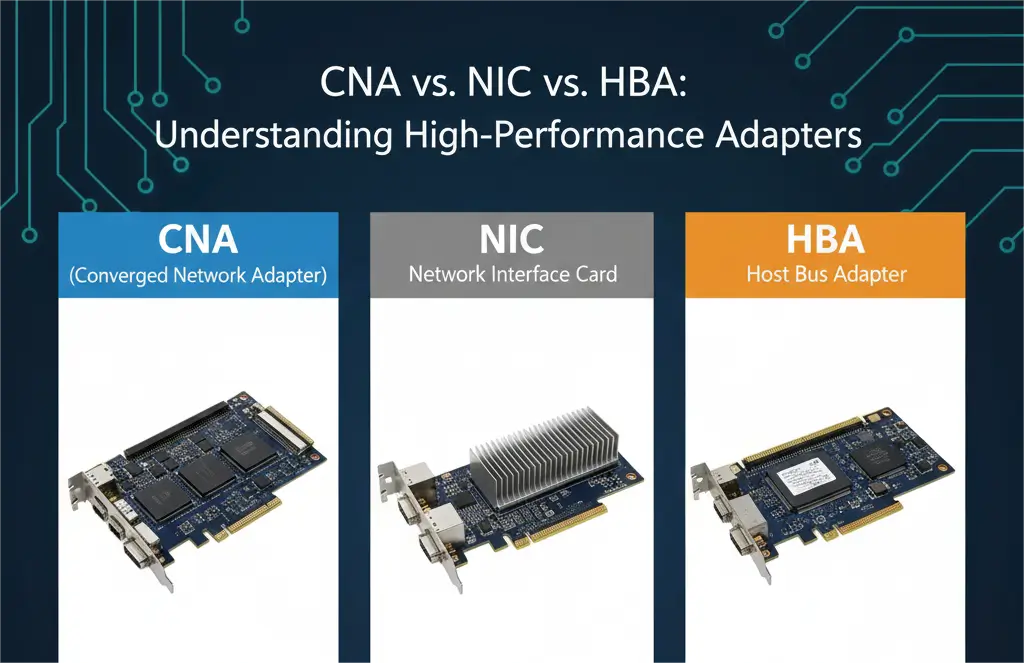
While both NICs and HBAs are essential components that connect the server’s CPU to the outside world, their functions and protocols are completely segregated.
Network Interface Card (NIC)
The NIC is designed exclusively for packet-based networking. It handles the server’s general communication needs, managing traffic destined for other servers, the internet, and applications. The NIC’s intelligence focuses on the TCP/IP stack and optimizing throughput for Ethernet standards.
Host Bus Adapter (HBA)
The HBA’s entire existence is dedicated to connecting the server to a dedicated block Storage Area Network (SAN). Unlike a NIC, which deals with connectionless packet traffic, an HBA manages connections and fabric logins, predominantly utilizing Fibre Channel (FC) or Serial Attached SCSI (SAS) protocols. An HBA requires dedicated storage switches and specialized management, making it an entirely separate ecosystem from the LAN.
How Does the Converged Network Adapter (CNA) Achieve I/O Unification?
The Converged Network Adapter (CNA) is an innovation built upon high-speed Ethernet infrastructure. It achieves unification by taking advantage of the physical bandwidth of 10G, 25G, 40G, 100G, and 200G Ethernet to transport storage traffic alongside network traffic.
Protocol Encapsulation (FCoE)
The key to convergence is Fibre Channel over Ethernet (FCoE). The CNA contains specialized hardware offload engines that perform protocol encapsulation: taking the native Fibre Channel frames (storage traffic) and wrapping them inside standard Ethernet packets. This allows the combined traffic stream—both LAN and SAN—to travel over the same physical Ethernet cable and transceiver, simplifying the physical infrastructure while maintaining the storage-specific logic required by the SAN.
Hardware Offload and Resource Management
A major strength of the Coverage Network Adapter is its sophisticated internal architecture. Instead of relying on the server’s CPU for encapsulation and traffic management (which would create significant overhead), the CNA uses dedicated ASIC processors and firmware to offload these tasks. This ensures that the consolidation of I/O does not burden the server, preserving CPU cycles for application processing—a critical factor in virtualized and high-performance computing (HPC) environments.
CNA vs. NIC vs. HBA: A Side-by-Side Technical Comparison
The following table summarizes the most important technical differentiators, illustrating the complexity reduction offered by the Coverage Network Adapter.
| Feature | NIC (Network Interface Card) | HBA (Host Bus Adapter) | CNA (Converged Network Adapter) |
| Primary I/O | Network (LAN/WAN) | Storage (SAN Block) | Network + Storage (Unified) |
| Main Protocols | TCP/IP, Ethernet | Fibre Channel, SAS | Ethernet, FCoE, iSCSI |
| Cabling Used | RJ45 Copper or LC Fiber | FC Fiber or SAS Cables | Single High-Speed Fiber/DAC |
| Physical Ports | 1 dedicated port per function | 1 dedicated port per function | 1 unified port for both I/O types |
| Required Adapter Count (Per Server) | 1-2+ | 1-2+ | 1 |
| I/O Logic Offload | TCP Offload Engine (TOE) | Fibre Channel Processing | FCoE Offload Engine |
What are the Operational and Financial Benefits of Adopting CNAs?
The decision to migrate to CNAs is fundamentally a business strategy driven by tangible operational and financial gains.
- Cost Savings in Hardware: By replacing four adapters (2x NIC, 2x HBA) with two Converged Network Adapters, data centers instantly see a reduction of up to 50% in required physical adapter slots per server.
- Reduced Power and Cooling: Fewer active components in the server mean a direct reduction in power consumption. Industry data suggests that moving from separate NIC/HBA pairs to modern CNAs can yield a 30% saving in adapter power draw per rack unit.
- Simplified Troubleshooting: The elimination of complex, redundant cabling streamlines maintenance. A unified fabric means fewer components to manage and fewer failure points, leading to faster Mean Time To Repair (MTTR).
- Case Study: Scaling Efficiency in Hyperscale: A large-scale enterprise deploying 10,000 servers estimates that adopting a 100G CNA strategy, combined with the resultant reduction in switch ports, saves millions in hardware acquisition and reduces cable count by 20,000 connections, drastically accelerating deployment times.
Why Must CNAs Utilize 100G and 200G Interconnects?
The single biggest technical hurdle for the Converged Network Adapter is managing the aggregated traffic load. When a CNA is running FCoE (storage) and standard Ethernet (network) simultaneously, the physical port must cope with the combined peak demand.
- Aggregated Bandwidth: If the NIC required 25G and the HBA required 25G, the CNA must provide a 50G pathway. Therefore, modern CNAs are almost exclusively deployed using 100G, 200G, or 400G QSFP/OSFP ports. The high bandwidth is a crucial insurance against I/O contention.
- Storage Latency Requirements: Storage traffic is hyper-sensitive to latency and packet loss. While a dropped TCP/IP packet might cause a small retransmission delay, a dropped FCoE frame can cause significant I/O pauses or connection resets on the SAN. This is why the physical layer must operate with extremely low Bit Error Rates (BER).
PHILISUN: Powering the Converged Future
Successful CNA deployment hinges on the quality of the interconnect that plugs into it. PHILISUN provides the foundational optics and cables necessary for mission-critical Converged Network Adapter deployment. Our portfolio includes a full range of high-speed transceivers—including SFP28 (25G), QSFP28 (100G), and QSFP-DD (200G/400G)—specifically designed to maximize the performance of modern CNAs.
Our focus is on delivering guaranteed compatibility and superior signal integrity, crucial for the highly sensitive nature of converged traffic.
Ensuring Protocol Stability with Quality Interconnects
As established, the stability of storage protocols running over Ethernet (like FCoE) is unforgiving. Network architects cannot afford to compromise the physical layer with substandard transceivers or passive cabling.
PHILISUN understands the criticality of a clean signal for FCoE. Our pre-tested Direct Attach Cables (DACs) and Active Optical Cables (AOCs) are manufactured with precision components to minimize insertion loss (a critical factor in high-speed links) and guarantee the stringent signal integrity required for handling block storage traffic reliably. Our comprehensive testing protocol verifies performance under load, ensuring that your CNA’s potential is never limited by the cable connecting it.
Conclusion
The Converged Network Adapter (CNA) is the undisputed future of server I/O, offering unmatched efficiency, cost savings, and operational simplicity by unifying network and storage functions. The move from separate NICs and HBAs to a single CNA solution provides a streamlined, high-bandwidth path essential for supporting virtualization, cloud infrastructure, and AI workloads.
The success of your I/O consolidation strategy is defined by the quality of your physical layer components. Don’t let cable and transceiver failures negate the benefits of convergence. Choose PHILISUN for all your optical transceiver and cabling needs to secure optimal, reliable performance when implementing your next generation of Converged Network Adapter (CNA) solutions.
Frequently Asked Questions (FAQ)
Q1: What specific protocols does a CNA usually support?
- A: CNAs primarily support standard Ethernet (TCP/IP), Fibre Channel over Ethernet (FCoE), and iSCSI. Some newer CNAs also support technologies like RDMA (Remote Direct Memory Access) for ultra-low latency applications.
Q2: Does a CNA still require separate zoning in the SAN?
- A: Yes. Although the CNA converges the physical layer, the Fibre Channel traffic carried over FCoE still requires the same logical zoning and masking configuration on the Fibre Channel switches (or FCoE gateways) to maintain security and isolation. The logical storage access remains separate from network access.
Q3: Are CNAs more expensive than purchasing separate NICs and HBAs?
- A: CNAs generally have a higher initial unit cost than a single NIC or HBA, but they offer substantial financial savings when calculating the Total Cost of Ownership (TCO). This includes savings from fewer required PCIe slots, fewer cables, fewer switch ports, and reduced ongoing power consumption and cooling needs.