

AI and HPC Network Fiber Solutions
PHILISUN AI and high-performance computing (HPC) network fiber solutions support GPU clusters, storage networks, management networks and leaf-spine fabrics that require high bandwidth, low latency, reliable cabling and clear deployment documentation.
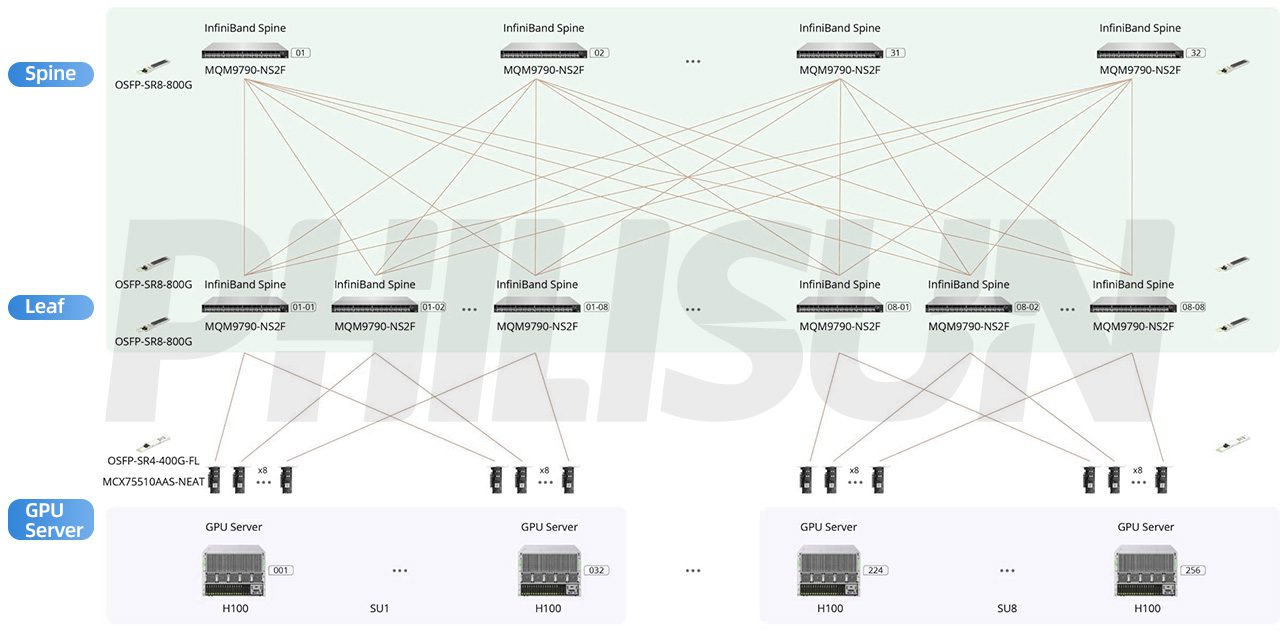
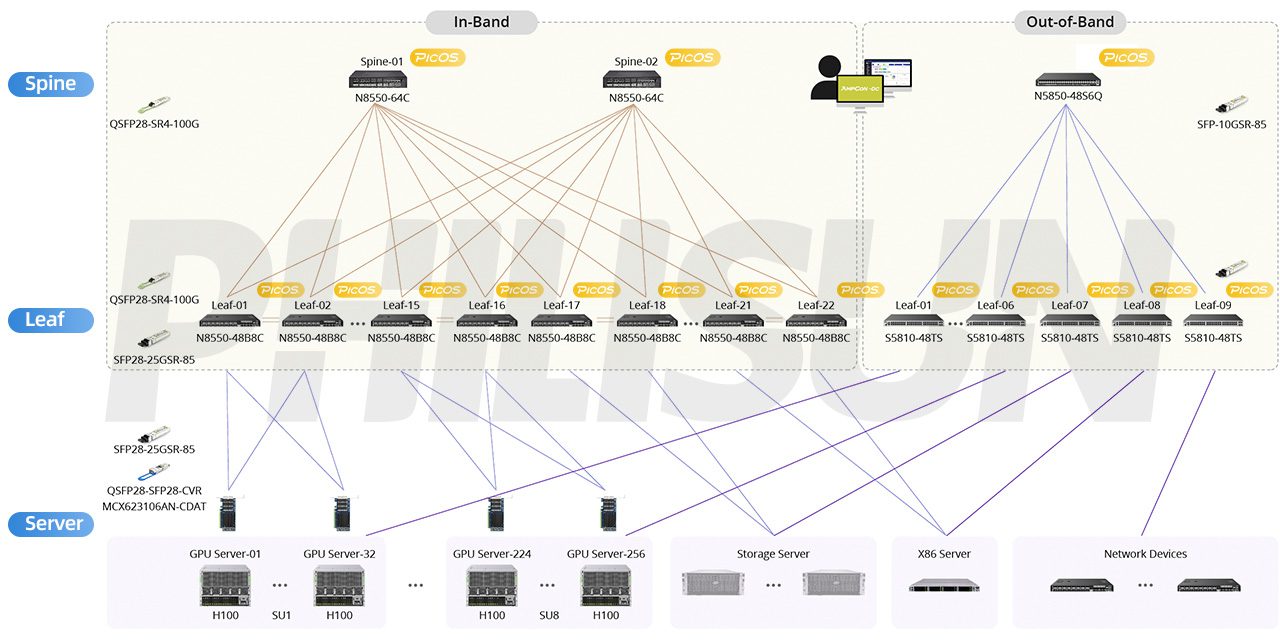
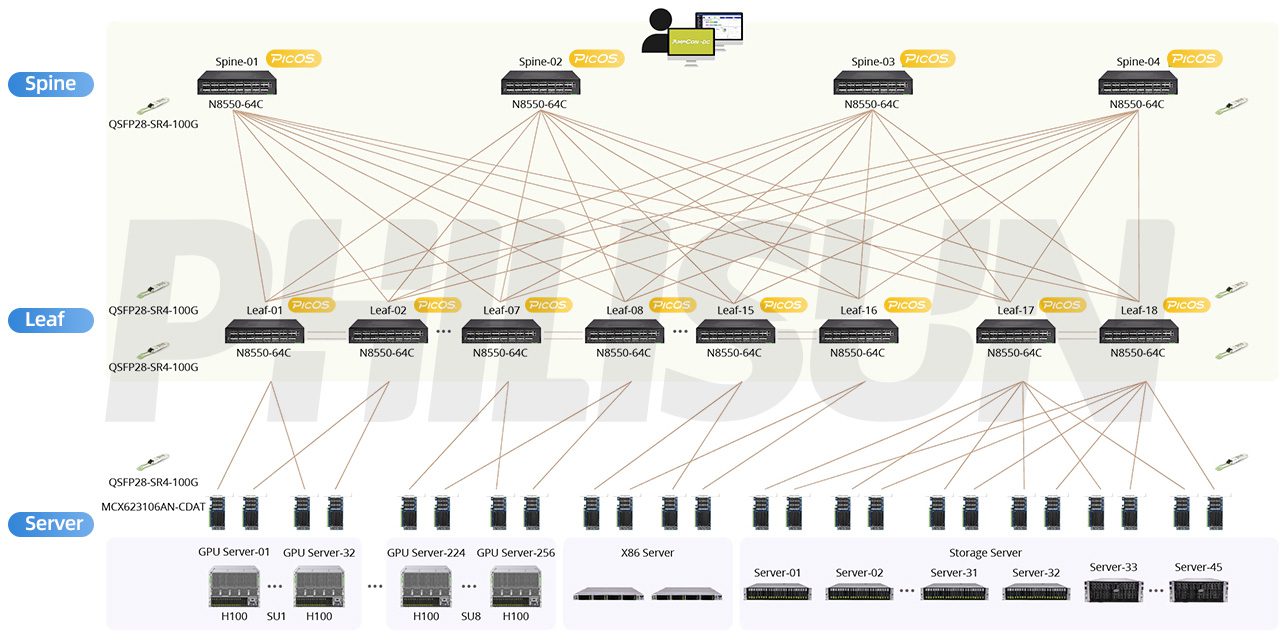
Based on the NVIDIA® H100 GPU, the H100 InfiniBand solution utilizes PicOS® software and the AmpCon-DC management platform, tailored to the network topology of HPC architecture—including InfiniBand networks, management networks, and storage networks—to accommodate various business needs.
AI and HPC Network Fiber Solutions for GPU Clusters
PHILISUN AI and HPC network fiber solutions help cluster teams plan high-speed interconnects for GPU servers, leaf-spine switches, storage networks and management networks. The solution combines AOC/DAC/ACC/AEC cables, 400G/800G optical transceivers, MPO trunks, patch cords, labeling and test documentation so low-latency links can be specified before rack deployment.
| AI/HPC requirement | Recommended PHILISUN solution | Planning notes | Start here |
|---|---|---|---|
| GPU server to leaf switch links | AOC, DAC, ACC or AEC high-speed cable assemblies. | Compare reach, power, airflow, bend radius, latency and platform compatibility before choosing the cable family. | AOC, DAC, ACC & AEC Cables |
| 400G/800G fabric uplinks | QSFP-DD, OSFP, QSFP28 and related optical transceivers. | Match module type, fiber type, connector, reach, firmware compatibility and link budget. | Optical Transceivers |
| Leaf-spine and row-level backbone | MPO trunks, patch panels, LC cassettes and structured cable routes. | Plan fiber count, polarity, gender, breakout mapping, pathway space and spare capacity. | MPO Cable Assemblies |
| Storage and management networks | LC patch cords, pigtails, SFP modules and documented cross-connects. | Separate high-speed fabric, storage and management paths so troubleshooting stays clear. | Fiber Patch Cords & Pigtails |
| Low-latency design validation | Route planning, link budget checks, labels and acceptance test records. | Distance, transceivers, switches, cable type and topology all affect real network delay. | Low-Latency AI/HPC Cabling |
How to plan an AI/HPC cabling BOM
- Define the fabric: InfiniBand, Ethernet, storage and management links may need different media and documentation.
- Confirm speed and form factor: include QSFP28, QSFP56, QSFP-DD, OSFP, SFP28, SFP56 and any breakout mapping.
- Choose the link media: use DAC or ACC for short copper links, AEC for active electrical links, AOC for longer direct routes, or optics plus fiber for structured links.
- Control rack routes: plan airflow, bend radius, cable weight, tray capacity, port labels and service loops before ordering.
- Verify compatibility: confirm switch or adapter model, firmware, EEPROM coding, DOM/DDM needs and test report format.
| Cluster area | Cabling focus | Common products | Related guide |
|---|---|---|---|
| GPU compute fabric | High-speed east-west links with repeatable rack routing. | AOC, DAC, ACC, AEC, 400G/800G optics and custom labels. | Interconnect Comparison |
| InfiniBand or Ethernet fabric | Topology, hop count, link media and compatibility. | Optical transceivers, AOC/DAC cables and structured fiber paths. | InfiniBand vs Ethernet Latency |
| Storage network | Reliable bandwidth and clear separation from compute fabric. | LC patch cords, optical modules, MPO trunks and patch panels. | Data Center Fiber Solutions |
| Management network | Stable access for monitoring, provisioning and maintenance. | SFP modules, RJ45 SFP options, patch cords and labeled ports. | SFP Module Guide |
| Expansion rows | Future-ready backbone and cross-connect capacity. | MPO trunks, LC cassettes, fiber panels and documented polarity. | Structured Cabling Guide |
For a faster AI/HPC network recommendation, send the switch or adapter model, port form factor, target speed, link count, cable length, rack route, topology, fiber type, label format, coding requirement and test report standard. PHILISUN can help translate the cluster design into a practical cabling and optical module BOM. For project support, contact PHILISUN.
AI and HPC Network Fiber FAQ
What cabling is used in AI and HPC networks?
AI and HPC networks commonly use AOC, DAC, ACC, AEC, optical transceivers, MPO trunks, LC patch cords and structured patch panels. The best choice depends on speed, distance, rack density, airflow, latency and platform compatibility.
How do I choose between AOC, DAC, ACC, AEC and optical transceivers?
Start with distance, speed, port form factor and whether the route is direct or structured. DAC and ACC fit short copper links, AEC fits active electrical links, AOC fits longer direct optical routes, and transceivers plus fiber fit patched or longer structured links.
Does fiber cabling affect AI cluster latency?
Yes, but cabling is only one part of total latency. Distance, transceiver type, switch hops, FEC behavior, topology, adapter settings and cable route all contribute to real network delay.
What should be included in a 400G or 800G HPC cabling BOM?
Include port form factor, speed, link count, cable family, length, fiber type, connector, MPO polarity, breakout mapping, labels, packaging, compatibility coding and test report requirements.
What information is needed for an AI/HPC network quote?
Send the topology, switch and adapter models, required speed, port type, link distance, rack layout, media preference, quantity, label format, coding needs and testing requirements.
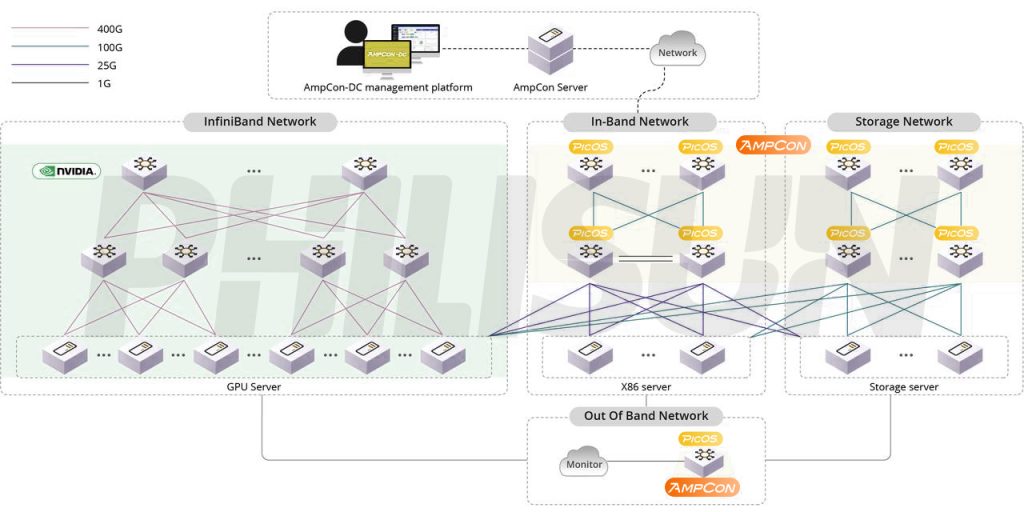
InfiniBand Network
Management Network
Storage Network
HPC Network Planning Notes
For AI and high-performance computing networks, validate the full path before choosing cables or optical modules: adapter generation, switch port speed, lane breakout mode, connector type, fiber grade, reach, airflow, bend radius and firmware compatibility all affect stability. A design that works in a short bench test may need different link media, cable length control or labeling when it is installed across dense racks.
Use this solution page together with PHILISUN technical resources to compare InfiniBand and Ethernet migration paths, 400G/800G interconnect choices, MPO trunk planning and transceiver compatibility. When the deployment uses mixed GPU servers, storage and leaf-spine switching, confirm both the electrical interface and the physical cabling route before final sourcing.