InfiniBand and Ethernet can both support high-performance AI and HPC clusters, but there is no single latency number that makes one fabric the winner in every design. InfiniBand is a purpose-built RDMA fabric with integrated flow control and mature in-network acceleration. Modern AI Ethernet can use RoCEv2 or the newer Ultra Ethernet architecture, but its result depends heavily on the NIC, switch, queue, congestion-control and topology design.
The practical decision is not “which logo is faster?” It is which end-to-end system delivers predictable collective performance for your workload, at the scale and operational model you can support. This guide separates fabric latency from cabling delay and shows what to measure before selecting an AI network.
Quick answer: InfiniBand vs Ethernet latency
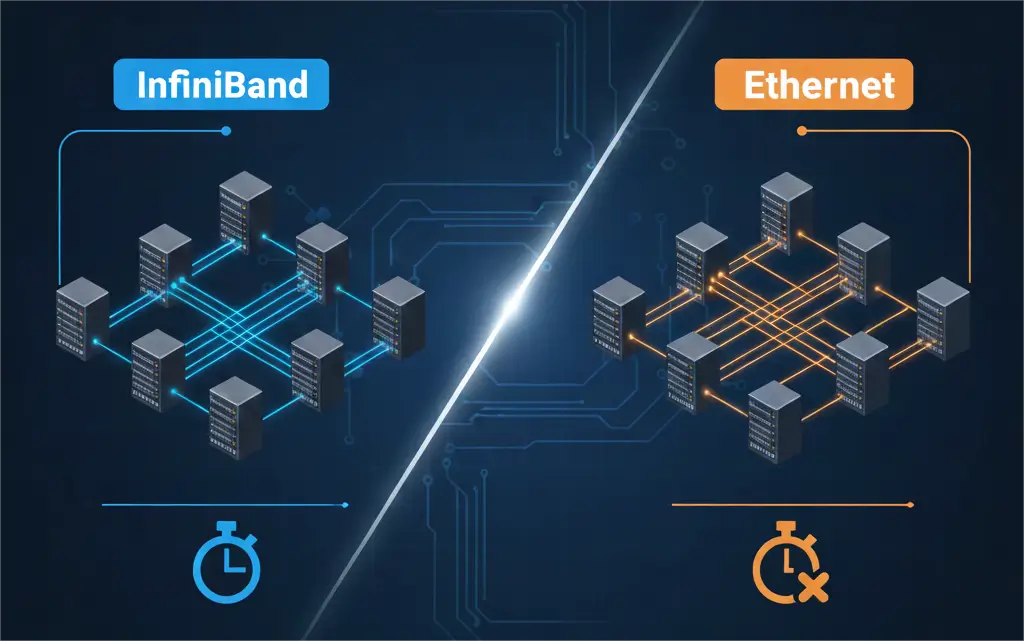
Choose InfiniBand when tightly coupled training or scientific workloads, predictable scale-out behavior and an integrated RDMA ecosystem outweigh the need to reuse a conventional Ethernet operating model. Choose AI-focused Ethernet when open Ethernet interoperability, routing, multi-vendor operations or convergence with existing infrastructure is a stronger requirement—and when the team can validate the complete RoCEv2 or Ultra Ethernet design.
Do not compare InfiniBand with ordinary TCP/IP Ethernet and then apply that result to a tuned RoCE fabric. Likewise, do not assume that matching 400 or 800 Gb/s port rates produce matching latency. Adapter behavior, switch pipelines, hop count, oversubscription, congestion control, GPU-to-NIC topology and collective software all affect the final result.
NVLink and NVSwitch are also a different layer of the architecture. They primarily provide scale-up connectivity inside a server or tightly integrated system, while InfiniBand and Ethernet commonly provide the scale-out fabric between nodes or racks.
Define latency before comparing fabrics
Switch port-to-port latency
This is the time a frame or packet spends traversing a switch under a stated packet size and load. It is useful for comparing specific switch models, but it excludes the adapter, PCIe or GPU path, software, cable propagation and additional hops. A vendor’s best-case switch figure is not an end-to-end cluster result.
Host-to-host RDMA latency
Host-to-host RDMA latency includes both adapters, the selected transport, the fabric path and the memory placement path. Message size, queue-pair configuration, CPU or GPU memory, PCIe topology, firmware and benchmark method must be identical before two results are comparable. NVIDIA’s current NCCL troubleshooting guidance recommends checking the active link layer, expected rate, error counters, bandwidth and point-to-point latency instead of relying on one headline value.
Collective communication time and job completion
Distributed AI training is often limited by all-reduce, all-gather, reduce-scatter or all-to-all behavior across many endpoints. Collective communication time includes topology, path balance, congestion, GPU-direct placement and library algorithms. Tail latency matters because one delayed flow can hold up a synchronized step. Measure average and P99/P99.9 behavior together with useful throughput and application iteration time.
How the three fabric approaches differ
InfiniBand: an integrated RDMA fabric
The InfiniBand Trade Association defines InfiniBand as a switched, point-to-point architecture with reliable messaging and RDMA semantics. Credit-based fabric flow control, adaptive routing, congestion management and in-network computing are designed as parts of the fabric rather than added as independent features.
That integration can make performance more predictable for tightly coupled workloads, but it does not remove the need for correct topology, healthy links, compatible firmware and measured validation. Congestion, errors, retries and poor GPU-to-NIC placement can still increase tail latency.
RoCEv2: RDMA over UDP/IP on Ethernet
RoCEv2 carries an RDMA transport over UDP/IP, allowing routed Ethernet fabrics while avoiding the normal kernel data path for supported applications. NVIDIA documents both lossless designs using PFC and ECN and lossy-mode designs using ECN. The correct mode is the one validated for the selected NIC, switch software and topology—not a universal setting copied from another cluster.
IEEE 802.1Qbb Priority-based Flow Control can pause an individual traffic class inside a controlled Data Center Bridging domain. It can reduce frame loss for loss-sensitive traffic, but poor thresholds or congestion trees can create pause propagation and unstable tails. ECN marking, queue allocation, load balancing and telemetry must be verified together. NVIDIA’s RoCE configuration documentation is a useful example of why the result depends on the complete design.
Ultra Ethernet: a newer AI/HPC Ethernet stack
Ultra Ethernet is more than a faster Ethernet link. The current UEC 1.0.2 specification covers software APIs, transport, congestion management, network behavior, link features and the physical layer. It is designed for large AI and HPC systems with direct data placement, multipathing, scalable congestion control and stronger tail-latency behavior.
UEC 1.0.2 is an important evaluation path, not proof that every product sold as “AI Ethernet” implements the specification. Confirm endpoint, switch, software and interoperability support available at procurement time. Do not treat Ultra Ethernet, conventional TCP/IP and RoCEv2 as interchangeable names.
InfiniBand vs Ethernet decision table
| Decision factor | InfiniBand | AI Ethernet with RoCEv2 or UET |
|---|---|---|
| Primary design model | Integrated RDMA fabric | Ethernet ecosystem with an AI/HPC transport and congestion design |
| Routing and operations | Dedicated InfiniBand fabric tools and subnet management | Can align with routed Ethernet skills and automation, subject to the validated design |
| Loss and congestion strategy | Fabric credit flow control plus integrated congestion mechanisms | RoCEv2 commonly uses ECN with validated lossless or lossy behavior; UET defines a broader stack |
| Collective acceleration | Mature in-network computing options in supported platforms | Platform-specific acceleration today; UET also defines in-network collective capabilities |
| Best fit | Tightly coupled AI/HPC where predictable scale-out performance is the priority | AI clouds needing Ethernet operations, routing, convergence or multi-vendor flexibility |
| Validation requirement | Benchmark the complete adapter-switch-topology-software path | Benchmark the complete path and verify queue, ECN/PFC, routing and telemetry behavior |
The table is a design guide, not a latency guarantee. A well-engineered Ethernet fabric can outperform a poorly deployed InfiniBand fabric, and the reverse is also true. Compare systems at the same port rate, topology, message profile, endpoint count and oversubscription.
NDR, XDR, 400GbE and 800GbE do not tell the whole story
NDR commonly describes 400 Gb/s InfiniBand connectivity, while NVIDIA’s current Quantum-X800 XDR platform supports 800 Gb/s connectivity. Ethernet platforms are also available at 400GbE and 800GbE. These labels describe line-rate generations; they do not by themselves define host latency, tail behavior or collective performance.
Lane rate, FEC, breakout mode, connector type and switch cage architecture also matter. For the InfiniBand generation boundary, use the separate NDR vs HDR InfiniBand cabling guide. For Ethernet platform developments across sites, see the Spectrum-XGS overview.
Which fabric should an AI or HPC cluster choose?
Choose InfiniBand when predictability is the main constraint
- The workload is tightly synchronized and communication-heavy.
- The deployment can operate a dedicated InfiniBand fabric and management stack.
- Adaptive routing, mature RDMA behavior or supported in-network collectives are central to the design.
- The vendor reference architecture and benchmark profile match the planned scale.
Choose AI Ethernet when integration is the main constraint
- The organization requires routed Ethernet operations, automation or infrastructure convergence.
- The NIC, switch and software combination has a validated RoCEv2 or UET architecture.
- The team can operate ECN, queueing, telemetry and any required PFC domain consistently.
- Multi-vendor interoperability is tested with the exact firmware and scale planned for production.
NVIDIA’s Spectrum-X platform illustrates that AI Ethernet performance comes from coordinated switches, SuperNICs, telemetry and congestion control. It should not be generalized to an arbitrary Ethernet switch and NIC combination.
The physical layer supports the fabric—it does not replace it
DAC, ACC, AEC, AOC and pluggable optics must match the switch and adapter protocol, port speed, form factor, breakout mode, reach and firmware policy. Some hardware families support both InfiniBand and Ethernet, but the active protocol still comes from the platform configuration. An OSFP or QSFP label alone does not establish compatibility.
Use the AOC, DAC, ACC and AEC choice guide for short-link media decisions, and the fiber latency guide when route length must be included in the budget. NVIDIA’s current NDR/XDR and 400/800G Ethernet cabling requirements also show why connector, fiber type and patching architecture must be specified from the actual port plan.
For a physical-layer review, send the switch and adapter models, protocol, port rate, connector/form factor, breakout map, link length, fiber type, airflow and compatibility policy when you contact PHILISUN. The output should be a compatible interconnect bill of materials—not an unsupported promise about application latency.
Measure before standardizing the fabric
- Fix the test scope: same server, GPU, NIC, firmware, port rate, MTU, message sizes, topology and endpoint count.
- Verify the link: active link layer, negotiated rate, lane state, FEC and physical error counters.
- Measure the transport: host-to-host bandwidth and latency with the same RDMA memory path.
- Measure congestion: queue drops, retransmissions, PFC pauses, ECN marks, CNPs and path imbalance under load.
- Measure collectives: NCCL or MPI performance at representative message sizes and scale.
- Measure the workload: iteration time, scaling efficiency, GPU utilization and P99/P99.9 tail latency.
The NVIDIA NCCL networking checklist is a useful starting point because it separates physical-link, adapter, transport and congestion evidence. Keep test results with firmware and topology records so future changes can be compared to the same baseline.
FAQ
Is InfiniBand always lower latency than Ethernet?
No universal result applies to every generation and topology. InfiniBand provides a tightly integrated low-latency RDMA architecture, while a validated RoCEv2 or Ultra Ethernet system can also deliver strong AI/HPC performance. Compare the same endpoint hardware, rate, topology, message profile and load, then examine tail latency and collective time—not only a best-case average.
Does RoCEv2 need PFC?
Many lossless RoCE designs use PFC with ECN, while some validated architectures operate RoCEv2 in lossy mode with ECN and appropriate endpoint behavior. Follow the selected vendor’s reference design and test congestion at scale. Enabling PFC everywhere without queue and threshold engineering is not a complete design.
Do optical transceivers change InfiniBand into Ethernet?
No. Some transceivers and cables can support hardware families used by both protocols, but the switch, adapter and firmware determine the active protocol. Select the interconnect only after confirming protocol, port rate, lane map, form factor, reach and the vendor compatibility matrix.