

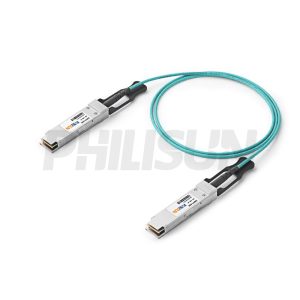
AOC Cables
Active optical cables for high-speed switch, server and storage links. Choose speed, form factor, length and host compatibility.
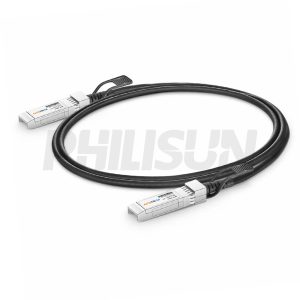
DAC Cables
Direct attach copper cables for short-reach data center links. Choose speed, connector type, length and passive or active design.
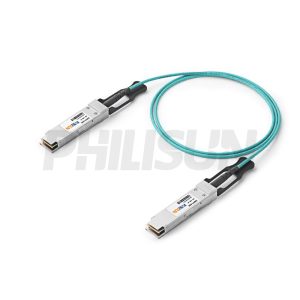
ACC Cables
Active copper cables for short high-speed links that need more signal margin than passive DAC. Choose speed, length and platform coding.
AEC Cables
Active electrical cables for 400G and 800G links where retiming, signal integrity and breakout mapping matter.
AOC, DAC, ACC and AEC Cable Selection for 100G-800G Links
PHILISUN AOC, DAC, ACC and AEC cables support high-speed switch, server, GPU, storage and AI cluster interconnects where link distance, airflow, power and platform compatibility must be decided together. Use this page as the main high-speed cable buying path: choose a DAC cable for the shortest low-power copper links, ACC when passive copper needs more signal margin, AEC for active electrical 400G/800G and breakout links, and an AOC cable for lighter optical rack-to-rack routes before choosing the exact form factor, speed and mapping.
Quick answer for DAC vs AOC and DAC cable vs AOC cable: DAC is usually the first choice for short same-rack links where cost and power matter most; AOC is usually better when the route is longer, cable weight and airflow matter, or an optical path is preferred. If you already know the cable family, go directly to DAC cables or AOC cables.
| Cable family | Best fit | Typical planning notes | Start here |
|---|---|---|---|
| DAC | Shortest same-rack or adjacent-port copper links. | Lowest power and cost, but length and cable weight become limiting factors at higher speeds. | DAC Cables |
| ACC | Short copper routes that need active signal conditioning. | Useful when passive DAC reach or signal margin is not enough for the platform and speed. | ACC Series |
| AEC | High-speed electrical links and breakout assemblies. | Retiming and active electronics can help 400G/800G links that need stronger signal integrity. | AEC Series |
| AOC | Longer or cleaner rack-to-rack optical cable routes. | Lighter than copper bundles and often better for airflow, bend radius and row-level routing. | AOC Cables |
When the route leaves the rack, crosses patch panels or needs a modular fiber plant, compare integrated high-speed cables with optical transceivers, MPO cable assemblies and fiber patching so the full channel is planned before purchasing.
How to choose a high-speed cable family
- Start with the port: confirm QSFP28, QSFP56, QSFP-DD, OSFP, SFP28, SFP56 or breakout requirements.
- Check route length: same-rack links often favor DAC or ACC, while longer or tighter routes may favor AOC.
- Plan for airflow and bend radius: copper bundles are heavier; AOC can simplify dense rack routing.
- Confirm platform compatibility: switch model, firmware, EEPROM coding and DOM/DDM requirements can affect recognition.
- Include application constraints: AI/HPC clusters may need predictable latency, FEC planning, clean labeling and repeatable rack routes.
| Deployment question | Recommended next step | Related guide |
|---|---|---|
| Which cable type fits 100G-800G links? | Compare DAC, ACC, AEC and AOC by distance, power, cost and latency. | DAC vs ACC vs AEC vs AOC guide |
| How long can each cable type run? | Map the rack route first, then check the speed and form factor limit. | Cable length limits guide |
| How should AI/HPC links be planned? | Include switch hops, FEC, optics, cable route and topology in the latency budget. | Low-latency AI/HPC cabling |
| When do modular optics make more sense? | Use optical transceivers plus fiber cabling for longer, patched or structured links. | Optical Transceivers |
Ordering checklist for AOC, DAC, ACC and AEC cables
For a faster recommendation, send PHILISUN the switch or NIC model, port form factor, speed, cable length, breakout mapping, rack route, quantity, coding requirements, label format and any packaging or test report requirements. For project-level cabling with patch panels, MPO trunks and optical modules, start from Fiber Optic Network & Cabling Solutions.
AOC/DAC Cable Selection FAQ
Is DAC better than AOC for short data center links?
DAC is often better for the shortest same-rack links when low power and cost are the priority. AOC becomes more attractive when the route is longer, the cable bundle is heavy, or airflow and bend radius are harder to manage.
When should I choose ACC instead of passive DAC?
Choose ACC when the link should stay copper-based but passive DAC does not provide enough reach or signal margin for the target speed, length and switch platform.
What is the role of AEC in 400G and 800G links?
AEC uses active electronics such as retiming or signal conditioning to support high-speed electrical links and breakout assemblies where signal integrity is more demanding.
Can PHILISUN customize cable length and coding?
Yes. Cable length, breakout mapping, EEPROM coding, label format, packaging and test documentation can be specified for the target switch, NIC or GPU platform.
What information is needed for a quote?
Send the port type, speed, length, host platform, breakout requirement, rack route and quantity. If the deployment is for AI or HPC, include topology and latency constraints as well.
Need Guidance on AOC & DAC Cables Selection?
Get practical recommendations based on your network architecture, transmission distance, and performance requirements. Philisun team helps you select the most suitable AOC, DAC, ACC and AEC high-speed cables for data centers, HPC, and AI deployments, delivering reliable performance, broad compatibility, and scalable connectivity.
Explore AOC & DAC Cables Insights
Cat6 vs. Fiber Optic: Why Your Business Network Needs to Upgrade Now
Cat6 or Fiber? Don’t decide based on speed alone. We compare latency, distance limits, EMI immunity, and TCO. Discover why switching to fiber optics and SFP+ modules is the future-proof choice.
Stop Fiber Optic Attenuation: A Field Troubleshooting Guide
Field guide for diagnosing high fiber optic attenuation. Learn to use the OTDR to identify contamination, micro-bends, and poor splices, ensuring your 400G network links remain within budget.
How to Clean Fiber Optic Connectors and Prevent Failures
98% of network failures are caused by dirty connectors. Learn the IEC standards for cleaning fiber. Our guide covers dry vs. wet cleaning for LC and MPO connectors to ensure zero packet loss.
Product Shortcuts
- 200G QSFP56 to 2×100G QSFP56 Active Direct Attach Copper Twinax Cable (ACC)
- 25G SFP28 to SFP28 Active Direct Attach Copper Twinax Cable (ACC)
- 400G QSFP-DD to 4×100G QSFP28 Active Electrical Copper Breakout Cable (AEC)
- 40G QSFP to QSFP Active Direct Attach Copper Twinax Cable (ACC)
- 800G QSFP-DD to QSFP-DD Active Direct Attach Copper Twinax Cable (ACC)
- 800G QSFP-DD to QSFP-DD Active Electrical Copper Breakout Cable (AEC)
- 56G QSFP+ to QSFP+ Active Optical Cable (AOC)
- 56G QSFP+ to QSFP+ Passive Direct Attach Copper Twinax Cable (DAC)
- 10G SFP+ to SFP+ Active Direct Attach Copper Twinax Cable (ACC)
- 10G SFP+ to SFP+ Passive Direct Attach Copper Twinax Cable (DAC)
- 1G SFP to SFP Passive Direct Attach Copper Twinax Cable (DAC)
- 100G SFP-DD to SFP-DD Active Optical Cable (AOC)
- 100G SFP112 to SFP112 Passive Direct Attach Copper Twinax Cable (DAC)
- 25G SFP28 to SFP28 Active Optical Cable (AOC)
- 25G SFP28 to SFP28 Passive Direct Attach Copper Twinax Cable (DAC)