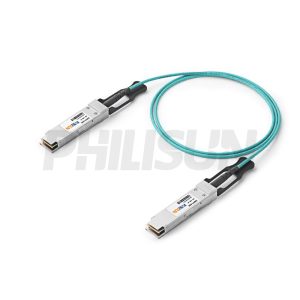

Quick answer: passive DAC is normally planned for the shortest in-rack runs, ACC and AEC extend high-speed copper options for short routes, and AOC is usually the cleaner choice when 100G-800G links need longer rack-to-rack distance, lower cable weight or better airflow.
There is no single universal length limit for DAC, ACC, AEC or AOC. The usable distance depends on speed, form factor, cable gauge, active electronics, switch support, firmware policy, thermal design and the exact vendor specification. Use the ranges below as planning guidance, then confirm the final cable length against the equipment data sheet and PHILISUN quote.
Typical Planning Ranges by Cable Type
| Cable type | Typical planning range | Best rack scenario | Main limitation |
|---|---|---|---|
| Passive DAC | About 0.5 to 3 m for many high-speed rack links; selected lower-speed designs may support longer | Same rack, shortest ToR-to-server or switch-to-switch run | Copper loss, cable thickness and bend radius |
| ACC | Short copper reach extension, often around 1 to 5 m depending on speed and platform | Same rack or very close adjacent-rack routes where passive DAC is marginal | Power, heat and switch compatibility |
| AEC | Short high-speed electrical links, often around 1 to 5 m or more depending on design | Dense 400G/800G links needing active signal integrity support | Active electronics, thermal load and platform support |
| AOC | Commonly several meters to tens of meters; some families support longer ordered lengths | Adjacent rack, row-level or cleaner optical cable routing | Higher cost than DAC and integrated optics must match the port |
These are not compliance limits. A 400G or 800G DAC, ACC, AEC or AOC cable should always be specified by exact form factor, length, breakout mapping and compatible switch platform. For the broader comparison, see DAC vs ACC vs AEC vs AOC.
Why Cable Length Shrinks as Speed Increases
Higher data rates leave less margin for insertion loss, crosstalk, reflection and connector variation. In copper cable assemblies, longer distance usually means more signal loss and more difficult equalization. This is why passive DAC that works well for a short 25G or 100G route may not be the right answer for a dense 400G or 800G deployment.
Active copper designs such as ACC and AEC add electronics to help the signal. AOC avoids the copper-distance problem by converting the link to an optical path inside the cable assembly, but it introduces optical engines, power draw and platform compatibility checks.
Same Rack: Start with DAC, Then Check Routing
For short same-rack server-to-switch links, passive DAC cables are usually the first option because they are simple, low power and cost-effective. The practical question is whether the routed length, bend radius and cable bundle are still comfortable after trays, cable managers and service loops are included.
If the link is at the edge of a passive copper length limit, compare ACC or AEC before switching to optical. For example, high-speed QSFP-DD or OSFP racks may benefit from active electrical cable when passive copper is too heavy, too short or too close to the signal-integrity limit.
Adjacent Racks: Compare AEC and AOC Carefully
Adjacent-rack routes are where the decision becomes more interesting. A direct physical distance of one or two meters can become a much longer routed cable path once it passes through vertical managers, overhead trays or rack doors. If copper length, airflow or bend radius becomes uncomfortable, AOC cables may be easier to deploy.
AEC can still be attractive when the link remains short and the platform supports the cable family. AOC becomes stronger when the route needs lighter cable, cleaner airflow, easier pulling or more length margin.
Row-Level AI Data Center Links: AOC or Structured Fiber
For row-level links in AI and HPC environments, copper assemblies can quickly become difficult to manage. Cable trays fill, airflow is restricted and service work becomes slower. In these cases, AOC or optical transceivers with structured fiber cabling are usually a better architecture.
Use Fiber Optic Network & Cabling Solutions when the design needs patch panels, structured pathways, MPO trunks or future migration. Use AOC when the project needs a fixed, factory-tested optical cable assembly between two equipment ports.
Length Planning Examples
| Route | First option to check | When to move up |
|---|---|---|
| Server to ToR in same rack | Passive DAC | Move to ACC/AEC if passive length or signal margin is tight |
| Switch to switch in same rack | Passive DAC or AEC | Move to AOC if cable bundle or airflow becomes difficult |
| Adjacent rack link | AEC or AOC | Move to AOC when routed length and bend radius exceed copper comfort |
| Across a row | AOC or transceivers plus fiber cabling | Use structured fiber when patching, documentation and future upgrades matter |
| GPU cluster service loop | DAC/AEC for very short runs, AOC for cleaner longer routes | Move to optical when airflow and serviceability are more important than cable unit cost |
What to Send for a Length Quote
- Port form factor: QSFP28, QSFP56, QSFP-DD, OSFP, SFP112 or another interface.
- Target speed: 100G, 200G, 400G, 800G or breakout mapping.
- Required routed length, not only straight-line rack distance.
- Switch or NIC model and firmware constraints.
- Cable family preference: DAC, ACC, AEC, AOC or open recommendation.
- Airflow direction, cable manager path and bend-radius constraints.
- Quantity, label format, pull-tab direction and packaging requirements.
PHILISUN Product Path by Length Need
For a full category view, start from AOC & DAC Cables. For short passive copper, see DAC Cables and 800G QSFP-DD DAC. For active copper options, see 800G QSFP-DD ACC and 800G QSFP-DD AEC. For longer or lighter optical assemblies, see AOC Cables and 400G QSFP-DD to 4x100G QSFP28 AOC.
Need a custom-length high-speed cable for an AI data center rack? Send the port type, target speed, routed length, equipment model and rack path. PHILISUN can help choose DAC, ACC, AEC or AOC before you lock the bill of materials.
DAC, ACC, AEC and AOC Length FAQ
What is the maximum length of a DAC cable?
The maximum DAC length depends on speed, form factor, cable gauge and switch support. For many high-speed rack links, passive DAC is planned around very short distances, often about 0.5 to 3 m, but exact limits must be checked against the product specification.
Can AEC go farther than passive DAC?
Usually yes. AEC uses active electronics to improve signal integrity, so it can support short high-speed routes that may be difficult for passive DAC. The usable length still depends on the cable design and platform support.
Is AOC better for longer AI data center links?
Often yes. AOC is usually easier for longer rack-to-rack routes because it is lighter and less affected by copper loss. It can also improve airflow and cable management in dense AI racks.
Should I order cable length by straight-line distance?
No. Order by routed length. Include vertical cable managers, trays, bends, service loops and port orientation. A straight-line rack distance can underestimate the actual cable length needed.
When should I use transceivers and fiber instead of AOC?
Use separate transceivers and structured fiber cabling when the route needs patch panels, MPO trunks, documented fiber paths, modular upgrades or easier moves and changes. AOC is better when a fixed point-to-point cable assembly is preferred.