
Quick answer: use passive DAC for the shortest and lowest-cost rack links, ACC when copper reach needs a little help, AEC when high-speed electrical links need active retiming, and AOC when the link needs longer reach, lighter cable routing or better airflow than copper can provide.
For 100G, 200G, 400G and 800G data center links, the right cable is rarely chosen by speed alone. Port form factor, rack distance, power budget, airflow, bend radius, latency target and switch compatibility all matter. This guide compares DAC, ACC, AEC and AOC so buyers can move from a rack layout to a practical PHILISUN cable choice.
DAC vs ACC vs AEC vs AOC Selection Table
| Cable type | Best fit | Typical tradeoff | PHILISUN path |
|---|---|---|---|
| DAC | Shortest in-rack links where cost and low power matter most | Reach and cable thickness are limited as speed rises | DAC cables |
| ACC | Short copper links that need active signal conditioning | More power and cost than passive DAC, but still copper-based | 800G QSFP-DD ACC |
| AEC | High-speed copper links where retiming and signal integrity are important | Active electronics add power but can improve link margin | 800G QSFP-DD AEC |
| AOC | Longer rack-to-rack or row-level links needing lighter cable and better routing | Usually higher cost than DAC, but easier for longer clean routes | AOC cables |
What DAC, ACC, AEC and AOC Mean
DAC means direct attach copper. It is a twinax copper cable with transceiver-style ends. Passive DAC is common for very short switch-to-server, switch-to-switch and top-of-rack links.
ACC means active copper cable. It still uses copper conductors, but active components help the signal travel farther or with more margin than a passive copper assembly of the same speed family.
AEC means active electrical cable. AEC assemblies use active electronics such as retimers or redrivers to improve signal integrity for high-speed electrical links, especially where passive copper becomes difficult.
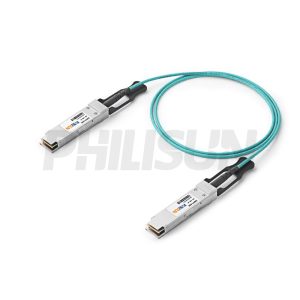
AOC means active optical cable. It integrates optical modules and fiber into one cable assembly. AOC is often used when a data center wants longer reach, lower cable weight or cleaner airflow than copper cable bundles can provide.
When to Choose Passive DAC
Choose passive DAC when the ports are close, the route is simple and the project needs the lowest practical cost and power. DAC is often the first option for same-rack server-to-ToR links, lab connections, short storage links and short high-speed switch interconnects.
The limitation is physical. As data rates rise, copper cable reach becomes shorter and the cable can become thicker or harder to route. For 400G and 800G links, a dense bundle of copper assemblies may create airflow and bend-radius problems even when the electrical link is technically valid.
When to Choose ACC
ACC is useful when a passive copper cable is too close to the edge of the signal budget, but the project still wants a copper assembly instead of an optical cable. It can be a practical middle path for short data center links where the reach, cable gauge or port speed makes passive DAC less comfortable.
Because ACC includes active signal conditioning, it draws more power than passive DAC. Buyers should check switch support, maximum supported cable length, power budget and thermal behavior before standardizing on ACC for a large deployment.
When to Choose AEC
AEC is strongest when signal integrity matters more than using the lowest-cost passive assembly. It is especially relevant for 400G and 800G electrical links, breakout use cases and dense AI or HPC racks where high-speed copper lanes need active help to remain stable.
AEC is still not a universal replacement for optics. It adds active electronics, heat and compatibility requirements. For longer rack-to-rack links, AOC or optical transceivers with structured fiber cabling may be easier to scale.
When to Choose AOC
AOC is a good fit when the link needs more distance than copper can comfortably provide, or when cable weight and airflow are important. Compared with copper, active optical cable can be easier to route across racks and rows, especially in high-density 100G, 400G and 800G environments.
AOC also simplifies ordering because the optical engines and fiber are integrated into one factory-tested assembly. For teams that do not want to choose separate transceivers and patch cords for every short data center run, AOC can reduce installation complexity.
How to Choose by Distance, Power and Rack Layout
- Same rack, shortest route: start with passive DAC, then check bend radius, cable thickness and switch support.
- Same rack but passive DAC is marginal: compare ACC or AEC depending on the port generation and equipment compatibility.
- Adjacent racks: AOC often becomes cleaner when copper routing is heavy, tight or airflow-sensitive.
- Row-level or structured cabling path: use AOC for fixed cable assemblies, or use optical transceivers with fiber cabling when the architecture needs patch panels and modular upgrades.
- AI or HPC clusters: compare link stability, thermal load, cable bend, serviceability and latency instead of choosing only by purchase price.
Latency Notes for DAC, AEC and AOC
Passive DAC is often attractive for ultra-short low-latency links because it avoids optical conversion. AEC and ACC add active electrical components, while AOC includes optical conversion. However, end-to-end application latency is also affected by switch forwarding, FEC, NIC behavior, topology and link distance. For a deeper engineering view, see PHILISUN’s fiber optic latency calculator.
Ordering Checklist for 100G-800G Cable Assemblies
| Item | What to confirm |
|---|---|
| Speed and form factor | QSFP28, QSFP56, QSFP-DD, OSFP, SFP112 or other interface family |
| Link layout | Direct attach, breakout, switch-to-server, ToR-to-spine or rack-to-rack |
| Length | Required routed length, slack policy and maximum supported reach |
| Compatibility | Switch brand, port firmware, cable coding and diagnostic support |
| Thermal design | Port power, airflow direction, cable bundle size and rack density |
| Serviceability | Labeling, pull tabs, bend radius, replacement path and packaging |
PHILISUN Product Path
For a complete product view, start from AOC & DAC Cables. For passive copper, see DAC Cables. For optical integrated cable assemblies, see AOC Cables. For project-level architecture help across cables, optics and fiber routing, use Fiber Optic Network & Cabling Solutions.
Need help choosing between DAC, ACC, AEC and AOC for a 100G-800G rack? Share your switch model, port type, target length, rack layout and preferred cable route. PHILISUN can recommend a cable family and compatible product path before ordering.
DAC vs ACC vs AEC vs AOC FAQ
Is AEC the same as ACC?
No. Both are active copper-based cable families, but AEC generally refers to active electrical cables with retiming or signal-conditioning electronics for high-speed links, while ACC is commonly used for active copper assemblies that extend copper reach beyond passive DAC limits.
Is DAC lower latency than AOC?
For very short links, passive DAC can have a latency advantage because it avoids optical conversion. In real networks, switch forwarding, FEC, topology and congestion often matter more than the cable type alone.
When should I choose AOC instead of DAC?
Choose AOC when the link is too long or too hard to route with copper, when cable weight and airflow matter, or when a clean rack-to-rack optical assembly is easier than a thick copper bundle.
Can DAC, ACC, AEC and AOC support 400G and 800G?
Yes, but support depends on the form factor, port generation, cable length, switch compatibility and cable design. Buyers should confirm the exact QSFP-DD, OSFP, QSFP56, QSFP28 or breakout requirement before ordering.
What information should I send when requesting a quote?
Send the port form factor, switch model, link speed, required length, breakout mapping, rack route, quantity, coding requirements and any labeling or packaging needs. That information is enough to narrow the correct PHILISUN cable family.