PHILISUN data center fiber optic solutions support cloud computing, AI, storage and enterprise networks with scalable cabling for reliable high-speed transmission across core, distribution and equipment areas.
Data Center Fiber Optic Solutions for 100G-800G Networks
PHILISUN data center fiber optic solutions help network teams plan high-density cabling from the main distribution area to equipment racks, GPU clusters, storage networks and spine-leaf switches. The solution combines MPO trunks, fiber patch panels, AOC/DAC/ACC/AEC cables, optical transceivers, fiber patch cords and documented testing so each route can be specified before installation.
Data center requirement
Recommended solution
Planning notes
Start here
Spine-leaf backbone and cross-connects
MPO trunks, MPO cassettes, patch panels and structured fiber paths.
Confirm Base-8, Base-12 or Base-16 design, polarity, gender, fiber count, rack route and insertion loss budget.
Define the architecture: map MDA, IDA, HDA, ZDA and EDA connections before choosing cable lengths.
Confirm speed and port form factor: include 10G, 25G, 40G, 100G, 200G, 400G or 800G ports such as SFP28, QSFP28, QSFP56, QSFP-DD and OSFP.
Choose the media: use DAC or ACC for short copper links, AEC for active electrical links, AOC for longer direct cable routes, or optical transceivers plus fiber for structured links.
Specify MPO details: include fiber count, polarity, male/female gender, key orientation, breakout mapping, cassette type and loss target.
Control operations: add route labels, rack labels, packaging groups, insertion loss, return loss and OTDR testing requirements.
Network zone
Connectivity role
Typical PHILISUN products
Related guide
Main Distribution Area (MDA)
Core switching, main cross-connects and carrier or campus handoff.
For 400G and 800G projects, the key decision is whether the route should be a direct cable assembly or a structured optical link. Same-rack and adjacent-rack links may favor AOC, DAC, ACC or AEC cables; longer or patched routes usually need optical transceivers with OS2, OM4, MPO trunks and patch panels. If route length is uncertain, review the DAC/ACC/AEC/AOC length limits guide before finalizing the BOM.
To speed up quoting, send the switch model, port type, target speed, link count, rack-to-rack distance, fiber type, MPO polarity, connector gender, label format, packaging group and test report requirements. PHILISUN can help translate the topology into a clear cabling list for procurement and installation. For project support, contact PHILISUN.
Data Center Fiber Optic Solutions FAQ
What fiber cabling is used in a data center?
Data centers commonly use MPO trunks for backbone and cross-connect routes, LC patch cords for equipment and panel patching, optical transceivers for structured links, and AOC/DAC/ACC/AEC cables for short high-speed switch, server, storage and GPU connections.
How do I choose between MPO trunks, patch cords, AOC/DAC cables and optical transceivers?
Start with speed, distance and whether the link must pass through patch panels. MPO trunks and patch cords are best for structured cabling, AOC/DAC/ACC/AEC assemblies are useful for direct high-speed links, and optical transceivers are used when modular optics, longer reach or field-replaceable links are required.
What should be included in a 400G or 800G data center cabling BOM?
A 400G or 800G BOM should include port form factor, transceiver type, cable family, length, fiber mode, MPO polarity, connector gender, breakout mapping, labels, packaging, insertion loss target and test report requirements.
Can PHILISUN support custom data center cable lengths and labeling?
Yes. PHILISUN can customize cable length, connector, polarity, fiber count, jacket, label format, packaging group and test documentation for data center deployment and maintenance workflows.
How should MDA, HDA, ZDA and EDA cabling be planned?
Plan the distribution areas as one structured system. Define the main cross-connect, intermediate or horizontal paths, zone distribution points and equipment connections first, then choose MPO trunks, cassettes, patch cords, optics and high-speed cable assemblies for each route.
DATA CENTER GLOBAL DIAGRAM
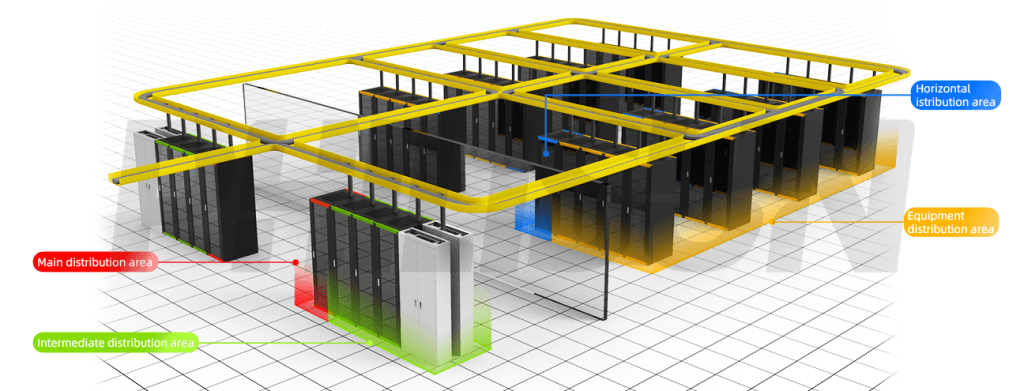
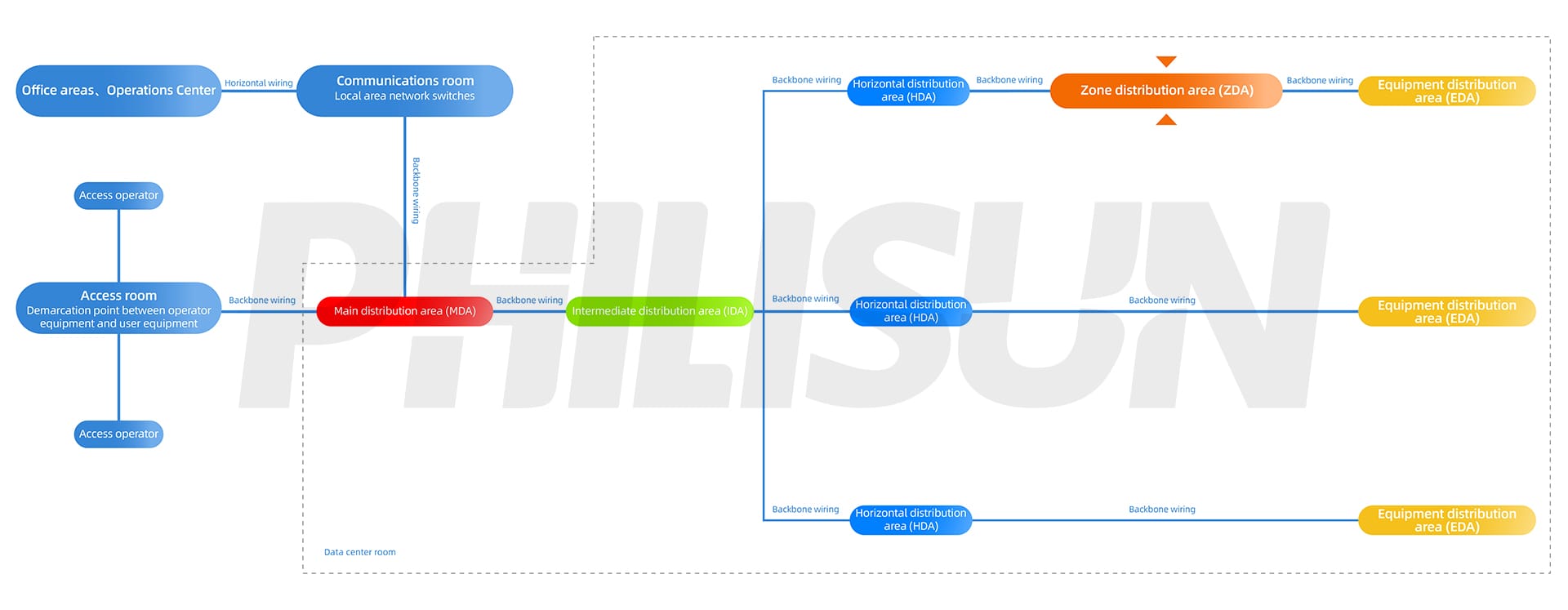
The data center is divided into multiple distribution areas at different levels: main distribution area (MDA), intermediate distribution area (IDA), horizontal distribution area (HDA); zone distribution area (ZDA), equipment distribution area (EDA)
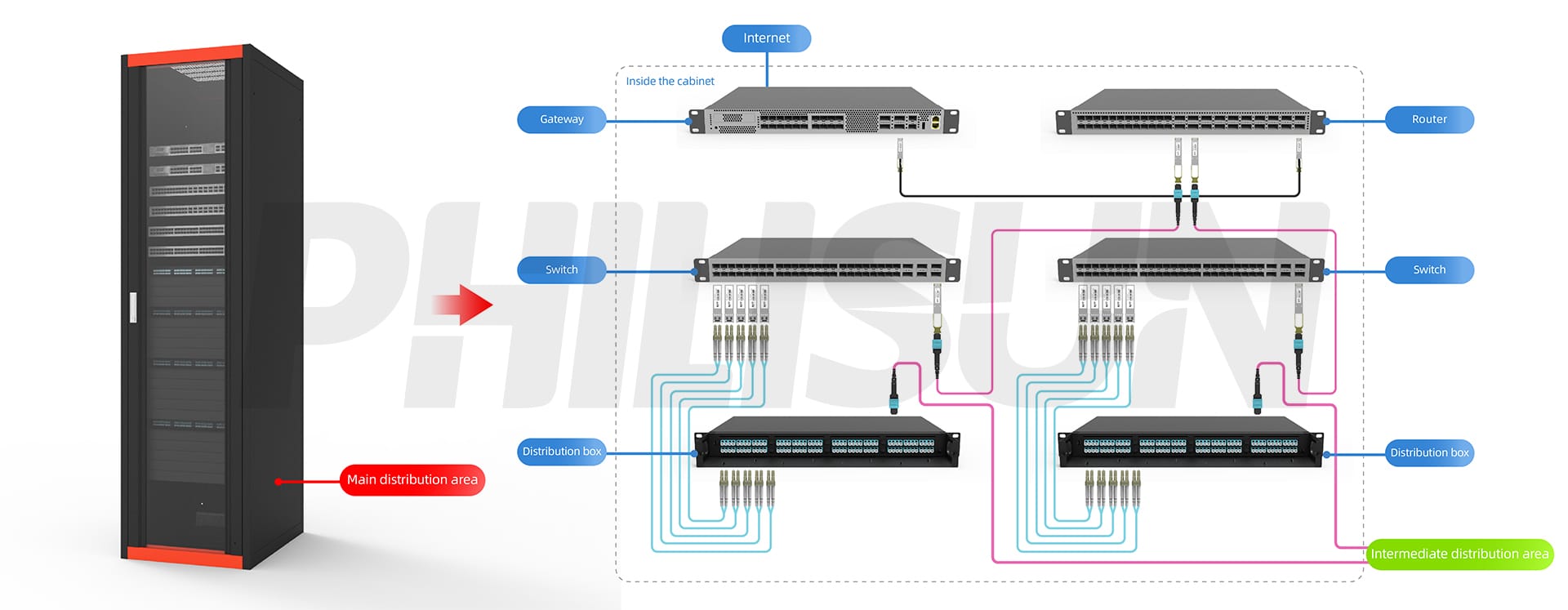
Included the main cross-connect (MC) distribution equipment, the main distribution area is the central distribution point of the structured wiring distribution system of the data center. When the equipment is directly connected to the main distribution area, the main distribution area can include horizontal cross-connect (HC) wiring equipment too. The main distribution area can be supported by routers, core switches, core storage area network switching equipment and PBX equipment at the core of the data center network to serve the middle distribution area, horizontal distribution and equipment distribution areas of one or more data centers at different locations, as well as telecommunications rooms outside each data center, and to provide services and support for office areas, operation centers, and other external support areas. Sometimes the communication equipment (such as communication transmission facilities) connected to the telecommunications business operator is also placed in this area to avoid exceeding the rated transmission distance due to the cable. The main distribution area is located inside the computer room. To improve safety, it can be set in a dedicated space in the computer room. Every data center should have at least one main distribution area.
Intermediate Distribution Area
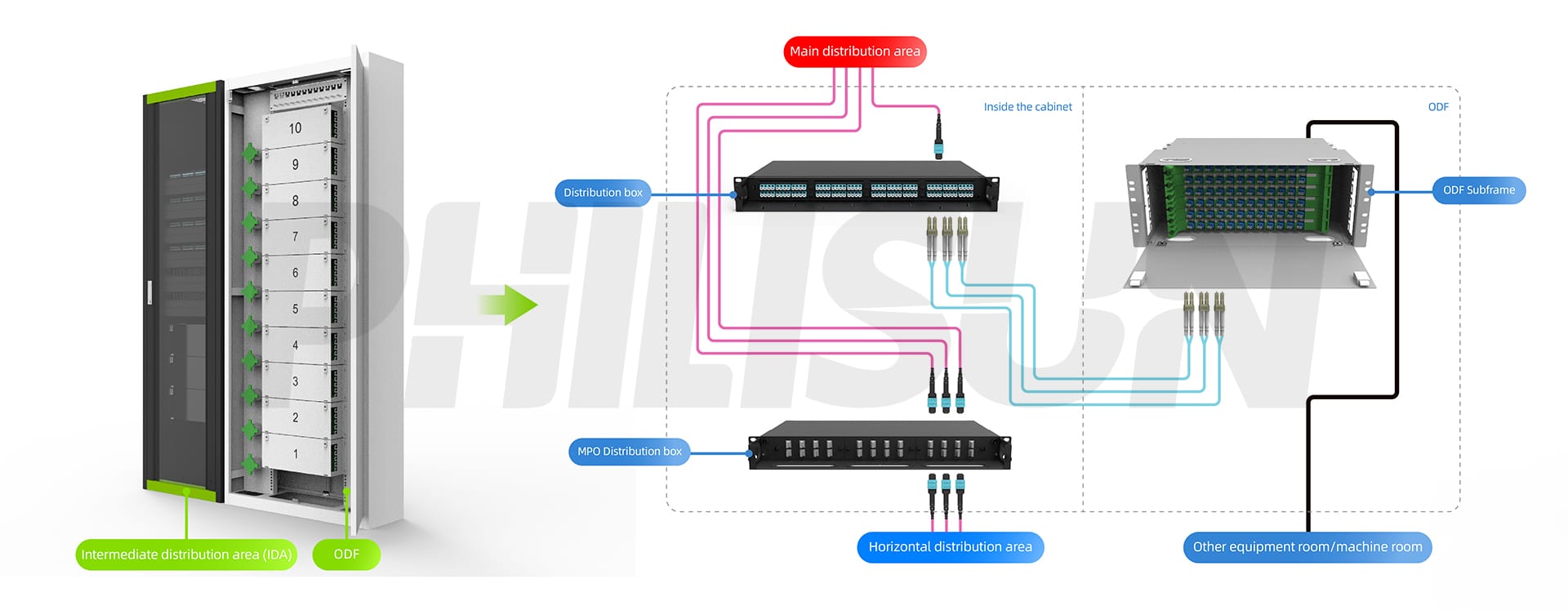
The optional intermediate distribution area is used to support intermediate cross-connections (IC), which is common in large data centers that occupy multiple buildings, multiple floors, or multiple computer rooms. Each room, each floor or even each building can have one or more intermediate distribution areas, serving one or more horizontal distribution areas and equipment distribution areas and one or more telecommunications rooms outside the computer room. As the second-level backbone, the crossed distribution equipment is located between the main distribution area and the horizontal distribution area. The middle distribution area can contain active devices.
Horizontal Distribution Area
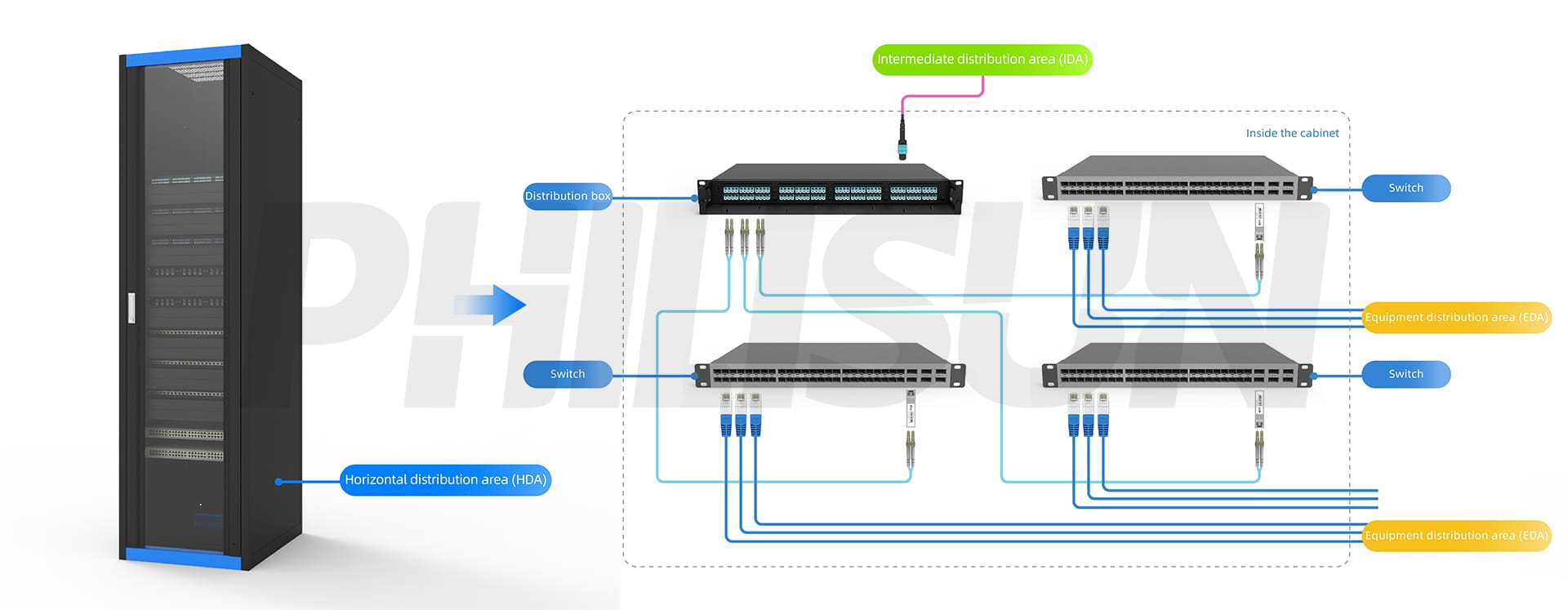
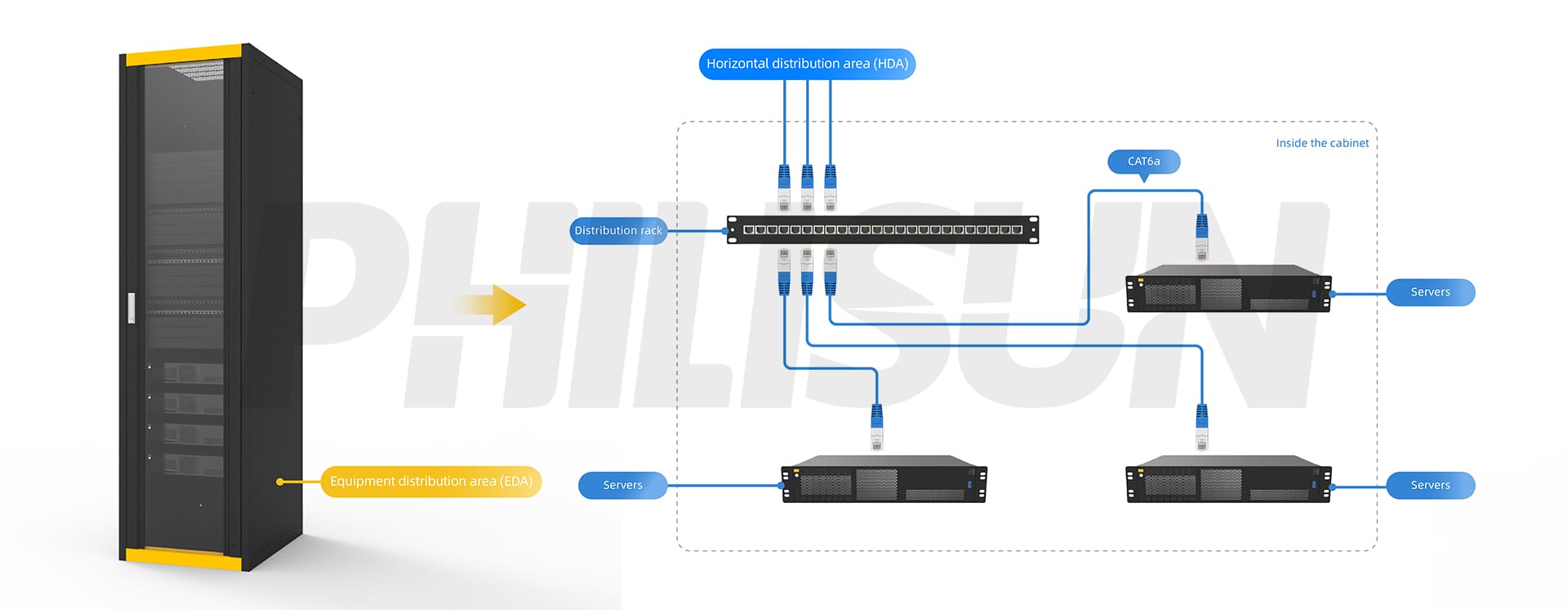
The horizontal distribution area is used to serve HC equipment that is not directly connected to the main distribution area. It mainly includes horizontal distribution equipment, local area network switches for terminal equipment, storage area network switches and KVM switches. Small data centers may not have horizontal distribution areas, but are supported by main distribution areas. A data center can be equipped with computer rooms on each floor, and each floor contains at least one horizontal distribution area. If the horizontal wiring distance of the equipment in the equipment distribution area exceeds the requirements of the horizontal cable length limit, multiple horizontal distributions can be installed. The horizontal distribution area provides network connections for the terminal equipment located in the equipment distribution area. The number of connections depends on the number of connected equipment ports and the space capacity of the cable duct, and space should be reserved for future development.
Zone Distribution Area
In a large computer room, in order to obtain higher configuration flexibility between the horizontal distribution area and the terminal equipment, the horizontal wiring system can include an optional docking point called the zone distribution area. The zone distribution area is located in an area where the equipment frequently moves or changes. The cable connection can be completed by the wiring facility through the assembly point (CP), or the regional socket can be set to connect the equipment in multiple adjacent areas. There must be no cross-connections in the zone distribution area, and no more than one zone distribution area shall be allowed in the same horizontal cable routing. Active devices cannot be used in the zone distribution area.
Equipment Distribution Area
The equipment distribution area is the space allocated for terminal equipment installation. Terminal equipment includes all kinds of servers, storage devices, small, medium and large computers and related peripheral equipment, etc. The horizontal cables in the equipment distribution area are terminated on the connecting hardware fixed to the cabinet or rack. A sufficient number of power sockets and connecting hardware should be installed in the cabinet or rack of each equipment distribution area to shorten the length of equipment cables and power cords to the shortest distance.
We use necessary technologies to run this website. With your permission, we also use analytics and customer-support technologies to improve the site and answer enquiries. You can accept, reject, or choose your preferences.
Necessary
Always active
The technical storage or access is strictly necessary for the legitimate purpose of enabling the use of a specific service explicitly requested by the subscriber or user, or for the sole purpose of carrying out the transmission of a communication over an electronic communications network.
Preferences
The technical storage or access is necessary for the legitimate purpose of storing preferences that are not requested by the subscriber or user.
Statistics
The technical storage or access that is used exclusively for statistical purposes.The technical storage or access that is used exclusively for anonymous statistical purposes. Without a subpoena, voluntary compliance on the part of your Internet Service Provider, or additional records from a third party, information stored or retrieved for this purpose alone cannot usually be used to identify you.
Customer support
The technical storage or access is used to load the optional customer-support chat and remember chat-related choices. This service may process identifiers and usage information.