If you’re deploying NVIDIA Quantum-2 for large-scale AI training or HPC fabrics, you already know the pressure:
Cluster congestion, thermal limits, and optical module compatibility can make or break your network’s performance.
A wrong decision between 800G OSFP vs QSFP-DD can result in:
- 15–30% higher cluster latency
- 10–20W additional thermal burden per switch port
- Compatibility issues with 800G AOCs/optics
- Bottlenecks in GPU-to-GPU communication
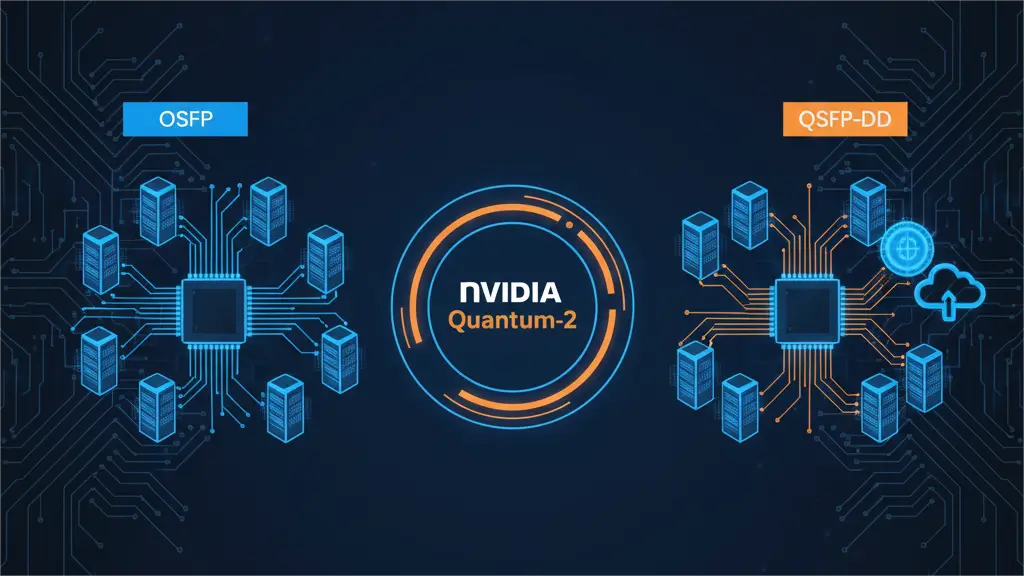
This guide gives you a clear, engineering-grade comparison of OSFP vs QSFP-DD — with a focus on what works best for NVIDIA Quantum-2.
The Rise of 800G in AI and HPC Networks
NVIDIA Quantum-2 Architecture Overview
Quantum-2 is NVIDIA’s latest 400G/800G InfiniBand platform, supporting:
- 64-port 400Gb/s switches
- 128 lanes of 100G PAM4 SerDes
- Up to 1.6Tb/s per GPU node (with multiple NICs)
- Direct support for 800G optical links
Its goal: eliminate scaling bottlenecks during distributed training by increasing interconnect bandwidth.
800G’s Role in AI Cluster Interconnects
AI clusters depend on:
- GPU-to-GPU throughput
- Network-induced training slowdown
- Lowering collective communications latency (All-Reduce, All-Gather)
800G optics—especially SR8 MPO-16 modules—are now essential for rack-to-rack GPU communication in dense clusters.
See PHILISUN’s 800G SR8 optics here:
👉 PHILISUN 800G SR8 MPO-16 Module
Technical Deep Dive — OSFP vs QSFP-DD
Comparing Size and Port Density
| Spec | OSFP | QSFP-DD |
| Width | Larger | Smaller |
| Power envelope | Up to 25–27W+ | ~18–20W typical |
| Cooling | Superior airflow | More limited |
| Port density | Lower | Higher |
Takeaway:
OSFP = more power + better thermal handling
QSFP-DD = higher port density per 1RU switch
Heat Dissipation & Thermal Management
800G optics require 16 x 100G PAM4 laser lanes, which generate substantial heat.
- OSFP was designed with thermal performance prioritised
- QSFP-DD is increasingly thermally constrained at 800G+
As module power climbs above 20–24W, OSFP becomes a superior choice for long-term reliability.
Mechanical Design and Port Compatibility
OSFP cannot be inserted into QSFP-DD ports, and vice versa.
- NVIDIA Quantum-2 switches come in both OSFP and QSFP-DD variants
- NICs for Quantum-2 depend on the system integrator (HGX platforms often use OSFP)
For many high-density GPU nodes, OSFP is the default form factor due to thermals.
Performance and Cost Considerations for 800G Modules
Assessing Power Consumption
Typical 800G module power (market avg):
- OSFP 800G SR8: 16–20W
- QSFP-DD 800G SR8: 18–22W
QSFP-DD tends to run hotter at similar reach due to form-factor constraints.
Cost Per Bit
As manufacturing scales, the cost gap is shrinking.
Currently:
- QSFP-DD may have a slightly lower cost
- OSFP offers better long-term reliability → reduces cooling costs
Vendor Ecosystem and Supply Chain
OSFP adoption has grown rapidly in:
- AI GPU clusters
- 400G/800G Ethernet
- Quantum-2 IB switches
- Meta, Microsoft, Baidu, Alibaba clusters
QSFP-DD is still widely used in:
- Cloud data centres
- Enterprise networks
Deployment Strategies with NVIDIA Quantum-2
DAC/AOC Use in the Same Rack
- DAC = cost-effective for ≤3m
- AOC = preferred for ≤30m
- 800G AOCs use OSFP or QSFP-DD, depending on switch model
Optical Transceivers for Row-to-Row Links
For 20–50m distance inside large accelerated compute clusters:
- 800G SR8 OSFP/QSFP-DD
- MPO-16 multimode cabling
PHILISUN’s SR8 is fully compatible with NVIDIA Quantum-2:
PHILISUN’s 800G Compatibility Solutions
PHILISUN provides:
- SR8 OSFP/QSFP-DD modules
- MPO-16 multimode jumpers
- 100G/400G/800G product families
- Vendor-tested interoperability
Future-Proofing the 800G Network
Scalability to 1.6T Networks
OSFP is already the chosen form factor for 1.6T, due to thermal headroom.
QSFP-DD 1.6T is possible but not ideal.
Choosing the Right Form Factor for Longevity
Use this rule:
- If thermals & long-term reliability are top priority → OSFP
- If maximum port density is more important → QSFP-DD
Conclusion
If your priority is:
- Thermal stability
- High reliability for dense AI training
- Future-proofing toward 1.6T
Then OSFP is the better choice.
If you need:
- High port density
- Lower upfront cost
- Compatibility with existing QSFP ecosystems
Then QSFP-DD remains suitable, especially for 800G SR8 short-reach links.
For either architecture, PHILISUN provides fully compatible 800G optical transceivers and MPO cabling to support Quantum-2 deployments.
FAQ
Q1: Is OSFP more reliable than QSFP-DD at 800G?
Yes. OSFP has better thermal headroom, which improves long-term module stability.
Q2: Do NVIDIA Quantum-2 switches support both OSFP and QSFP-DD?
Quantum-2 switches are available in both OSFP and QSFP-DD variants. Check the model before ordering modules.
Q3: Are PHILISUN 800G SR8 transceivers compatible with Quantum-2?
Yes. PHILISUN 800G SR8 modules are fully compatible with Quantum-2 800G optical ports.
Q4: What fiber is required for 800G SR8?
You need MPO-16 OM4/OM5 multimode fiber for SR8 optical connectivity.