Modern data centers face pressure to deliver higher bandwidth, lower latency and better energy efficiency while keeping cabling practical. For servers, switches, storage arrays and GPU clusters, teams often compare DAC cables, AOC cables and optical transceivers paired with fiber. For 100G-800G racks, the decision now often also includes ACC and AEC active copper options when passive DAC is too limited but a fixed optical route is not required.
This article provides a deep yet practical comparison. You will learn how each technology works, its strengths and limitations, and the best deployment scenarios. We will also show real-world decision criteria to help you choose the right interconnect for performance, scalability, and total cost of ownership.
The Foundation of Modern Data Center Connectivity
The Ever-Growing Need for Speed and Efficiency
Data centers today must support link speeds of 10G, 25G, 100G, 400G, and increasingly 800G. These connections must operate reliably across diverse topologies such as server-to-ToR switches, ToR-to-spine layers, and high-performance GPU fabrics.
Server-to-ToR, ToR-to-Spine, and GPU Interconnects
Different parts of the data center require different interconnect characteristics:
- Server-to-ToR typically uses short distances, prioritizing low latency and low cost.
- ToR-to-Spine involves moderate distances where flexibility becomes important.
- GPU clusters require extremely high bandwidth with strict thermal constraints.
Balancing Bandwidth, Latency, and Cost
The challenge is to select a cabling method that meets performance needs without driving up capital expenditure or complicating cable management.
Navigating Short-to-Medium Reach Challenges
There is no single cable type suitable for all distances. Short-reach applications benefit from cost-efficient copper, while longer runs require fiber. Understanding the trade-offs leads to more efficient design and reduced TCO.
Direct Attach Cables (DAC): The Cost-Effective Copper Backbone
Simplicity and Affordability for Short Links
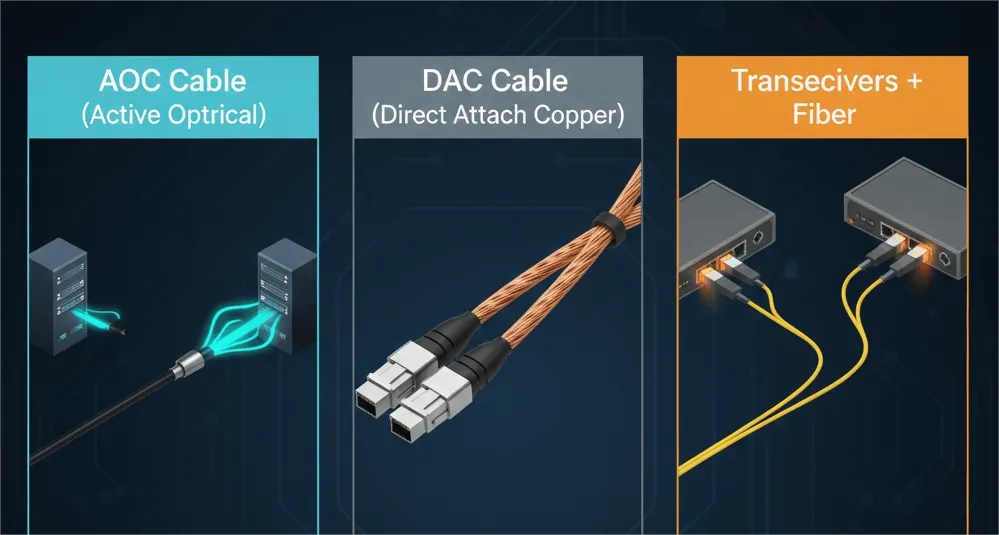
DAC cables are copper-based, pre-terminated assemblies used to connect networking equipment directly — no additional optics required.
Passive vs Active DAC Explained
- Passive DAC contains no electronics. Best for up to 3–5 meters with minimal latency.
- Active DAC includes a small amplification circuit enabling up to 7 meters.
Ideal for Intra-Rack Connectivity
DACs dominate:
- Server-to-ToR
- Short GPU-to-switch runs
- Short hyperscale internal cabling
Their plug-and-play design and low cost make them the first choice within racks.
Limitations and Considerations
Weight, Bulk, and EMI Concerns
Copper is heavier and less flexible than fiber, creating challenges in high-density racks.
Power Consumption at Longer Distances
Active DACs draw more power than AOCs and transceivers, and still cannot exceed short distances. For anything over 7 meters, DAC becomes impractical.
Active Optical Cables (AOC): Bridging the Gap with Fiber
Fiber Advantages in a Cable Package
AOCs combine the convenience of DACs with the performance of fiber.
Light, Flexible, and EMI Immune
AOCs solve key copper challenges:
- Lightweight
- Very flexible
- Immune to electromagnetic interference
- Ideal for crowded racks or noisy environments
Longer Reach (Up to 100m+)
AOCs can extend beyond the reach of DACs, making them ideal for inter-rack connections.
Integrated Solution for Plug-and-Play
AOC assemblies include built-in optical engines. Unlike transceivers + fiber, AOCs cannot be detached or repurposed, but they provide:
- lower power consumption
- lower heat output
- guaranteed compatibility
Common Applications
AOCs are preferred in:
- AI / HPC interconnects
- Inter-rack Ethernet or InfiniBand links
- GPU clusters requiring airflow-friendly cable designs
Optical Transceivers + Fiber: The Flexible and Scalable Choice
Versatility for Any Distance and Application
Optical transceivers allow operators to match three variables independently:
- transceiver type (10G, 25G, 100G, 400G, 800G)
- fiber type (MMF or SMF)
- cable length
This modularity makes them ideal across the entire data center — and beyond.
Modular Design Advantages
Operators can freely choose:
- jumper length
- connector type (LC, MPO)
- cable routing strategy
MMF and SMF Support
Choose MMF for short-to-medium distances or SMF for longer applications.
Advanced Capabilities and Future-Proofing
Optical transceivers support technologies far beyond AOCs and DACs.
BIDI, DWDM, and High-Speed Modules
- BiDi transceivers reduce fiber count
- DWDM supports metro-scale multiplexing
- 400G / 800G optics support AI clusters and hyperscale fabrics
Scalability
This is the only option that scales reliably to:
- cross-floor
- cross-building
- campus
- metro links
Head-to-Head Comparison: Choosing the Right Interconnect
Decision Matrix: Key Criteria
| Criteria | DAC | AOC | Transceiver + Fiber |
| Cost | ★★★★★ (lowest) | ★★★★ | ★★ (higher upfront) |
| Distance | ≤7m | ≤100m+ | Up to 40km+ |
| Power | Very low (passive) | Low | Moderate |
| Flexibility | Low | Medium | Very high |
| Weight | Heavy | Very light | Light |
| EMI Immunity | Low | High | High |
| Reusability | Low | Low | High |
| Scalability | Low | Medium | Very high |
Optimal Scenarios for Each Technology
Where DACs Shine
- Shortest links
- Cost-sensitive deployments
- Server racks with consistent layouts
When AOCs Provide the Best Value
- Medium-range connections
- Airflow-sensitive or high-density racks
- HPC, AI, ML, or GPU clusters
The Indispensable Role of Transceiver + Fiber
- Long-distance links
- Rapidly scaling networks
- Environments requiring full modularity
Where ACC and AEC Fit in the Choice
The original AOC vs DAC decision is still useful, but 400G and 800G racks often need a more detailed copper discussion. ACC cables and AEC cables sit between passive DAC and AOC: they keep a copper-style cable assembly, while active electronics help signal integrity when passive DAC is too close to its limit.
| Choice | Use it when | Next page to review |
| Passive DAC | Same-rack, shortest link, lowest power and lowest cost are most important. | DAC Cables |
| ACC | You want a short copper assembly but passive DAC needs more active signal conditioning. | DAC vs ACC vs AEC vs AOC Guide |
| AEC | High-speed electrical links need retiming or stronger signal integrity support. | DAC vs ACC vs AEC vs AOC Guide |
| AOC | The route needs lighter cable, longer reach or cleaner airflow than copper can provide. | AOC Cables |
| Transceivers + fiber | The link needs structured cabling, patch panels, long reach or modular upgrades. | Fiber Optic Network Solutions |
If your main question is cable length, see the dedicated DAC, ACC, AEC and AOC cable length limits guide. It explains how same-rack, adjacent-rack and row-level AI data center routes change the cable family decision.
PHILISUN’s End-to-End Interconnect Solutions
PHILISUN provides a complete portfolio of DAC, AOC, ACC, AEC and optical transceiver solutions for modern data centers. Products are tested for compatibility and performance across switches, servers and storage platforms, helping teams reduce deployment risk while choosing the right interconnect for cost, distance, airflow and upgrade flexibility.
Conclusion
Choosing the right interconnect solution is fundamental to performance, airflow management, scalability, and long-term cost. DAC serves short-distance, cost-efficient needs; AOC meets medium-distance, lightweight requirements; and optical transceivers deliver unmatched flexibility across all distances.
By evaluating bandwidth, thermal environment, and scaling projections, data centers can build robust and future-ready infrastructure. PHILISUN stands ready to assist with expert guidance, high-quality interconnect products, and comprehensive data center solutions to support your next upgrade.
FAQ
Q1: Is AOC better than DAC?
AOC is better for medium distances and high-density routing, while DAC is cheaper and best for short links.
Q2: Are AOCs interchangeable with transceivers?
No. AOCs are integrated cables, while transceivers are modular and reusable.
Q3: What is the maximum DAC cable length?
Typically up to 7 meters, depending on whether it is passive or active.
Q4: Can AOC cables support 400G?
Yes. Many vendors, including PHILISUN, offer 100G–400G AOCs for HPC and AI clusters.
Q5: Where do ACC and AEC fit between DAC and AOC?
ACC and AEC are active copper options. They are useful when passive DAC is too limited for a short high-speed route, but the project still prefers a copper-style cable assembly instead of AOC or separate transceivers.
Q6: Should I choose AOC or transceivers with fiber for longer links?
Choose AOC for a fixed point-to-point optical cable assembly. Choose transceivers with structured fiber when the route needs patch panels, MPO trunks, documented cabling paths or easier future upgrades.
Q7: Which option is most future-proof?
Optical transceivers + fiber provide the highest scalability and longest reach.