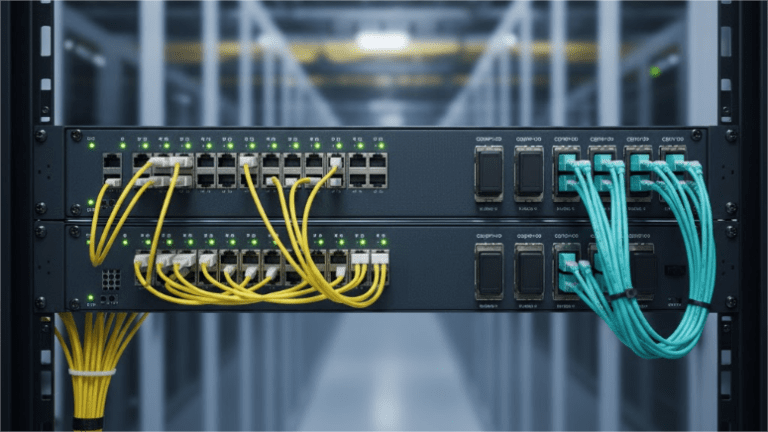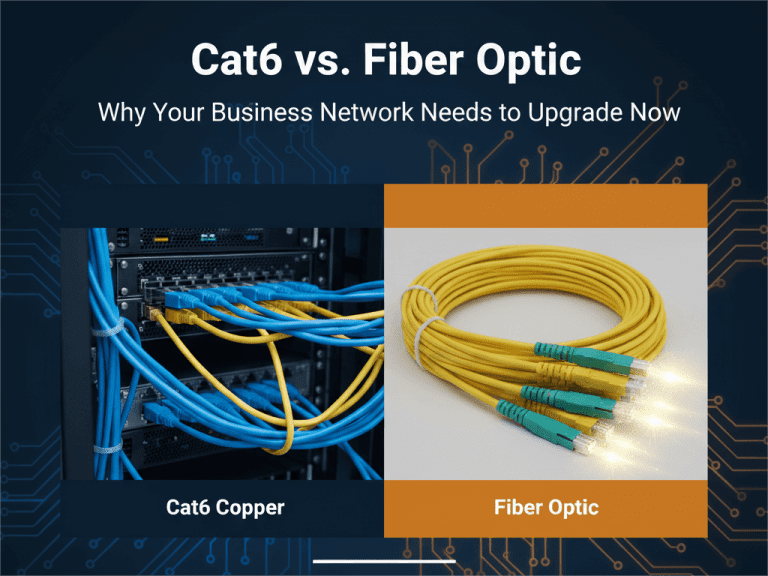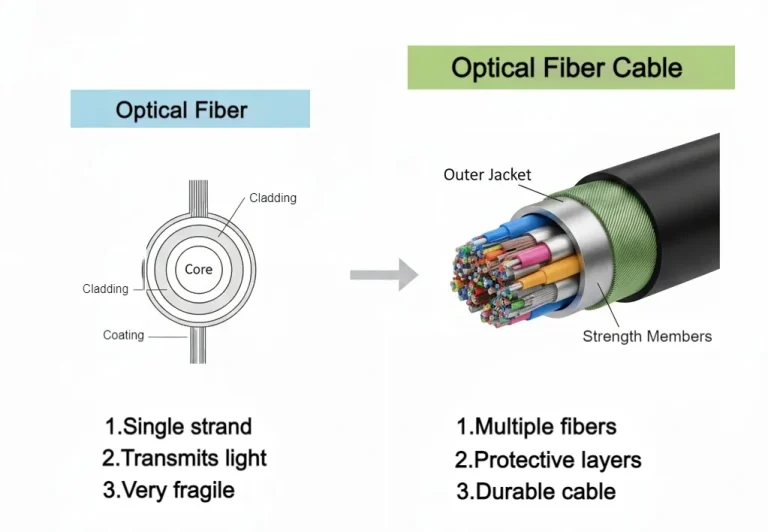

Your legacy OM2 fiber cable served its purpose, but it is now the bottleneck crippling your network upgrade potential. As demands shift to 10G and 25G, the critical question is simple: Can your installed OM2 support your new, expensive transceivers? This article directly addresses the financial and technical risks of keeping legacy OM2. We will analyze its severe distance limitations (the 82-meter wall) versus modern OM3 and OM4 standards, providing the definitive commercial justification you need for a cost-effective infrastructure upgrade.
What Is OM2 Fiber Cable
OM2 is part of the Multimode Fiber family, designed to use multiple paths (modes) of light to transmit data over short distances. Its specifications mark a crucial point in fiber history as it embraced new laser technology.
Core Specifications, Structure, and Application History
OM2 fiber is primarily identified by its 50/125µm core diameter and its standard orange jacket, which signals its MMF designation. Unlike the older OM1 fiber (62.5/125µm), OM2 was one of the first MMF types specifically optimized for use with the economical 850nm VCSEL (Vertical-Cavity Surface-Emitting Laser) light sources. This shift made OM2 a staple for new installations during the first wave of widespread Gigabit Ethernet deployment, providing superior performance and cost savings over the more expensive Single Mode Fiber solutions of the time.
Key Differentiator: Modal Bandwidth (MBW) and Dispersion
The fundamental limit of any Multimode Fiber is its Modal Bandwidth (MBW), which dictates how far and how fast light can travel before the signal degrades. OM2 has a typical MBW of 500 MHz·km at 850nm. When multiple light paths travel down the core simultaneously, they arrive at slightly different times—a phenomenon called modal dispersion. This dispersion causes the data pulses to spread out and eventually overlap, leading to Bit Error Rates (BER) too high for reliable communication. The 500 MHz·km limit means OM2 can only tolerate a certain amount of dispersion before the signal collapses, directly constraining its maximum distance at high speeds.
The Viability Crisis: Why OM2 Fails at High Speeds
The limitations of OM2 are not theoretical; they are hard physical barriers that impact the procurement and deployment of modern 10G/40G transceivers.
Reliable 1 Gigabit Performance (1000BASE-SX)
For standard 1000BASE-SX (1 Gigabit) links, OM2 fiber is reliable, mature, and safe. At this speed, OM2 can comfortably support a distance of up to 550 meters. For short patch runs or low-demand access layer connections, using existing OM2 fiber remains a cost-effective solution. The issue is not OM2’s performance at 1G, but its inability to scale.
The Critical Bottleneck at 10 Gigabit (10GBASE-SR)
The severe vulnerability of OM2 fiber is exposed when upgrading to 10 Gigabit Ethernet using the popular 10GBASE-SR standard. To maintain signal integrity at the ten-fold increase in speed, the fiber link must be far shorter. The physical properties of OM2 limit the maximum reliable reach for 10G to a crippling distance of only 82 meters.
In contrast:
- OM3 (LOMMF): Supports 10GBASE-SR up to 300 meters.
- OM4 (High-Performance LOMMF): Supports 10GBASE-SR up to 400 meters.
This dramatic 82-meter restriction means that nearly any horizontal or vertical cable run connecting two separate distribution closets or floors within a building will instantly become a bottleneck, forcing IT managers to either reduce speed or deploy costly active electronics to bridge the gap.
Non-Viability for 40G and Beyond
For newer 40GBASE-SR4 and 100GBASE-SR4 applications, OM2 fiber is considered non-viable by industry standards, offering distances of only a few meters. Therefore, any data center planning to implement high-speed server aggregation or core trunking must prioritize upgrading the physical fiber cable infrastructure.
The Financial and Commercial Case for Upgrading
From an enterprise procurement perspective, the cost of fiber cable is small compared to the cost of the active electronics it supports. OM2 hinders the ROI of those expensive active components.
Maximizing Transceiver ROI
The primary financial justification for replacing OM2 is unlocking the full potential of high-value active components. High-speed transceivers (e.g., 10G SFP+ and 40G QSFP) represent a significant capital expense. When these transceivers are connected via legacy OM2, their speed and reach capabilities are effectively capped at the fiber’s lowest common denominator (82m at 10G). Upgrading the fiber cable to OM3 or OM4, which is a relatively low cost per meter, immediately unlocks the full 300m/400m range of your SFP+ transceivers, thereby maximizing the lifetime ROI on your switch and optics investment.
Future-Proofing with PHILISUN Fiber Solutions
Standardizing on OM4 fiber eliminates uncertainty across the network. It means IT teams no longer need to check cable codes against link budgets for every deployment. OM4’s superior MBW of 4700 MHz·km at 850nm simplifies network documentation and reduces troubleshooting time. PHILISUN provides a comprehensive portfolio of high-performance OM3 and OM4 fiber cable assemblies, pre-terminated to simplify installation and guarantee that every link exceeds TIA standards. This ensures your infrastructure is ready for the next decade of bandwidth growth.
Conclusion
While legacy OM2 fiber cable remains technically functional for short-distance 1G connections, its severe 82-meter limit at 10 Gigabit creates a debilitating technical and commercial bottleneck for modern enterprise networks. The economic reality is that the modest investment required to replace OM2 with high-bandwidth OM3 or OM4 fiber cable is immediately offset by the ability to utilize high-speed transceivers across far greater distances. Replacing legacy fiber is the most reliable and cost-effective strategy for future-proofing your network infrastructure.
Ready to maximize the performance of your network core? Explore PHILISUN’s high-bandwidth OM3 and OM4 Fiber Solutions for cost-effective enterprise upgrades.
Frequently Asked Questions (FAQ)
Q1: What is the maximum distance OM2 supports at 10 Gigabit?
A1: OM2 fiber is strictly limited to a maximum distance of 82 meters for the 10GBASE-SR standard.
Q2: What is the primary difference between OM2 and OM4 fiber?
A2: OM4 is a Laser-Optimized MMF (LOMMF) with a much higher Modal Bandwidth (MBW) (4700 MHz·km), allowing it to support 10G up to 400 meters, compared to OM2’s 82-meter limit.
Q3: Can I run 40G or 100G over OM2?
A3: Technically, only over distances of a few meters. OM2 is not a viable standard for high-bandwidth 40G or 100G applications in the data center.
Q4: What color is OM2 fiber typically jacketed in?
A4: OM2 fiber is typically identified by an orange jacket, while OM4 is identified by an aqua jacket.
Q5: What is the main financial argument for replacing OM2?
A5: Replacing the fiber cable unlocks the full distance potential of expensive 10G and 40G transceivers, maximizing the network’s overall ROI.