
In modern networking, the physical cable is the unsung hero that determines your system’s total speed ceiling and reliability. The choice of fiber optic cable is far more complex than just picking a color; it involves matching specific glass compositions, jacket materials, and connector tolerances to the demands of your environment, whether that’s a subterranean conduit or a high-density 800G rack.
This guide provides network architects and procurement specialists with a complete blueprint for selecting the right fiber optic cable type. We move beyond basic definitions to cover essential industry standards (ITU-T G.657), advanced construction methods (Ribbon fiber), and the critical Ultra-Low Loss (ULL) requirements that define performance in today’s fastest data centers.
Part I: The Fundamentals – Fiber Type and Performance Standards
The first step in fiber selection is identifying the core glass structure, which dictates the cable’s distance and bandwidth capabilities.
1. The Core: Single-Mode vs. Multimode Fiber
1.1 Single-Mode Fiber (SMF)
Single-Mode Fiber (SMF) features an extremely thin core (typically 9μm) that allows only one path (or mode) of light to travel. Because the light travels a single, straight path, modal dispersion is eliminated, making SMF the choice for virtually all long-distance applications.
- Application: Long-haul telecommunications (Metro, ISP backbones), and increasingly, for high-speed (400G and 800G) links within massive Hyperscale Data Centers where reach is critical and density is paramount.
1.2 Multimode Fiber (MMF)
Multimode Fiber (MMF) uses a larger core (typically 50μm or 62.5μm), allowing multiple light paths (modes) to travel simultaneously. This modal dispersion limits MMF distance but makes it easier to install and more cost-effective for short-range deployments.
- Application: Enterprise Local Area Networks (LANs) and short-range interconnects within data center racks (typically up to 400m).
2. Fiber Standards: ITU-T Classifications
The specific letter-number designations dictate the fiber’s exact performance characteristics, which are non-negotiable for system compatibility.
2.1 Single-Mode Standards (G.65x)
- G.652.D (Standard SMF): The most common and widely deployed single-mode fiber, offering excellent performance across the 1310nm and 1550nm windows.
- G.657 Bend-Insensitive Fiber (BIF): This standard is crucial for modern high-density cabling. BIF includes a reflective trench around the core, allowing the fiber to withstand much tighter bends without leakage.
- G.657.A1 / A2: Used in data centers and telecom, with MBRs as tight as 10mm.
- G.657.B3: Used in FTTx and ultra-tight applications, with MBRs as tight as 5mm.
2.2 Multimode Standards (OMx)
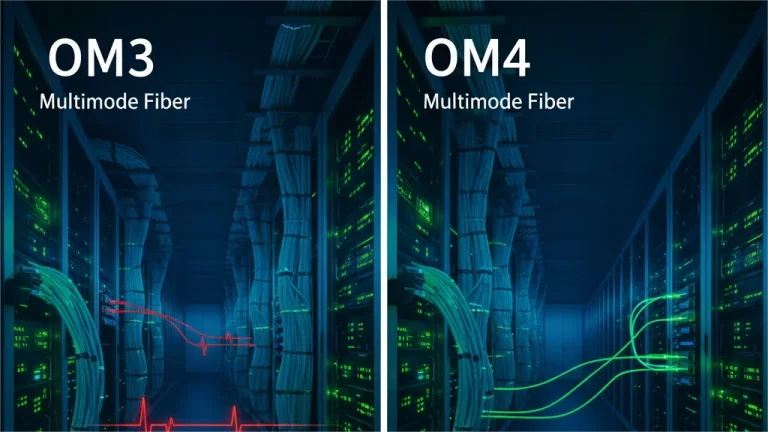
- OM3 (Aqua): Laser-optimized for 10G transmission.
- OM4 (Violet): The current standard for 40G and 100G, offering extended reach over OM3.
- OM5 (Lime Green):Wideband Multimode Fiber (WBMMF). Optimized for short-wavelength division multiplexing (SWDM), allowing multiple signals over one fiber, extending the MMF lifespan in certain data center applications.
Part II: Cable Construction and Environmental Durability
Once the core fiber type is chosen, the construction of the outer jacket and internal components must be specified to match the environment and installation method.
3. Cable Construction: Loose Tube vs. Tight Buffer vs. Ribbon
- Loose Tube Construction: The fibers float freely within gel-filled plastic tubes.1 This construction protects against water ingress and temperature contraction, making it ideal for Outside Plant (OSP) cables. However, it is challenging to terminate indoors.
- Tight Buffer Construction: The fibers are coated with a protective buffer layer (900μm), which makes the cable robust and easy to strip for termination. It is primarily used for Indoor/Riser applications and patching.
- Ribbon Fiber Construction: Multiple fibers (typically 12 or 24) are encapsulated side-by-side in a flat ribbon structure. This is the highest density construction, enabling rapid mass fusion splicing and crucial for MPO/MTP technology.
- Expansion: Rollable Ribbon vs. Traditional Ribbon: Rollable ribbon is a new generation of ribbon fiber that can be rolled up to occupy less space inside a tube. This allows manufacturers to drastically increase the fiber count in a smaller diameter OSP cable, easing congestion in dense pathways.
4. Environment and Jacket Types (OSP vs. Indoor)
- Outside Plant (OSP) Cables: Must withstand environmental extremes. Specifications often include UV resistance, Armoring (steel tape for crush resistance in direct-burial applications), and Gel-Filled (for water blocking). Types include Direct-Burial, Aerial, and Duct cables.
- Indoor/Riser/Plenum Cables: Governed by strict fire safety codes:
- OFNR (Optical Fiber Nonconductive Riser): For vertical runs between floors.
- OFNP (Optical Fiber Nonconductive Plenum): For use in air-handling spaces (plenums), where low-smoke, low-flame characteristics are mandatory.2
Part III: The High-Performance Bridge – From Bulk Fiber to Low-Loss Assemblies
In high-speed data centers, simply buying G.657 fiber is not enough. The connectivity components must meet specialized performance requirements.
5. The 800G Requirement: Ultra-Low Loss (ULL) Connectivity
As speeds increase to 400G and 800G, the tolerance for signal loss decreases dramatically. The total Insertion Loss Budget (the maximum allowable power loss across the entire link) shrinks from 3.0dB (for 1G) to often less than 1.5dB.
- The ULL Solution: Ultra-Low Loss (ULL) assemblies use premium components, precision polishing, and strict manufacturing processes to achieve MPO connector loss below 0.35dB (compared to 0.75dB for standard MPO). This is non-negotiable for high-speed parallel optics.
- AOC Integration:Active Optical Cables (AOCs) combine fiber and transceivers into one pre-terminated assembly. For specific AI/HPC clusters, AOCs offer a high-speed, lower-power alternative to traditional optical cables for short-to-medium distances.
6. High-Density Connectors: MPO/MTP and MPO-16
The density requirements of modern AI and Spine-Leaf architecture make MPO/MTP cables mandatory.
- Density & Parallel Optics: MPO/MTP is a multi-fiber connector (12, 16, or 24 strands) that supports parallel optics, allowing 40G to 800G transmission using multiple fibers simultaneously.
- The Polarity Challenge: Correct MPO Polarity (Type A, B, or C) is critical for matching the transmitter of one transceiver to the receiver of another. Incorrect polarity is the leading cause of installation failure and must be verified by the supplier.
- NVIDIA Ecosystem: For 400G and 800G deployments in NVIDIA DGX and InfiniBand clusters, the specialized MPO-16 connector is now standard. PHILISUN provides engineered, custom ULL MPO-16 assemblies to ensure seamless integration with these high-performance systems.
Part IV: Procurement Framework & Quality Assurance
The final layer of selection involves ensuring quality and long-term cost-effectiveness.
7. Fiber Selection Framework: Matching Type to TCO
Effective procurement goes beyond initial purchase price.
- TCO Analysis (Single Mode vs. Multimode): While Single Mode cable is initially more expensive than Multimode, its massive bandwidth and reach potential mean it may never need to be replaced, resulting in a lower Total Cost of Ownership (TCO) over a 10-year period.
- The Installation Safety Net (MBR): Specifying G.657 Bend-Insensitive Fiber upfront significantly reduces the risk of attenuation and service calls caused by MBR violations during installation—a massive saving in maintenance cost.
- Color Coding Compliance: Verify that all cable jackets and connectors adhere to TIA-598-D color standards (e.g., yellow for OS2, violet for OM4) to simplify field maintenance and prevent accidental mating errors.
8. Quality Assurance: Guaranteeing Performance
- Tier 2 Certification: For any fiber link operating above 10G, Tier 2 certification (using an OTDR) is necessary to measure actual loss across the link, including splices and connectors. PHILISUN ensures all critical MPO/Trunk cables are delivered with comprehensive Tier 2 test results.
- Manufacturer Expertise:PHILISUN specializes in manufacturing custom, ULL fiber optic cable assemblies and transceivers. By controlling both the active and passive components, PHILISUN provides a single-source performance guarantee that bulk fiber suppliers cannot match, ensuring your high-speed investment is fully protected.
Conclusion
Selecting the right fiber optic cable is a multi-layered decision that requires navigating core standards, verifying physical construction, and ensuring absolute adherence to Ultra-Low Loss connectivity principles. Effective procurement means matching the cable’s Mode, Structure, and Quality to the demands of your system—from 1G simplicity to 800G complexity. Investing in the correct, certified cabling today prevents the need for costly rip-and-replace projects tomorrow.
Don’t guess with your connectivity.
Whether you need a simple Simplex patch cord or a complex MPO-16 trunk for AI clusters, PHILISUN has the certified solution. Contact our engineering team today for a free cable selection consultation and quote.
Frequently Asked Questions (FAQ)
- Q: Can I use an orange (OM2) fiber optic cable for 10G?
- A: No. OM1/OM2 cables are legacy fibers designed for LED sources and cannot reliably support 10G speeds, which require laser-optimized OM3 (Aqua) or faster. Using OM2 will result in immediate link failure or high attenuation over short distances.
- Q: What is the primary benefit of using a G.657 Bend-Insensitive Fiber?
- A: The primary benefit is improved durability and reduced signal loss in tight spaces. G.657 BIF drastically lowers the Minimum Bend Radius (MBR) requirement, making it ideal for compact fiber management systems and dense patch panels.
- Q: How does MPO-16 differ from the standard MPO-12?
- A: MPO-12 supports 40G and 100G using 4 or 8 active fibers. MPO-16 is a newer standard that supports 400G and 800G over 8 or 16 active fibers. It is essential for newer transceivers like OSFP and QSFP-DD that use the 400G per-lane signaling rate.
- Q: What is the TIA color code for an OM5 cable jacket?
- A: The TIA standard color code for the jacket of OM5 Wideband Multimode Fiber is Lime Green. This distinguishes it from OM3 (Aqua) and OM4 (Violet).
- Q: Does PHILISUN manufacture custom length fiber cables?
- A: Yes, PHILISUN specializes in custom-length fiber optic cable assemblies, including custom breakout configurations and specific polarity configurations for MPO trunks, all delivered with full test reports.