Modern data centers demand increasingly high-bandwidth, low-latency connectivity. As 400 G and 800 G optical networks become the standard, reliable fiber-optic interconnects are more critical than ever. NVIDIA’s MFP7E-series cables — including MFP7E30, MFP7E20, and MFP7E10 — are specifically engineered for next-generation optical interconnections between switches, adapters, and distribution frames.

What Are the MFP7E-Series Fiber Cables
The MFP7E-series fiber cables represent three distinct optical configurations tailored to different transmission needs.
MFP7E30 — Single-Mode MPO-12/APC Cable
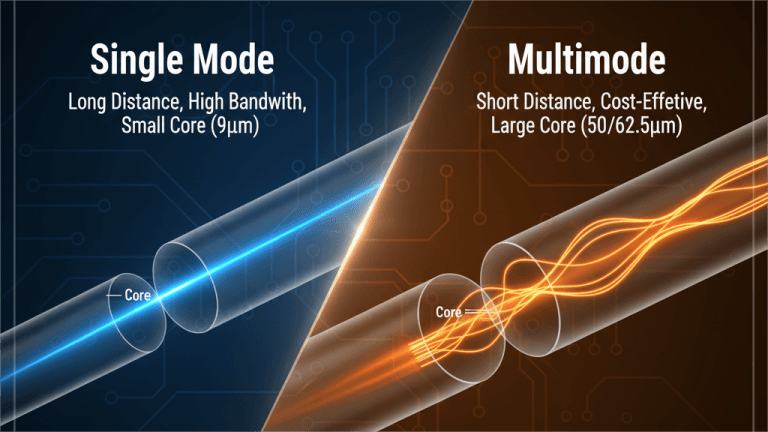
The MFP7E30 is a single-mode (OS2) trunk cable designed for long-distance, high-speed interconnects such as switch-to-switch or switch-to-network-adapter links.
- Connector Type: MPO-12/APC (8 active + 4 inactive fibers)
- Polish: 8° angled (APC) for minimal reflection
- Polarity: Type B (crossover)
- Fiber Type: OS2 single-mode
- Jacket Type: OFNR / LSZH (yellow)
- Maximum Reach: 150 m under ideal conditions; 50 m when up to four connector junctions are used (two patch panels)
- Typical Use: 400 G and 800 G single-mode network links
The 8° angled APC interface minimizes back-reflection, ensuring stable signal transmission even across multiple connector pairs.
MFP7E20 — Multimode Optical Splitter Cable
The MFP7E20 is a multimode 4-channel-to-two-2-channel optical splitter that enables signal branching from one input to two parallel outputs — ideal for redundancy, monitoring, or parallel optical architectures.
- Connector Type: MPO-12/APC
- Fiber Type: 50/125 µm multimode (OM3 ≤ 30 m / OM4 > 30 m)
- Configuration: 4-channel input → two 2-channel outputs
- Polarity: Type B (crossover)
- Jacket: OFNR / LSZH
- Maximum Reach: 50 m (assuming two patch panels = four connector junctions)
This model is frequently used in optical monitoring and branch distribution within large-scale network deployments where one transceiver must feed two end devices.
MFP7E10 — Multimode MPO-12/APC Trunk Cable
The MFP7E10 is a multimode trunk cable used for short-distance interconnections within racks or between adjacent network cabinets.
- Connector Type: MPO-12/APC (8 active + 4 inactive fibers)
- Fiber Type: 50/125 µm multimode (OM3 ≤ 30 m, OM4 > 30 m)
- Polarity: Type B (crossover)
- Jacket Type: OFNR / LSZH (aqua color)
- Minimum Bend Radius: 30 mm
- Maximum Reach: 50 m (assuming up to four connector junctions)
This version is optimized for switch-to-adapter or switch-to-switch interconnections inside high-density racks, offering excellent flexibility and repeatable performance.
Core Technical Highlights
1. MPO-APC Connector Precision
All MFP7E cables feature MPO-12/APC connectors with an 8° angle polish to minimize back-reflections and maintain high return-loss values — critical in high-speed data links.
2. Low Optical Loss
Each cable assembly achieves extremely low insertion loss and high return loss. Although NVIDIA does not publish a numerical IL formula, all variants are rated for “very low insertion loss” and consistent performance across connector pairs.
3. Robust Jacket Options
Available in OFNR or LSZH, these jackets provide flame resistance and low smoke generation, ideal for commercial and data-center installations. PHILISUN offers color-coded jackets (yellow for single-mode, aqua for multimode) to simplify cable identification.
4. Strict Polarity and Lane Mapping
All three cables use Type B (crossover) polarity, ensuring correct lane mapping between transceivers — aligning TX to RX automatically.
5. Fiber Type Selection
- OS2 (single-mode) → MFP7E30 for long-distance backbone connections
- OM3 / OM4 (multimode) → MFP7E20 and MFP7E10 for short-distance or splitter applications
6. Compact Bend Radius
With a minimum bend radius of 30 mm (for MFP7E10) and similar robustness across the series, these cables support dense routing in confined racks.
Applications
1. Data-Center Interconnects
- MFP7E30: Long-distance single-mode switch-to-switch links.
- MFP7E20: Splitter connections for optical redundancy and load sharing.
- MFP7E10: Intra-rack and short inter-rack connections for 400 GBASE-SR8 / 800 G SR8 links.
2. Telecommunications Systems
Used in high-density fiber distribution frames and optical line terminals requiring stable MPO interfaces and reliable fiber management.
3. Enterprise & Commercial Networks
Perfect for campus and edge data centers where compact fiber routes and fast deployment are priorities.
PHILISUN’s MFP7E-Compatible Manufacturing
PHILISUN‘s optical engineering team adopts NVIDIA-grade standards and advanced termination equipment to produce fully compatible MFP7E cables.
- Precision Termination: Computer-controlled MPO alignment and end-face polishing.
- Comprehensive Testing: 100% IL / RL and polarity inspection per IEC standards.
- Cleanroom Assembly: Ensures no dust or debris within ferrules.
- Customization: Lengths, fiber type (OM3, OM4, OS2), polarity (A/B/C), and jacket color available.
Every PHILISUN cable is verified against IEEE 802.3 and TIA-604-5 standards to guarantee signal integrity and mechanical reliability.
Choosing the Right MFP7E Model
| Use Case | Model | Fiber Type | Connector | Max Length | Polarity |
| Long-distance single-mode backbone | MFP7E30 | OS2 | MPO-12/APC | 150 m | Type B |
| Optical signal splitting/redundancy | MFP7E20 | OM3 / OM4 | MPO-12/APC | 50 m | Type B |
| Short-distance multimode trunk | MFP7E10 | OM3 / OM4 | MPO-12/APC | 50 m | Type B |
Installation & Maintenance Tips
- Always keep connectors capped when not in use.
- Clean MPO ferrules before mating using lint-free tools.
- Avoid bending below the rated radius (≥ 30 mm).
- Confirm polarity and continuity before final deployment.
Following these guidelines prevents signal degradation and extends fiber lifespan in mission-critical networks.
Conclusion
The MFP7E-series — MFP7E30, MFP7E20, and MFP7E10 — provides high-precision optical connectivity that meets the needs of modern 400 G and 800 G networks.
With PHILISUN’s proven manufacturing quality and engineering expertise, enterprises can deploy reliable, fully compatible fiber solutions for both single-mode and multimode applications.
Contact PHILISUN today to configure custom MFP7E-series assemblies for your network.