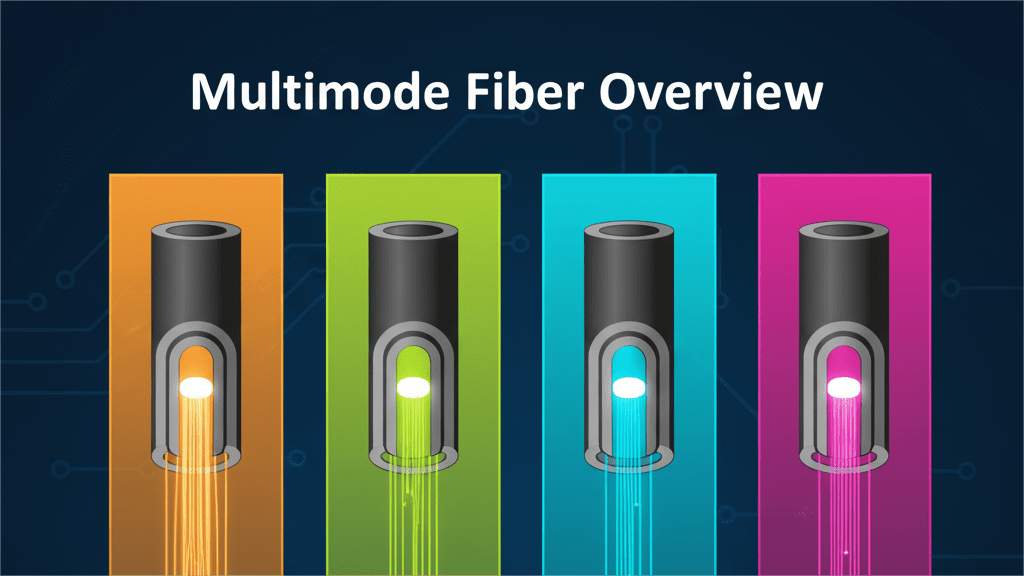

Multimode fiber is the short-reach optical fiber used in many data centers, enterprise LANs, campus backbones and equipment rooms. It uses a larger 50 um or 62.5 um core so multiple light paths can travel through the fiber at the same time. That makes multimode cabling practical and cost-efficient for high-speed links across racks, rows and buildings where long-haul single-mode reach is not required.
The main multimode fiber grades are OM1, OM2, OM3, OM4 and OM5. Older OM1 and OM2 fibers still appear in legacy networks, while laser-optimized OM3 and OM4 are common in modern 10G, 40G and 100G deployments. OM5 is a wideband multimode option used when the optics architecture is designed around SWDM or other wavelength-aware short-reach designs.
This guide compares multimode fiber types by core size, bandwidth, distance, jacket color, optics and upgrade path. It also links to PHILISUN OM3, OM4 and OM5 cabling options for real projects.
Multimode Fiber Quick Answer
Choose OM3 for many cost-sensitive 10G and short 40G links, OM4 for most new 40G and 100G data center cabling, and OM5 only when the design specifically benefits from wideband or SWDM operation. Keep OM1 and OM2 mainly for maintaining legacy networks rather than building new high-speed backbones.
What Is Multimode Fiber?
Multimode fiber (MMF) is an optical fiber with a larger core than single-mode fiber. Common multimode core sizes are 62.5 um for OM1 and 50 um for OM2, OM3, OM4 and OM5. The larger core allows easier light coupling and lower-cost short-reach optics, but modal dispersion limits the maximum reach compared with single-mode fiber.
In practical network design, multimode fiber is usually selected for short, dense links such as rack-to-rack connections, data center rows, server rooms, campus LAN backbones, storage networks and pre-terminated MPO cable assemblies. For long-haul, metro or carrier links, single-mode fiber is normally the better fit.
Multimode Fiber Types: OM1, OM2, OM3, OM4 and OM5
| Fiber type | Core size | Common color | Bandwidth at 850 nm | Typical role |
| OM1 | 62.5 um | Orange | 200 MHz-km | Legacy 1G and older LAN links |
| OM2 | 50 um | Orange | 500 MHz-km | Legacy enterprise and short 10G links |
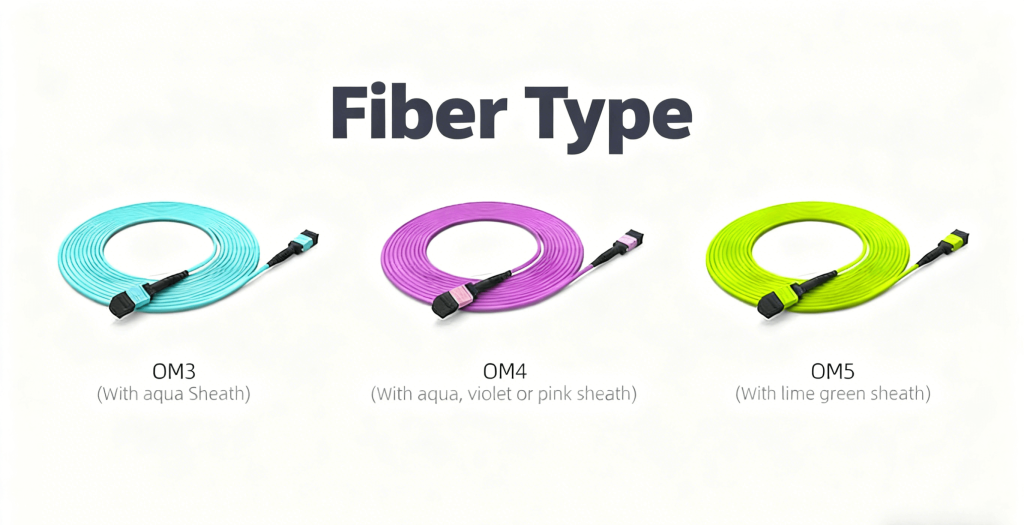
| OM3 | 50 um | Aqua | 2000 MHz-km | Laser-optimized 10G and short 40G/100G links |
| OM4 | 50 um | Aqua or violet | 4700 MHz-km | Mainstream 40G/100G data center cabling |
| OM5 | 50 um | Lime green | 4700 MHz-km at 850 nm, wideband support to 953 nm | SWDM and selected wideband multimode designs |
The biggest shift is from LED-optimized OM1/OM2 to laser-optimized OM3/OM4/OM5. Modern Ethernet optics such as 10GBASE-SR, 40GBASE-SR4 and 100GBASE-SR4 are normally designed around VCSEL light sources, so OM3 and OM4 are more relevant for new high-speed networks.
Multimode Fiber Distance and Speed Table
Distance depends on the transceiver, connector loss, splice loss, cable quality and link budget. The values below are common planning references for short-reach Ethernet links, not a replacement for the optical module datasheet.
| Ethernet speed | OM1 | OM2 | OM3 | OM4 | OM5 | Common optics |
| 1GBASE-SX | 275 m | 550 m | 550 m | 550 m | 550 m | 1G SX SFP |
| 10GBASE-SR | 33 m | 82 m | 300 m | 400 m | 400 m | 10G SFP+ SR |
| 40GBASE-SR4 | Not recommended | Not recommended | 100 m | 150 m | 150 m | 40G QSFP+ SR4 |
| 100GBASE-SR4 | Not recommended | Not recommended | 70 m | 100 m | 100 m | 100G QSFP28 SR4 |
| 400G short-reach parallel optics | Not recommended | Not recommended | Design-specific | Short-reach only | Short-reach or SWDM-specific | 400G QSFP-DD / OSFP |
For a deeper comparison of modern laser-optimized fibers, see the PHILISUN guide to OM3 vs OM4 vs OM5. For bandwidth and EMB details, see OM3 fiber vs OM4 fiber.
OM1, OM2, OM3, OM4 and OM5 Explained
OM1 Fiber
OM1 is a 62.5 um multimode fiber mainly found in older enterprise networks. It can still support legacy 1G links, but it is not a good foundation for new 10G, 40G or 100G projects. Mixing OM1 with 50 um multimode fiber can cause excessive loss, so legacy upgrades should identify the installed core size before replacing jumpers or modules.
OM2 Fiber
OM2 uses a 50 um core and offers more bandwidth than OM1, but it is still mostly a legacy fiber grade. It can support some short 10G links, yet OM3 or OM4 is usually a better choice when a new cabling path is being installed.
OM3 Fiber
OM3 is a laser-optimized multimode fiber commonly used for 10G links and shorter 40G or 100G multimode connections. It is a practical option when link distances are modest and the project needs a balance between cost and modern optical performance.
OM4 Fiber
OM4 improves on OM3 with higher effective modal bandwidth and longer practical reach for high-speed Ethernet. For most new MPO trunk cable backbones, 40G/100G data center links and high-density patching projects, OM4 is the safest mainstream multimode fiber choice.
OM5 Fiber
OM5 is wideband multimode fiber. It is designed to support transmission across multiple short wavelengths, which can help selected SWDM designs reduce fiber count. OM5 is not automatically better for every project; it should be chosen when the optics, roadmap and cabling architecture actually use its wideband capability.
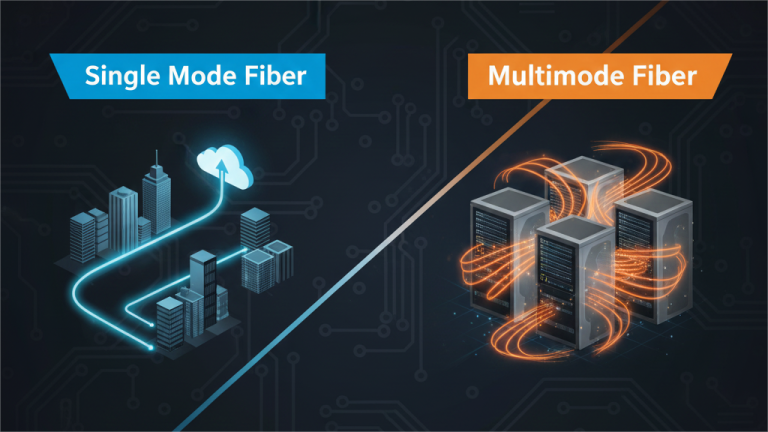
Single Mode vs Multimode Fiber
| Comparison point | Single-mode fiber | Multimode fiber |
| Core size | About 9 um | 50 um or 62.5 um |
| Typical reach | Long distance, metro and carrier links | Short-reach data center, LAN and campus links |
| Common optics | Laser-based LR, ER, ZR, CWDM, DWDM | LED or VCSEL-based SX, SR and SR4 |
| Typical cost profile | Higher optics cost, longer reach | Lower short-reach optics cost, easier coupling |
| Best fit | Long-haul, telecom, MAN, high-reach backbone | Equipment rooms, server rows, short data center links |
For a full decision framework, read Single Mode vs Multimode Fiber. In short, use multimode fiber when the link is short and dense, and use single-mode fiber when reach, future scaling and long-distance optical budgets matter more.
How to Choose Multimode Fiber
| Project scenario | Recommended approach | Why |
| Maintaining an existing 1G legacy LAN | Keep OM1 or OM2 only if the installed link tests cleanly | A full cable replacement may not be needed for low-speed legacy links |
| New 10G multimode links | Use OM3 or OM4 | Both are laser-optimized and align with 10G SR optics |
| New 40G or 100G data center backbone | Use OM4 in most cases | OM4 gives better margin and is widely deployed for high-speed SR links |
| SWDM or wavelength-aware multimode design | Evaluate OM5 | OM5 matters when the optics use its wideband capability |
| Mixed old and new cabling | Audit core size, connector type, loss budget and optics first | The lowest-grade fiber section limits the full channel |
PHILISUN Multimode Fiber Product Paths
PHILISUN supports multimode cabling projects with standard patch cords, MPO jumpers, trunk cables, cassette-based distribution, armored assemblies and compatible short-reach transceivers. Typical selection starts with the fiber grade, then connector format, polarity, fiber count, jacket, length and insertion loss target.
- OM3 Series: cost-effective laser-optimized multimode cabling for modern short-reach links.
- OM4 Series: mainstream choice for new 40G and 100G data center cabling.
- OM5 Series: wideband multimode option for SWDM-aware designs.
- MPO cassettes and enclosures: modular distribution from MPO backbone to LC equipment ports.
- Optical transceivers: match the module speed, wavelength, connector and supported fiber type to the link.
Migration and Testing Checklist
- Identify the existing fiber grade, core size and connector type before mixing old and new jumpers.
- Confirm the transceiver standard, such as 10GBASE-SR, 40GBASE-SR4 or 100GBASE-SR4.
- Check link distance against the module datasheet and the total channel loss budget.
- For MPO links, verify polarity, gender, fiber count and whether the design uses base-8, base-12, base-16 or base-24 cabling.
- Clean and inspect connectors before final testing; dirty connectors are a common cause of short-reach link instability.
Conclusion
Multimode fiber remains a practical choice for short-reach, high-density optical networks. OM1 and OM2 mainly support legacy environments, OM3 is useful for cost-sensitive modern links, OM4 is the mainstream choice for many new 40G and 100G data center deployments, and OM5 should be selected when the optical architecture benefits from wideband multimode transmission.
For project-specific OM fiber selection, PHILISUN can help match fiber grade, connector type, MPO structure, transceiver standard and link budget. Contact PHILISUN when you need a customized multimode fiber cabling plan.
Multimode Fiber FAQ
What is multimode fiber used for?
Multimode fiber is used for short-reach optical links in data centers, enterprise LANs, campus backbones, server rooms and storage networks. It is common where link distances are relatively short and lower-cost short-reach optics are preferred.
What is the difference between OM1, OM2, OM3, OM4 and OM5?
The main differences are core size, modal bandwidth, supported distance, jacket color and optical application. OM1 and OM2 are mostly legacy fibers, OM3 and OM4 are laser-optimized for modern high-speed links, and OM5 is a wideband multimode fiber for selected SWDM designs.
Which multimode fiber is best for 100G?
OM4 is usually the best practical choice for new 100G multimode cabling because it provides more margin than OM3 and is widely supported by 100G short-reach optics. OM3 can work on shorter links, while OM5 is mainly useful when the design specifically uses wideband or SWDM optics.
Can I mix OM1 with OM3 or OM4?
Mixing OM1 with OM3 or OM4 is not recommended because OM1 uses a 62.5 um core and OM3/OM4 use a 50 um core. The mismatch can create high insertion loss and unstable optical performance.
Is OM5 always better than OM4?
No. OM5 is better only when the network design benefits from its wideband capability, such as selected SWDM applications. For many standard 40G and 100G SR4 links, OM4 remains the more common and cost-effective choice.