
In high-speed fiber cabling, especially in data center and short-reach network deployments, OM3, OM4, and OM5 may look similar, but they differ significantly in transmission capacity, supported speeds, scalability, and cost.
When planning a network deployment, most teams are trying to answer a few very specific questions. Can an existing OM3 network still support current demand? Is OM4 the better choice for a new 100G link? Does OM5 offer real value over OM4? And when 400G is part of the roadmap, what should be considered before making a decision? These questions cannot be answered by looking at the label alone. Distance, optics, network architecture, and future expansion all need to be evaluated together.
This guide breaks down the core differences between OM3, OM4, and OM5 fiber to help you build a clear selection framework for your high-speed network cabling,especially in data center.
What is Multimode Fiber (MMF)?
Multimode fiber is designed for high-speed, short-distance transmission, typically within data centers and enterprise backbones. With a larger core (50 μm or 62.5 μm), it allows multiple light modes to propagate simultaneously. Usually paired with VCSEL (Vertical-Cavity Surface-Emitting Laser) sources, it operates primarily at 850 nm and 1300 nm wavelengths.
OM3 vs OM4 vs OM5
The summary table below provides a quick side-by-side comparison of OM3 vs OM4 vs OM5, making it easier to understand their key differences at a glance.
| Category | OM3 | OM4 | OM5 |
| Fiber Type | Laser-optimized multimode fiber | Laser-optimized multimode fiber | Wideband laser-optimized multimode fiber |
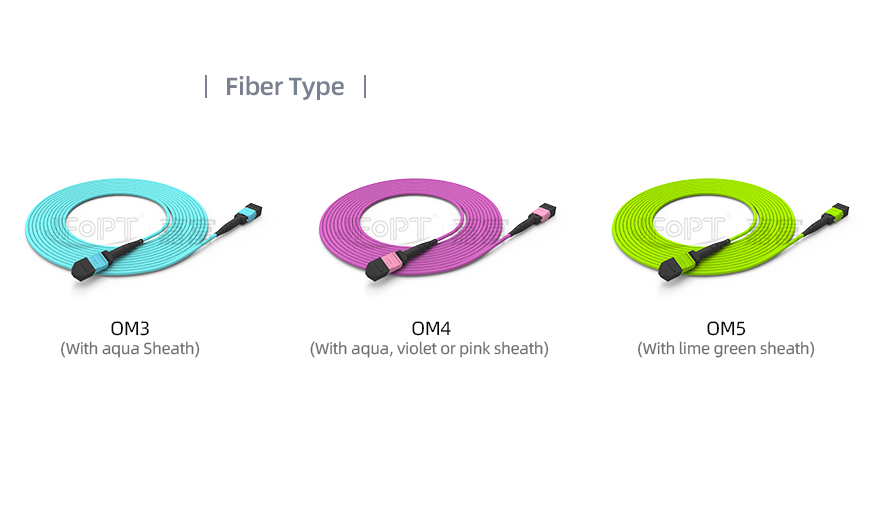
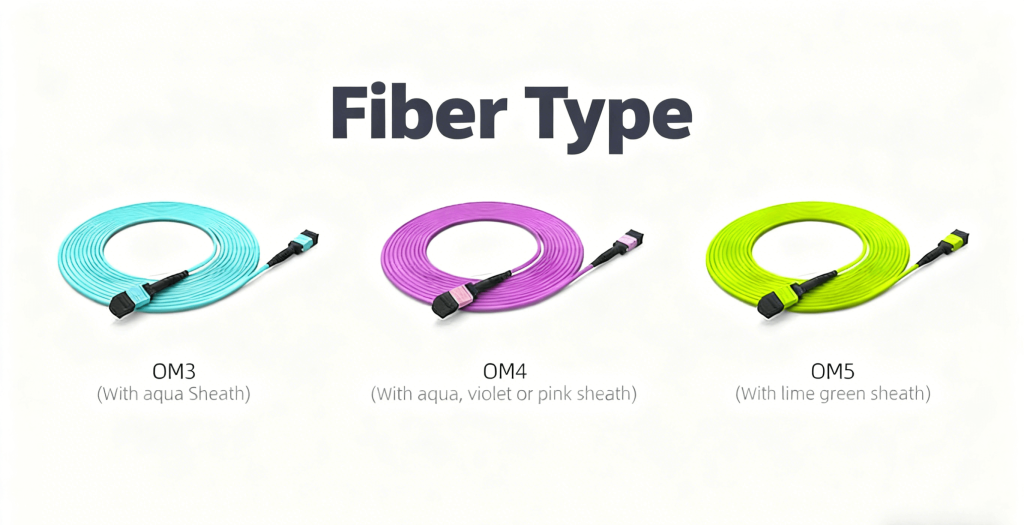
| Common Jacket Color | Aqua | Aqua / Violet | Lime Green |
| Effective Modal Bandwidth (EMB) | 2000 MHz·km @ 850nm | 4700 MHz·km @ 850nm | 4700 MHz·km @ 850nm; 2470 MHz·km @ 953nm |
| Typical Light Source | 850nm VCSEL | 850nm VCSEL | 850nm–953nm VCSEL / SWDM |
| Maximum Distance for 10G | 300 m | 400 m | 400 m |
| Maximum Distance for 40G | 100 m | 150 m | 150 m |
| Maximum Distance for 100G | 70 m | 100 m | 100 m |
| 400G Suitability | Not a mainstream choice | Supports certain short-reach parallel optics applications | Better suited for specific wideband applications |
| Typical Use Case | Legacy 10G and short-range links | 40G/100G data center backbone and interconnects | SWDM deployments and applications aiming to reduce fiber count |
From an overall positioning perspective, OM3 fiber is more suitable for legacy multimode deployments, OM4 remains the mainstream choice for most data center cabling projects, and OM5 is more relevant to specific SWDM and wideband application scenarios.
What Makes OM3, OM4, and OM5 Different?
What OM3, OM4, and OM5 Are?
OM3, OM4, and OM5 fiber are all laser-optimized multimode fiber types designed for short-reach, high-speed transmission. They are commonly used in data center interconnects, rack-to-rack cabling, pre-terminated backbone links, and other high-density multimode fiber applications.
What they share is that they all belong to the multimode fiber family. What sets them apart is that they do not offer the same performance level.
Why Their Transmission Performance Differs
To understand the difference between OM3, OM4, and OM5, two metrics matter most: modal bandwidth and effective modal bandwidth (EMB). These two factors determine how well a multimode fiber can control signal spreading during high-speed transmission, which affects the data rates and distances it can support.
What Is Modal Bandwidth?
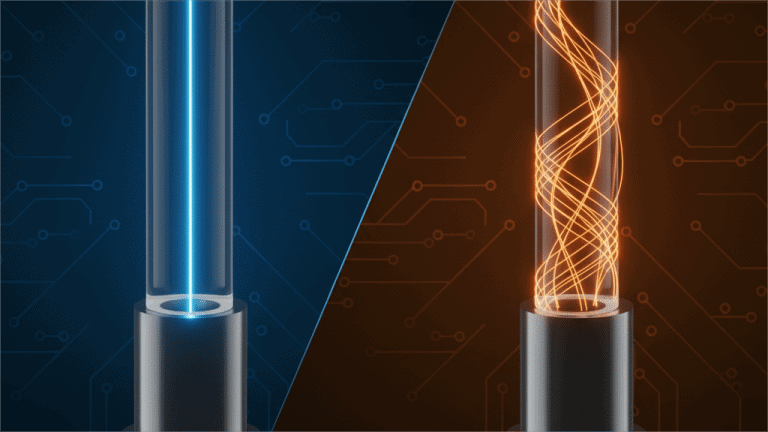
In a multimode fiber link, light travels through multiple paths at the same time. Because those paths do not have exactly the same travel time, the optical pulse gradually spreads out as distance increases. This pulse spreading can reduce signal quality in high-speed applications.
Modal bandwidth describes how well the fiber can maintain signal integrity under those conditions. A higher modal bandwidth generally means the fiber is better suited for carrying more data over longer distances.
What Is Effective Modal Bandwidth (EMB)?
For modern data center cabling applications using OM3, OM4, and OM5, traditional modal bandwidth alone is not enough. Since these fibers are typically used with VCSEL-based optics, effective modal bandwidth, or EMB, provides a more practical view of real-world performance.
EMB is especially relevant when evaluating 40G, 100G, and some higher-speed multimode links. Because OM4 and OM5 offer higher EMB, they usually perform better than OM3 in these higher-bandwidth scenarios.
Know more about modal bandwidth and effective modal bandwidth (EMB) in the OM3 fiber vs OM4 fiber bandwidth guide.
OM3 vs OM4 vs OM5 Transmission Distance Comparison
From a selection standpoint, transmission distance is one of the most practical ways to compare OM3 vs OM4 vs OM5 in real network deployment.
The table below provides a quick reference for typical OM3 vs OM4 vs OM5 distance performance across common Ethernet speeds.
| Ethernet Speed | OM3 | OM4 | OM5 | Typical Optics |
| 10GBASE-SR | 300 m | 400 m | 400 m | 10G SR optics |
| 40GBASE-SR4 | 100 m | 150 m | 150 m | 40G SR4 optics |
| 100GBASE-SR4 | 70 m | 100 m | 100 m | 100G SR4 optics |
| 100G SWDM4 | Not supported | Not supported | 150 m | SWDM4 optics |
| 400GBASE-SR8 | Not supported | 70 m | 70 m | 400G SR8 optics |
In terms of distance capability, the performance boundaries of OM3, OM4, and OM5 from 10G to 400G are already quite clear. The next step is to evaluate those numbers against the optics architecture and deployment model you are actually building.
How to Choose OM3, OM4, and OM5 for Different Network Cabling Scenarios
Existing 10G Networks and Incremental Expansion
If your current environment still runs mainly on 10G and already has a substantial OM3 installed base, there is usually no need to replace it simply because a newer fiber grade exists. A more practical approach is to review link length, interface type, and your upgrade plan over the next two to three years before making a change.
Without a clear near-term demand for higher-speed migration, OM3 fiber can still be a practical option for maintaining existing 10G links and other short-range connections.
New 40G / 100G Multimode Backbone Cabling
For new data center builds or new 40G and 100G multimode backbone links, OM4 fiber is usually the safer choice. Compared with OM3, it offers stronger transmission capability and better alignment with mainstream optics, pre-terminated MPO cabling, and common deployment requirements.
For most standard 100G-SR4 architectures, rack-to-rack interconnects, and pre-terminated backbone designs, OM4 remains the best multimode fiber for high-speed network deployments that need a balance of performance, maturity, and deployment efficiency.
Planning for 400G Upgrades
When planning a 400G migration, the key question is not whether you should automatically move to OM5. The better question is what optics architecture the link will use. Different 400G standards place different demands on fiber count, link distance, and cabling structure, and in some short-reach parallel optics scenarios, OM4 still covers real deployment needs.
In other words, if you are asking do I need OM5 for 400G, the answer depends less on the fiber label and more on the specific 400G architecture you are building.
Projects Built Around SWDM
If the project is designed around SWDM from the start, the value of OM5 becomes much clearer. The advantage of OM5 for SWDM is not that it replaces OM4 across the board, but that it supports a wider operating wavelength range and enables multi-wavelength transmission in a more targeted way.
For projects that aim to reduce fiber count, improve cabling density, and adopt a clear wideband roadmap, OM5 deserves closer evaluation.
OM4 vs OM5: How to Decide Which Is More Suitable?
For most standard 40G and 100G SR4 deployments, OM4 is usually the more practical choice because it aligns well with mainstream architectures and mature deployment practices.
The same applies to many 400G scenarios. OM5 becomes more relevant only when the project is built around SWDM or requires a wideband approach to improve fiber utilization and cabling density.
In short, the right choice depends on whether your optics architecture and upgrade path actually need what OM5 is designed to deliver.
PHILISUN Connectivity Solutions for OM3 / OM4 / OM5 Cabling
In multimode fiber deployments, fiber grade is only one part of the design. What also matters is how the connectivity solution is built around it.
For OM3, OM4, and OM5 projects, PHILISUN delivers a structured approach that combines backbone cabling, modular distribution, equipment-side interconnects, and breakout design tailored to real-world deployment scenarios.
Standard 40G / 100G Backbone Cabling
For standard OM4-based backbone deployments, a common solution is to use MPO trunk cable with MPO cassette and fiber enclosure. This setup is well suited to rack-to-rack interconnects, structured backbone layouts, and centralized cable management.
Modular Distribution and Fiber Management
Where cleaner routing, easier maintenance, and future expansion are priorities, MPO cassette and fiber enclosure provide a more modular solution than simple point-to-point cabling.
Short-Reach Equipment Interconnects
For short links inside the rack or between devices and patching units, MPO jumper is often the more efficient choice. It fits well in high-density 100G-SR4 environments and other short-reach multimode connections.
Physically Demanding Installations
In underfloor spaces, exposed pathways, or other demanding environments, MPO armored jumper offers better mechanical protection and improves link reliability.
Direct Fan-Out to Device Ports
When the design requires direct branching from the MPO backbone to multiple device-side ports, MPO harness or MPO breakout cable can simplify the connection path and improve deployment efficiency.
OM5 or SWDM-Based Projects
For projects built around OM5 fiber or SWDM, the fiber, connectivity structure, and optics architecture should be evaluated together. OM5-related configurations are most meaningful when the link design truly requires wider wavelength support.
How PHILISUN Supports Different Network Cabling Projects
Complete MPO Connectivity Support
PHILISUN helps build high-density fiber cabling solutions around OM4 backbone cabling, modular distribution, and equipment-side interconnects.
Flexible Configuration for Different Architectures
Solutions can be adapted to different fiber counts, connector formats, polarity options, rack structures, and installation conditions.
Customization for Project-Specific Requirements
PHILISUN supports customized MPO solutions based on different deployment goals, application scenarios, and structural requirements, helping customers match products more closely to actual project needs.
Support for Complex Installation Environments
For underfloor routing, exposed pathways, and other mechanically demanding conditions, armored MPO solutions can improve connection reliability.
Project Support from Design to Deployment
PHILISUN provides targeted support in solution matching, product configuration, and deployment planning to help projects move more smoothly from design to implementation.
Conclusion
The key to multimode fiber selection is not simply choosing the newest standard. What matters more is whether the fiber actually fits your network architecture and deployment goals. For data center and high-speed cabling projects, fiber grade only becomes meaningful when it is evaluated together with optics, link distance, and connectivity design.
If you are planning 40G, 100G, or 400G multimode backbone links, or looking for a more suitable pre-terminated cabling solution for your existing network, Feel free to contact PHILISUN to help you match the right fiber products and connectivity solution to your project requirements.
FAQs about OM3, OM4, and OM5
1. What is the main difference between OM3, OM4, and OM5?
The main difference between OM3, OM4, and OM5 lies in bandwidth capability, supported transmission distance, and suitability for different high-speed applications.
In practical terms, OM3 fiber is more suitable for earlier-generation high-speed networks, OM4 fiber is better aligned with mainstream data center deployments, and OM5 fiber is mainly used for specific SWDM applications.
2. Which is better for 100G, OM4 VS OM5
For standard 100G-SR4 deployments, OM4 vs OM5 for 100G is usually a practical comparison, and OM4 is often enough. It is more mature, more widely deployed, and generally more cost-effective. OM5 becomes more relevant only when the project is clearly built around SWDM.
3. Do I need OM5 for 400G upgrades?
Not necessarily. If you are asking do I need OM5 for 400G, the answer depends on the specific optics standard, link distance, and cabling architecture. In some short-reach parallel optics scenarios, OM4 fiber can still support real 400G deployment needs.
4. Can OM3 and OM4 be used in the same cabling system?
Yes, OM3 fiber and OM4 fiber can be used in the same cabling system, but overall performance will be limited by the lower-grade section. If any part of the cabling system uses OM3, the full channel should be evaluated based on OM3 performance rather than OM4 performance.
5. Are OM4 and OM5 compatible?
At the interface level, OM4 multimode fiber and OM5 multimode fiber are generally compatible because both can use common LC and MPO connectivity. However, physical compatibility does not mean equal performance. The final result still depends on how the full link is designed and validated.