NVIDIA H800 vs H100: NVLink Limits and AI Cluster Interconnect Design


The NVIDIA H100 Tensor Core GPU, built on the NVIDIA Hopper architecture, is designed for large language model training, generative AI, high-performance computing, and data center acceleration. With Tensor Cores, Transformer Engine, HBM memory, and high-speed NVLink, it delivers strong performance for AI training and inference, as well as scientific computing workloads.
To meet export control and compliance requirements, NVIDIA introduced the H800 Tensor Core GPU for certain restricted markets. Rather than being a new architecture, the H800 is a modified version of the H100 with specific performance limitations, especially in inter-GPU communication and high-precision computing.
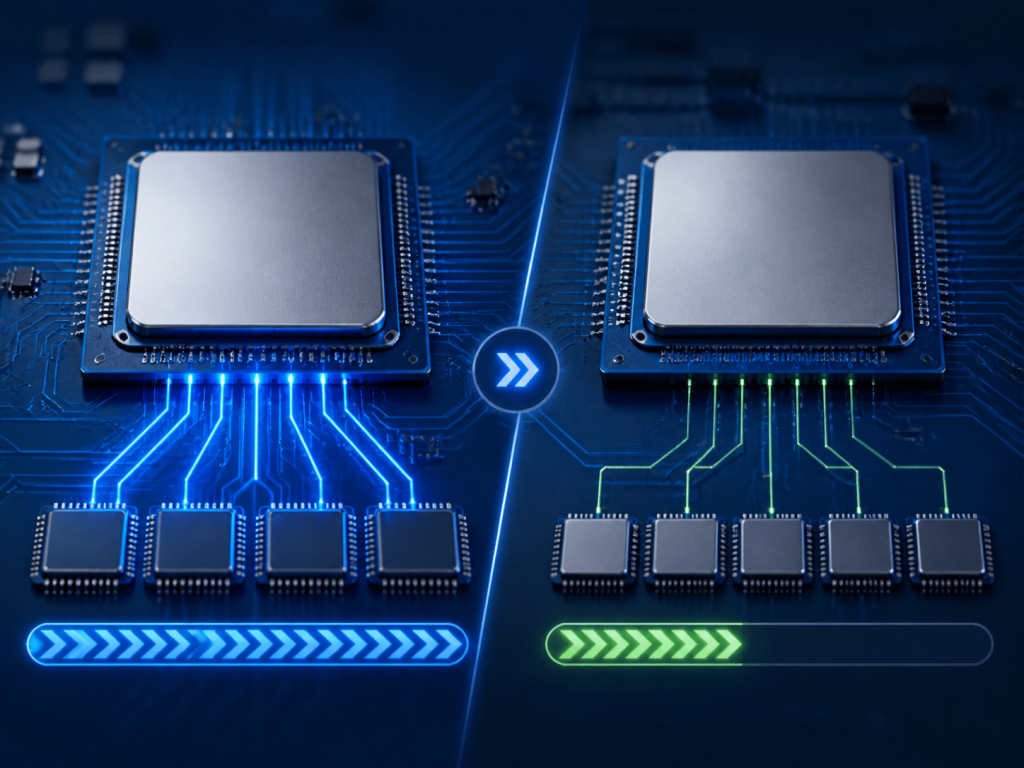
This article compares NVIDIA H800 vs H100 across core specifications, NVLink bandwidth, FP64 performance, AI training scalability, and AI cluster optical interconnect design. It also explains why high-speed AI cluster networking and optical interconnect design are critical to H800 and H100 GPU cluster performance.
Key Takeaway: NVIDIA H800 vs H100 Core Differences
The simplest way to look at it is this: The H800 is a Hopper-based variant derived from the H100 platform, configured with specific performance limitations for compliance-sensitive markets. In terms of basic architecture, process technology, and low-precision AI compute, the two GPUs are very similar. The real H800 vs H100 performance differences show up in NVLink bandwidth, FP64 capability, and multi-GPU scaling.
The H100 is the stronger choice for large-scale AI training, FP64-intensive HPC, and deployments that need the best possible GPU-to-GPU communication. The H800 can still handle AI training and inference, especially FP16, BF16, and FP8 workloads. But for large multi-GPU or multi-node AI training clusters, it needs more careful GPU cluster networking and external interconnect planning.
H800 vs H100 Core Specification Comparison
| Technical Specification | NVIDIA H100 SXM | NVIDIA H800 |
| GPU Architecture | Hopper | Hopper |
| Manufacturing Process | TSMC 4N | TSMC 4N |
| Transistor Count | Approx. 80 billion | Approx. 80 billion |
| GPU Memory | 80GB HBM3 | 80GB HBM2e / 94GB HBM3, depending on SKU |
| Memory Bandwidth | 3.35TB/s | 2TB/s / 3.9TB/s, depending on SKU |
| FP64 | 34 TFLOPS | Approx. 1 TFLOPS class |
| FP64 Tensor Core | 67 TFLOPS | Significantly limited |
| FP32 | 67 TFLOPS | Approx. 51 TFLOPS, depending on SKU |
| TF32 Tensor Core | 989 TFLOPS; up to 1,979 TFLOPS with sparsity | Approx. 756 TFLOPS, depending on SKU |
| FP16 / BF16 Tensor Core | 1,979 TFLOPS; up to 3,958 TFLOPS with sparsity | Approx. 1,513 TFLOPS, depending on SKU |
| FP8 Tensor Core | 3,958 TFLOPS; higher with sparsity | Approx. 3,026 TFLOPS, depending on SKU |
| NVLink Bandwidth | 900GB/s | 400GB/s |
| Maximum Power Consumption | Up to 700W | Approx. 350W / 400W, depending on SKU |
| Target Applications | High-end AI training, HPC, scientific computing | AI training, AI inference, restricted-market deployments |
| Cluster Networking Focus | High-performance compute and storage networking | Multi-node training requires careful external network design |
Note: GPU specifications may vary depending on SXM, PCIe, NVL versions, and server vendor configurations. The H100 data above mainly refers to NVIDIA H100 SXM specifications, while H800 data is based on publicly available server vendor specifications and commonly referenced configurations. Actual performance may vary depending on the specific GPU SKU, server platform, driver version, cooling design, and network topology.
Key Difference 1: NVLink Bandwidth and Multi-GPU Scaling Efficiency
What Is NVIDIA NVLink?
NVLink is NVIDIA’s high-speed interconnect technology for GPU-to-GPU communication. It enables low-latency, high-bandwidth data exchange among multiple GPUs inside a single server.

In large-scale AI training, model parameters, gradients, activations, and optimizer states often need to move frequently between GPUs. This makes NVLink bandwidth an important factor in multi-GPU scaling efficiency and overall AI training throughput.
H800 vs H100 NVLink Bandwidth
The H100 SXM/HGX platform offers stronger NVLink connectivity. The H100 NVLink bandwidth can reach up to 900GB/s of aggregate bidirectional bandwidth, enabling efficient communication across eight GPUs in HGX systems. This level of inter-GPU bandwidth is especially important for large-scale LLM training, model parallelism, tensor parallelism, data parallelism, and gradient synchronization.
By contrast, the H800 NVLink bandwidth is commonly limited to 400GB/s to meet specific compliance requirements. Compared with H100 SXM/HGX systems, the H800 has a clear limitation in intra-server GPU communication, especially when workloads depend heavily on frequent data exchange between GPUs.
How Reduced Bandwidth Impacts Cluster Performance
A drop in NVLink bandwidth creates cascading bottlenecks that undermine multi-GPU training efficiency and scalability.
First, GPU communication wait time may increase.
For compute-intensive workloads that require frequent synchronization, such as large-batch training, complex model architectures, model parallelism, tensor parallelism, and optimizer state synchronization, lower inter-GPU bandwidth can increase data exchange time and reduce overall training efficiency.
Second, multi-GPU scaling may reach a bottleneck earlier.
The H800 can still support AI training and inference, but as model size grows, communication density increases, or parallel strategies become more complex, its interconnect limitations become more noticeable. In these cases, adding more GPUs may deliver less performance improvement than on an H100-based system.
Third, external network design becomes more important in multi-node AI training.
400G InfiniBand or 400GbE cannot replace intra-server NVLink. However, stable 200G/400G optical interconnects can help reduce cross-server communication bottlenecks, preventing external network limitations from further affecting H800 cluster performance.
When evaluating an H800 cluster, it is important to look beyond single-GPU AI compute. Server-level interconnects, cross-node networking, communication library optimization, and overall system topology all play a role in real-world performance.
Key Difference 2: FP64 Performance and HPC Compatibility
Why FP64 Matters in HPC
Beyond AI training and inference, the H100 is widely used as an HPC GPU for scientific computing workloads. Many HPC applications rely heavily on FP64 double-precision computing, including molecular dynamics, computational fluid dynamics, climate simulation, astrophysics, nuclear physics, and high-fidelity scientific modeling.
H800 vs H100 FP64 Performance
- H100: The H100 offers strong FP64 and FP64 Tensor Core performance, making it suitable for FP64-intensive HPC workloads and AI-HPC applications.
- H800: The H800’s FP64 capability is heavily restricted compared with H100, with commonly cited figures placing it around the 1 TFLOPS class.
H800 Limitations in HPC Scenarios
Mismatched for Premium HPC Workloads
The drastic FP64 performance cut renders the H800 largely incompatible with traditional HPC applications reliant on high-fidelity double-precision computing. It is positioned exclusively as a GPU optimized for low-precision (FP16, BF16, FP8) AI training and inference.
Compliance-Driven Performance Restrictions
This limitation aligns with the core intent of export controls: restricting advanced hardware from being repurposed for dual-use general-purpose scientific supercomputing in regulated regions. The H800 is engineered to strictly adhere to such regulatory rules. While focused on AI training and inference, large-scale H800 cluster deployments still rely on resilient optical interconnect infrastructure.
AI Cluster Network Architecture: Roles of NVLink, InfiniBand, and Ethernet
In H800 or H100 AI clusters, raw GPU performance is only one part of the equation. AI cluster networking also plays a major role in real-world training efficiency and system stability. Intra-server GPU interconnects, cross-node compute networks, storage networks, and management networks each handle different parts of the cluster traffic.
Intra-Server GPU Interconnect: NVLink / NVSwitch
Inside a single 8-GPU server, GPU-to-GPU communication is handled primarily through NVLink / NVSwitch or PCIe. This layer depends on the server platform and GPU form factor. Optical transceivers are generally not involved in intra-server GPU communication.
Cross-Node Compute Network: 400G InfiniBand / 400GbE
When training workloads span multiple GPU servers, cross-node communication becomes critical. High-speed networks are used for gradient synchronization, parameter exchange, and distributed AI training traffic across nodes.
Common options include 400G NDR InfiniBand, 400GbE, 200G InfiniBand, and 200GbE. For large-scale LLM training, cross-node bandwidth, latency, congestion control, and link stability directly affect GPU cluster networking performance.
High-Speed Storage Network: 200G/400G Ethernet or RoCE
AI training requires continuous access to massive datasets and frequent writes of checkpoints, logs, and model weights. Storage networks often use 200G/400G Ethernet, NVMe-oF, RoCE, or other high-speed networking solutions to support data-intensive training workloads.
Management Network: Stable and Isolated
The management network handles server monitoring, remote administration, log collection, and operations control. It does not need to match the speed of the compute network, but it should remain isolated from training traffic to help maintain compute network stability.
400G InfiniBand vs 400GbE: Which Is Better for H800/H100 GPU Clusters?
Both 400G InfiniBand and 400GbE are widely used in high-speed AI cluster networking, but they are typically suited to different deployment needs.
400G NDR InfiniBand is often preferred for latency-sensitive AI training clusters. It is well suited for large-scale LLM training, multi-node synchronous training, high-frequency GPU-to-GPU communication across servers, and workloads that rely on low-latency RDMA.
400GbE fits seamlessly into standard Ethernet-based AI data centers. It features high standardization, a mature ecosystem and easy integration with existing data center infrastructure, making it perfect for AI inference, storage networking, enterprise AI platforms and cost-optimized deployments.
The right network depends on several factors:
- GPU cluster scale
- Workload type: training or inference
- Switch ecosystem and compatibility
- Network adapter interface
- RDMA or RoCE requirements
- Rack layout and cabling distance
- Budget, power consumption, and operations capability
Deployment Best Practices for H800 Clusters
When planning an H800 cluster deployment, raw GPU compute performance should not be the only consideration. Server count, power draw, cooling, network topology, optical interconnect links, and software communication optimization all affect real-world performance.
Because the H800 has limitations in NVLink bandwidth and FP64 performance, a system-level design is needed to reduce additional bottlenecks in large-scale AI workloads.
TCO Optimization
To achieve training throughput comparable to H100 clusters in large-scale AI workloads, H800 deployments demand careful planning of GPU quantity, server density, switch port allocation, cabinet power consumption and cooling capacity. Proper selection of DAC, AOC or 400G optical transceivers balances link distance, power usage, cost and deployment complexity.
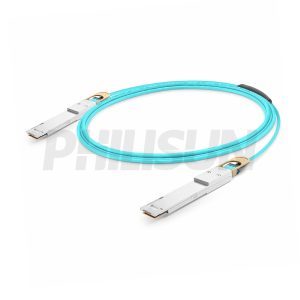
Philisun 400G QSFP DD AOC Cable
Software & Network Co-Optimization
For communication-intensive models, optimize parallel strategies, adjust batch sizes, leverage communication acceleration libraries and eliminate unnecessary data synchronization to ease inter-GPU communication pressure.
Optical Interconnect Sizing & Selection
H800 cluster deployment does not require over-specifying optical hardware. Instead, select tailored 200G/400G InfiniBand or Ethernet interconnect solutions based on cluster scale, network topology, link distance and workload characteristics.
Key selection criteria:
- Switch and server port form factors (OSFP, QSFP-DD, QSFP56)
- Link distance (in-cabinet, cross-cabinet, cross-data center)
- Network type (InfiniBand, Ethernet, RoCE)
- Application scenario (AI training, inference, high-speed storage access)
- Transceiver power consumption, thermal tolerance, FEC configuration and compatibility
Philisun Optical Interconnect Solutions for AI Clusters
In H800 and H100 AI clusters, GPU compute performance can only be fully utilized when the network, storage, and optical interconnect infrastructure are stable enough to support it. In multi-node training, insufficient cross-node bandwidth, unstable links, high bit error rates, or compatibility issues can lead to GPU idle time, lower training throughput, or even interrupted workloads.
Philisun provides high-speed AI cluster optical interconnect products and selection support for AI data centers, GPU server clusters, storage networks, and leaf-spine architectures. Its solutions cover 200G/400G InfiniBand and Ethernet environments, including optical transceivers, DAC, and AOC cables for different link distances, port types, and network topologies.
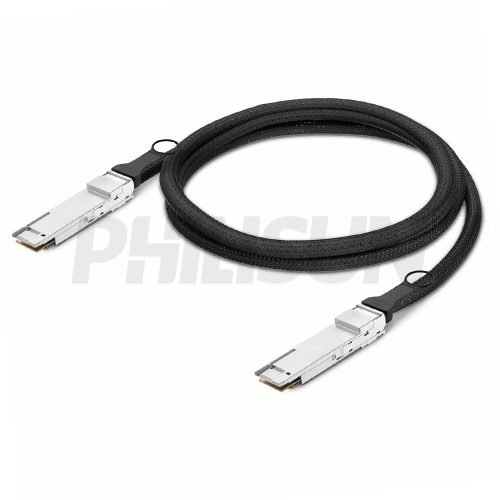
Philisun 400G QSFP-DD DAC Cables
200G/400G InfiniBand and Ethernet Product Coverage
Philisun offers 200G/400G optical transceivers, DAC, and AOC cables for AI data center applications, including server-to-switch, switch-to-switch, compute network, and storage network connections.
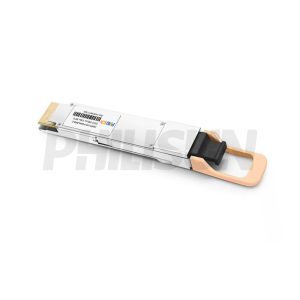
Product types include:
- 400G QSFP-DD optical transceivers
- 200G QSFP56 optical transceivers
- 400G DAC high-speed copper cables
- 400G AOC active optical cables
Selection Support by Distance, Topology, and Port Form Factor
AI clusters have different requirements for link distance, power consumption, cost, and cabling. Philisun can help select suitable fiber solutions based on rack layout, link distance, switch ports, network adapter interfaces, and fiber type.
This helps customers build a more reliable GPU cluster optical interconnect while avoiding over-specification or under-provisioning.
Compatibility Validation and Deployment Risk Reduction
Optical transceiver compatibility directly affects AI cluster network stability. Philisun provides adaptation recommendations and compatibility validation based on customers’ existing switches, network adapters, link modes, and FEC settings, helping reduce deployment risks and operational costs.
Beyond supplying standalone optical components, Philisun helps customers build high-bandwidth, low-latency, and scalable optical interconnect infrastructure for H800/H100 GPU clusters.
Conclusion: H800 Positioning, Limitations & Optical Interconnect Optimization Roadmap
H800 is a performance-constrained variant of the H100 shaped by geopolitical export regulations, optimized primarily for low-precision AI training and inference. Its inherent intra-server bandwidth shortcomings can be effectively offset with professional optical interconnect design. Choosing the right optical transceivers is critical to unlocking full performance from H800 clusters.
Philisun’s 200G/400G optical transceiver and cabling portfolio stands as the optimal solution to maximize H800 cluster performance. Explore Philisun’s high-performance optical products today to maximize the ROI of your H800/H100 AI cluster investment.
FAQ: H800 vs H100 & AI Cluster Optical Interconnect Basics
Q1: What is the main difference between NVIDIA H800 and H100?
Both GPUs adopt the NVIDIA Hopper architecture, with the H800 built as a regulated restricted-market variant. Core differences lie in NVLink interconnect bandwidth and FP64 double-precision computing performance. The H100 targets high-end AI training and HPC, while the H800 is optimized for mainstream AI training and inference deployments.
Q2: Is the H800 suitable for large language model training?
The H800 supports LLM training and inference, particularly for FP16, BF16 and FP8 low-precision workloads. However, due to capped NVLink bandwidth, it delivers inferior scaling efficiency in large-scale multi-GPU and multi-node training, requiring refined network design and parallel strategy tuning.
Q3: Why do H800 clusters require 400G InfiniBand or 400GbE?
Multi-node AI training demands frequent gradient synchronization, parameter exchange and training data transmission across GPU servers. 400G InfiniBand and 400GbE deliver higher bandwidth and lower latency, preventing cross-node networks from becoming secondary bottlenecks for H800 clusters.
Q4: Can 400G optical transceivers replace NVLink?
No. NVLink handles high-speed intra-server GPU-to-GPU communication, while 400G optical transceivers serve external network connections between servers, switches and storage devices. They fulfill distinct roles yet both are vital to overall AI cluster performance.
Q5: Which optical transceivers are suitable for H800/H100 AI clusters?
Common options include 400G OSFP, 400G QSFP-DD, 400G SR4/SR8, 400G DR4, 400G FR4, 200G QSFP56, plus 400G DAC and 400G AOC. Final selection depends on switch port type, network adapter interface, link distance, fiber specification, power constraints and budget.
Q6: Should H800 clusters use InfiniBand or Ethernet?
Opt for 400G NDR InfiniBand for large-scale AI training with strict latency and synchronization efficiency demands. Choose 400GbE for cost efficiency, universal compatibility, storage networking integration and alignment with existing data center architectures.
Q7: What support can Philisun offer for H800/H100 clusters?
Philisun supplies 200G/400G InfiniBand and Ethernet optical transceivers, DAC, AOC and end-to-end high-speed interconnect solutions. We provide customized sizing recommendations based on your GPU servers, switches, network adapters, link distance and network topology, enabling stable, high-bandwidth and scalable optical interconnect deployment for AI clusters.
Building AI or HPC clusters? PHILISUN can help you choose high-speed AOC/DAC cables, optical transceivers, and fiber cabling solutions. Contact us for a practical connectivity recommendation.