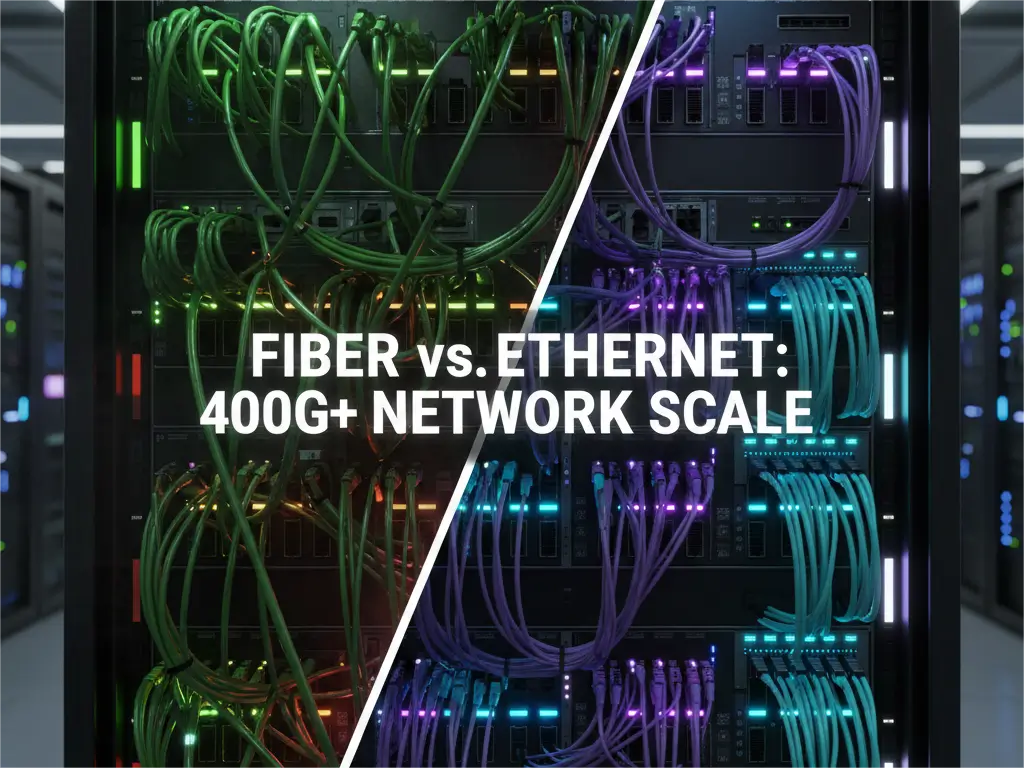

The choice between fiber vs Ethernet cables defines the future performance and scalability of any modern network. While Ethernet (copper) dominates desktop connections, its limitations in bandwidth, distance, and security severely restrict growth beyond 10G. This guide provides a definitive comparison of these two core technologies. We will examine seven critical differences to help you determine when copper cabling hits its ceiling. Crucially, we explain why fiber optics, with its near-limitless potential, is the only sustainable choice for modern AI and cloud infrastructure.
Bandwidth Showdown: Can Copper Go Beyond 10G Speeds?
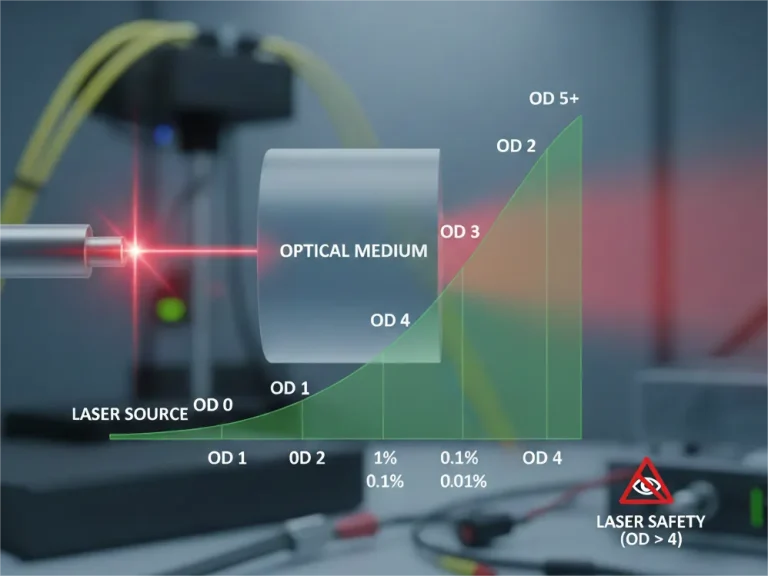
The primary differentiator between copper Ethernet and fiber optics is bandwidth capacity. Standard Category 6A (Cat 6A) copper cable reliably supports 10 Gigabit Ethernet (10GBASE-T) over 100 meters. Pushing copper beyond this—to 25G, 40G, or 100G—introduces severe distance limitations and signal integrity challenges. Fiber optics, conversely, uses light signals instead of electrical pulses. This fundamental shift allows it to carry vast amounts of data—hundreds of terabits per second—over a single strand, making its bandwidth virtually limitless for current applications.
Why Fiber is Essential for 400G/800G Data Center Architectures
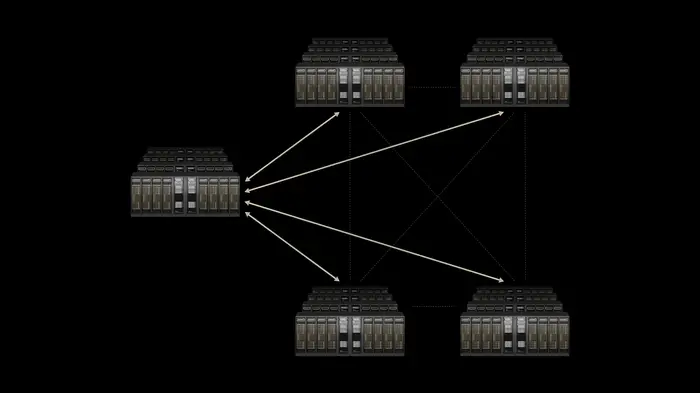
Modern hyperscale data centers and AI superclusters operate at 400G and are rapidly migrating to 800G interconnects. At these speeds, copper cables are relegated to very short DAC (Direct Attach Cable) connections, typically less than 3 meters. Any critical link, such as switch-to-switch or core-to-leaf, must use fiber optics. This infrastructure relies on high-speed QSFP-DD and OSFP modules, which can only function with fiber, making the fiber vs Ethernet choice clear for core networks.
The Hidden Power and Thermal Constraint of High-Speed Copper
High-speed copper transmission (e.g., 25GBASE-T) requires sophisticated signal processing and equalization circuitry. This significantly increases the power consumption and heat generation within the transceiver port. Fiber optic transceivers, while requiring power, are often more thermally efficient per bit of transmitted data, especially over longer distances. This thermal efficiency is a crucial factor in calculating the Total Cost of Ownership (TCO) for large-scale data centers.
Distance and Latency: When Does Copper Become Impractical?
Distance is copper’s most restrictive limitation. Even optimized Category 8 copper is limited to 30 meters for 40G applications. Fiber optics, however, can transmit data hundreds of meters (multi-mode fiber, OM4/OM5) or tens of kilometers (single-mode fiber, OS2) without signal repeaters.
Is Fiber Always Lower Latency Than Copper? (Impact on HPC/AI)
While the propagation speed of light in glass is slightly slower than the electrical signal in copper, fiber optics offer a significant advantage in effective latency. This is because copper cables operating at high speeds require extensive Forward Error Correction (FEC) and signal re-timing. These processes introduce unavoidable, measurable latency. For High-Performance Computing (HPC) and AI collective communication, where microsecond delays can cripple performance, fiber offers the cleanest, lowest-latency path.
Cost and Complexity: Initial Investment vs. Lifetime TCO
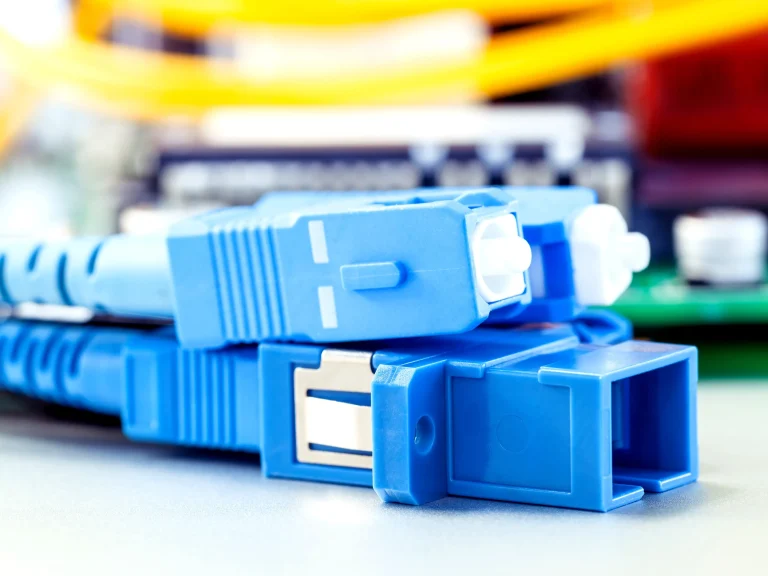
The initial investment for copper Ethernet cabling is lower. The cable itself and the RJ45 connectors are inexpensive. Fiber requires higher-cost components: the optical cable, the transceivers (SFP, QSFP), and the specialized termination tools.
Does Pre-Terminated Fiber (MPO) Reduce Installation Labor and Time?
The primary cost of fiber deployment historically involved expensive, time-consuming on-site fusion splicing and field termination. However, modern deployment relies heavily on pre-terminated fiber cable assemblies, such as those provided by PHILISUN. These solutions utilize factory-polished, high-density MPO/MTP connectors. They arrive ready to install, drastically reducing labor time, eliminating human error, and ensuring superior link loss performance. This approach flips the cost dynamic: a reduced installation timeline means a lower TCO over the network’s lifecycle, mitigating the initial component cost.
Security and Interference: Which Cable is Immune to EMI?
Fiber optic cable is entirely non-metallic, meaning it is immune to electromagnetic interference (EMI) and radio frequency interference (RFI). It does not conduct electricity and is impossible to tap without physically cutting the glass, which results in a detectable loss of light.
Why Fiber is the Preferred Choice for Industrial and Medical Environments
In environments with heavy machinery, high-voltage equipment, or sensitive medical devices, EMI from copper cabling can cause data errors or network instability. Fiber’s EMI immunity makes it the mandatory choice for industrial automation, utility substations, and medical imaging facilities. For mission-critical security and data integrity, fiber offers unparalleled protection.
PHILISUN’s Strategic Fiber Solutions for Hyperscale Migration
For network planners facing the fiber vs Ethernet challenge in upgrading their backbone, the focus must shift from simply buying cable to sourcing validated, high-performance optical infrastructure. PHILISUN specializes in high-density and high-speed optical modules and cable assemblies designed to simplify complex network migrations.
We ensure that your migration path to 400G and 800G is seamless. This includes providing fully compatible QSFP/OSFP transceivers and custom-length MPO cable assemblies. Our products are engineered for quick deployment, minimizing infrastructure bulk while maximizing port density.
Selecting the Right Fiber Type: OS2 vs. OM4 for Your Network Core
- OM4 (Multi-mode): Best for short-reach, high-speed links (up to 400m for 10G, shorter for 40G/100G) within a single data center building or campus. It is often used with VCSEL-based optics for lower power consumption.
- OS2 (Single-mode): Essential for long-haul links (up to 10-40km), campus backbones, and future-proofing. It offers essentially unlimited bandwidth potential and is the standard for high-speed, long-distance communication.
Conclusion
The debate over fiber vs Ethernet is fundamentally a discussion about network limitations. While copper remains viable for desktop access, fiber optics is the only technology that offers the bandwidth, distance, security, and TCO benefits necessary to support the 400G and 800G architectures of tomorrow. Choosing fiber is not just a technology upgrade; it is a strategic investment in the future capacity and resilience of your organization.
Ready to future-proof your network with high-performance optical solutions?
Contact the PHILISUN sales team today for a consultation on selecting the optimal transceivers and pre-terminated MPO assemblies for your network core.