Choosing the right fiber connector is perhaps the most critical—yet often overlooked—step in designing a stable, high-performance fiber optic network. Selecting the wrong connector type can lead to unnecessary cabling bulk, higher installation costs, and future upgrade difficulties. Whether you are building a hyperscale data center, upgrading an enterprise network, or deploying Fiber-to-the-Home (FTTH), this comprehensive guide will help you compare the essential LC, SC, and MPO fiber connector types. We will show you which connector is best for your specific application.
The Data Center Standard: Why LC and MPO Fiber Connectors Dominate
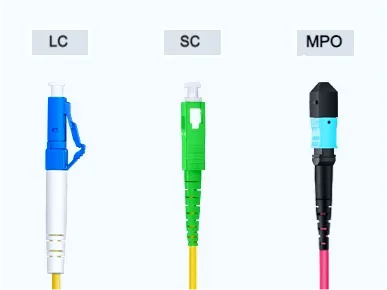
In the data center environment, the top priorities are density, speed, and ease of management. This is where the LC and MPO fiber connector families truly shine.
High-Density Cabling: When to Choose MPO over LC for Server Racks
The LC (Lucent Connector) remains the gold standard for individual, duplex connections in server racks and patch panels due to its compact size and secure latch mechanism.
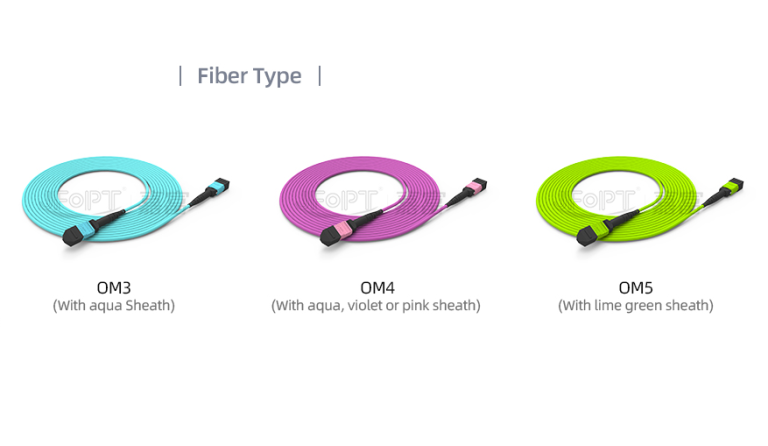
However, once networks move beyond 10G to 40G, 100G, and 400G, the MPO (Multi-fiber Push-On) connector becomes indispensable. The MPO connector integrates 8, 12, or 24 fibers into a single ferrule, allowing instantaneous deployment of high-bandwidth links. You must choose MPO when:
- High-Speed Parallel Optics: Connecting QSFP+ (40G) or QSFP28 (100G) transceivers, which require parallel transmission across multiple fibers.
- Trunking: Consolidating hundreds of fibers from an MDA (Main Distribution Area) to a ZDA (Zone Distribution Area) to minimize cable management complexity.
FTTH and Telecom Networks: When is SC Fiber Connector the Most Cost-Effective Choice?
The SC (Subscriber Connector), known for its simple push-pull mechanism and larger size, is less common in internal data center cabling but still holds a significant advantage in telecommunications and local loop environments.
SC connectors are typically used in FTTH (Fiber-to-the-Home) deployments because:
- Cost-Effectiveness: SC connectors and their termination tools are often simpler and cheaper, making them ideal for high-volume residential installations.
- Ease of Termination: The connector’s large size makes field termination easier for technicians working on site.
- Durability: SC is robust and widely accepted as the standard optical termination point inside a customer premise.
The Role of the Robust FC Fiber Connector in Specialized Industrial Settings
While LC, SC, and MPO dominate commercial applications, the FC (Ferrule Connector)—a screw-on, threaded connector—is still preferred in high-vibration or specialized industrial and medical environments. Its screw-on coupling mechanism provides high resistance to motion and superior mechanical stability, ensuring the connection remains solid even under stress.
Cost and Installation: Comparing the Termination and Deployment Costs of Fiber Connector Types
When evaluating the total cost of ownership (TCO) for a cabling project, installation time and materials are often more expensive than the cable itself.
| Metric | LC/SC (Field Terminated) | MPO (Pre-Terminated) |
| Typical Insertion Loss | 0.25 dB – 0.50 dB (Field Spliced) | < 0.35 dB (Factory Polished) |
| Labor Cost | High (Requires fusion splicer and highly trained technician) | Low (Plug-and-play installation) |
| Installation Time | 5-10 minutes per fiber pair | Seconds per 12-fiber link |
| Best for | Low-count, single-mode, long-distance runs | High-count, multi-fiber, intra-data center runs |
Choosing pre-terminated solutions from PHILISUN drastically reduces on-site labor costs and virtually eliminates human error, regardless of whether you choose LC or MPO fiber connector types.
PHILISUN’s Solution Kits: Get a Complete, Pre-Terminated Fiber Connector Package
At PHILISUN, we believe the best fiber connector is a pre-terminated one. We specialize in providing end-to-end, tested fiber solutions that simplify your deployment and guarantee minimal insertion loss across the entire link.
Custom Length and Jacket Options for Simplex Fiber Optic Patch Cord Series
For all your LC and SC connectivity needs, our Simplex and Duplex patch cords are manufactured with top-grade ferrules and precision polishing. This ensures that every individual connection meets or exceeds industry standards for low loss.
We offer extensive customization options for our Simplex Fiber Optic Patch Cord Series, including:
- Custom lengths (down to 0.5m increments)
- Various jacket ratings (LSZH, Plenum, Riser)
- Multimode (OM3/OM4) and Single-mode (OS2) options
Simplifying Breakout with Pre-Assembled MPO Jumpers Series for 40G/100G
The complexity of MPO systems (polarity and gender) can cause major installation delays. Our pre-assembled MPO solutions solve this problem by ensuring correct Type A, B, or C polarity and proper male/female pin configuration straight from the factory.
Use our high-quality MPO Jumpers Series when:
- Connecting MPO-to-LC modules (fanout) at the rack.
- Connecting trunk cables directly to QSFP transceivers (MPO to MPO).
This plug-and-play approach eliminates the need for expensive MPO field testing and significantly speeds up high-density deployments.
Future-Proofing: How to Ensure Your Fiber Connector Supports Future 800G Speeds
The next generation of networking demands higher fiber density and reduced component size. While current 400G networks heavily rely on 16/24-fiber MPO connectors, the trend towards 800G (and beyond) will push the limits of existing connector tolerances.
When sourcing fiber connector assemblies today, focus on products that meet the strictest end-face geometry standards (Telcordia GR-326 CORE). This includes high-precision factory polishing and 100% inspection, a standard practice at PHILISUN, ensuring that your current cabling will be ready to handle the tighter power budget and loss requirements of future ultra-high-speed transceivers.
Conclusion
The decision between an LC, SC, or MPO fiber connector is a strategic one that defines your network’s future. By matching the right connector type to your application—be it LC for high-density enterprise or MPO for high-bandwidth data centers—you set the stage for success.
Don’t compromise on quality or risk costly installation errors.
Take the next step: Contact a PHILISUN fiber expert today to request a quote for your next cabling project and simplify your path to high-speed connectivity.