
What is an SFP Transceiver and How Does It Work?
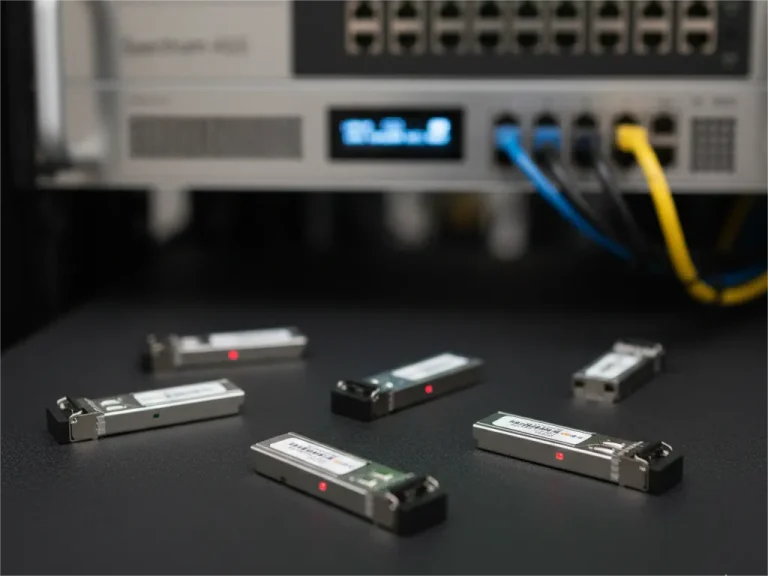
The SFP (Small Form-factor Pluggable) is a standardized, hot-pluggable transceiver module used in network switches and routers. It replaced the larger GBIC (Gigabit Interface Converter) to offer higher port density.
- Core Function: The SFP’s main role is electro-optical conversion. It takes electrical data from a switch’s ASIC (Application-Specific Integrated Circuit) and converts it into light pulses via its laser (transmitter, Tx), sending it over a fiber optic cable. The process is reversed by the photodetector (receiver, Rx) at the other end.
- MSA (Multi-Source Agreement): The SFP’s success hinges on the MSA, an agreement among multiple manufacturers. The MSA ensures that SFP transceivers adhere to standardized physical dimensions and electrical interfaces, allowing modules from different companies to work interchangeably in compliant ports.
The SFP Family: Speed and Size Evolution
To meet the demands of escalating network speeds, the original SFP form factor has evolved while generally maintaining its compact footprint:
- SFP (1G): The original standard, supporting speeds up to 1.25 Gbps (Gigabit Ethernet).
- SFP+ (10G): The successor, maintaining the same physical size but optimized for 10Gbps data rates.
- SFP28 (25G): Used heavily in modern server interconnects and 25G spine/leaf networks.
- QSFP (Quad SFP): A physically larger form factor that supports 40G and higher (100G, 400G). It achieves this speed by combining four or more parallel lanes of SFP signaling into one module.
SFP Module Types Based on Application
The specific type of SFP chosen depends entirely on the required distance, the fiber type used, and the necessary bandwidth.
SFP Module Types by Media and Distance
- Fiber Optic Modules (Optical): These are classified primarily by their distance capability and the wavelength of light they use:
- Distance (Reach): Modules are labeled SR (Short Reach), LR (Long Reach), ER (Extended Reach), and ZR (Z-Extended Reach), covering distances from 300m up to 80km.
- Specialized Types: Includes BiDi (Bi-directional) SFP modules, which use WDM technology to send and receive data over a single fiber strand, and CWDM/DWDM modules for high-capacity, long-distance transmission over dedicated wavelengths.
- Copper Modules (Electrical):
- 1000BASE-T (RJ-45): Allows an SFP port to connect directly to copper Ethernet cabling.
- DAC (Direct Attach Cable): Passive and Active copper cables that bypass the optics entirely for very short-reach, high-speed connections (25G/100G) inside the rack.
- PHILISUN Product Mapping: PHILISUN provides a complete and verified range of SFP, SFP+, SFP28, and QSFP transceiver modules, ensuring a solution for every distance and speed requirement.
The Crucial Difference: Single-Mode vs. Multimode SFPs
It is vital to match the transceiver type to the physical cable plant:
- Multimode SFPs (e.g., SFP-GE-S) operate at 850nm and use VCSEL (Vertical-Cavity Surface-Emitting Laser) technology, requiring Multimode (OM) fiber. These are typically used for distances under 550m.
- Single-Mode SFPs (e.g., SFP-GE-L) operate at 1310nm or 1550nm and use DFB (Distributed Feedback) lasers, requiring Single-Mode (OS2) fiber for long distances.
The Buyer’s Choice – Compatibility and Advanced Features
The Compatibility Challenge and Vendor Locking
The primary hurdle in SFP procurement is ensuring the module is recognized by the host equipment. Major switch vendors (like Cisco, Juniper, HPE) embed proprietary digital signatures into their hardware. If the transceiver’s code does not match the expected signature, the switch will often disable the port.
- The Solution (Third-Party Transceivers): High-quality third-party vendors (like PHILISUN) program their modules with the correct digital code to simulate the OEM original. This offers:
- Cost Savings: Significant reduction in Total Cost of Ownership (TCO) compared to OEM parts.
- Testing: PHILISUN ensures 100% compatibility by testing its programmed transceivers in the actual OEM equipment.
Advanced Features for Network Monitoring
- Digital Optical Monitoring (DOM): The DOM feature (also known as DDM) is a critical specification outlined in the SFF-8472 standard.
- What it Monitors: DOM provides administrators with real-time diagnostics of the transceiver’s performance, including temperature, laser bias current, transmitted optical power (Tx), and received optical power (Rx).
- Buyer Benefit: DOM is essential for proactive network troubleshooting, quickly identifying failing components or degraded fiber links before a total outage occurs.
Procurement & Future-Proofing
SFP in the Age of 400G and 800G
Even as core networks move to 400G QSFP-DD, the 10G SFP+ and 25G SFP28 remain foundational for server connectivity and access layer switches.
- Breakout Cables: The most common use case is connecting a high-speed 400G QSFP port to four separate 100G or 25G SFP ports using breakout cables (e.g., QSFP to 4x SFP28).
- PHILISUN Integration: PHILISUN ensures its latest 400G and 800G Transceivers are compatible with the entire range of industry-standard SFP+ and SFP28 modules via rigorously tested breakout assemblies.
The PHILISUN Quality & Support Advantage
Choosing a transceiver requires assurance that it will perform reliably and integrate seamlessly.
- Pre-Programming & Testing: Every PHILISUN SFP Transceiver is pre-coded to the customer’s specified switch and undergoes rigorous functional testing in the target OEM hardware before shipping.
- Certification: PHILISUN guarantees adherence to all Multi-Source Agreement (MSA) and IEEE standards, ensuring quality that meets or exceeds OEM specifications.
Conclusion
Selecting the right SFP Transceiver is a strategic network decision. By choosing rigorously tested, high-quality modules, such as those provided by PHILISUN, you can ensure your network runs at its peak, regardless of the OEM brand.
PHILISUN offers a complete range of certified, 100% compatible SFP, SFP+, and QSFP transceivers for all major brands.
Contact us today for a compatibility consultation and quote.
Frequently Asked Questions (FAQ)
- Q: Can I mix and match SFP Transceivers from different vendors?
- A: Yes, provided the third-party transceiver is programmed with the correct vendor code (digital signature) to ensure hardware recognition. Quality third-party vendors like PHILISUN ensure this 100% compatibility.
- Q: What does the “P” mean in SFP+?
- A: The “P” in SFP+ stands for Pluggable (Small Form-factor Pluggable Plus). It signifies the module’s ability to handle 10Gbps speeds while retaining the compact form factor of the original SFP.
- Q: Should I choose an SFP or a QSFP module for my 40G link?
- A: You must choose a QSFP module. QSFP (Quad SFP) is designed to handle 40G by using four parallel 10G lanes. The original SFP has a 1G limitation.
- Q: What is the benefit of the DOM feature in an SFP transceiver?
- A: Digital Optical Monitoring (DOM) allows network administrators to monitor the transceiver’s performance in real-time, checking critical parameters like temperature, power levels, and voltage, which is essential for proactive maintenance and troubleshooting.
- Q: Are PHILISUN transceivers guaranteed to work with Cisco/Juniper/HPE equipment?
- A: Yes. PHILISUN transceivers are rigorously tested in OEM equipment and pre-coded to ensure seamless, guaranteed compatibility with all major network hardware brands, providing a high-quality alternative to proprietary modules.