
Understanding the distinctions between SFP vs SFP+ vs QSFP vs QSFP28 is crucial for future-proofing your network infrastructure. These small, hot-pluggable modules dictate everything from server connectivity at 1G/10G to core switch performance at 100G. The differences—spanning speed, power consumption, channel count, and physical architecture—represent seven critical distinctions that impact your budget, deployment density, and overall network health. This comprehensive guide provides the clearest technical breakdown.
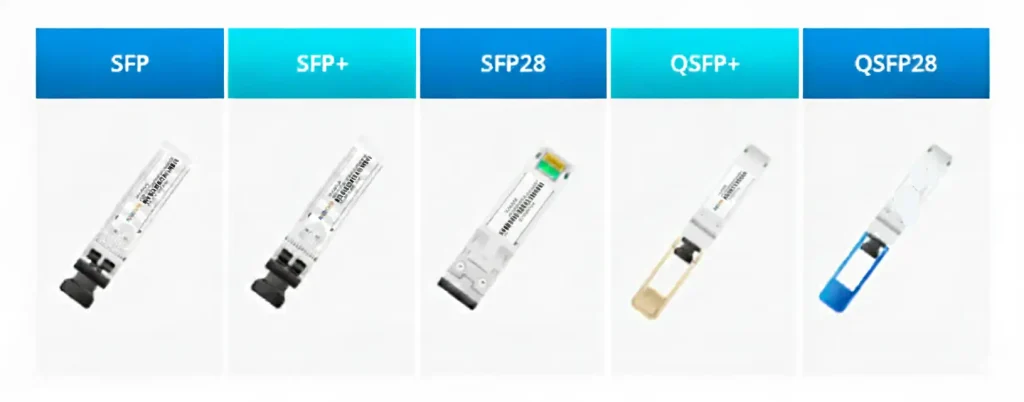
1. Defining the SFP Family: SFP (1G), SFP+ (10G), and SFP28 (25G)
The SFP (Small Form-factor Pluggable) family is built around a single data channel, primarily focusing on high port density for server and access connectivity.
What is an SFP Transceiver? (1G)
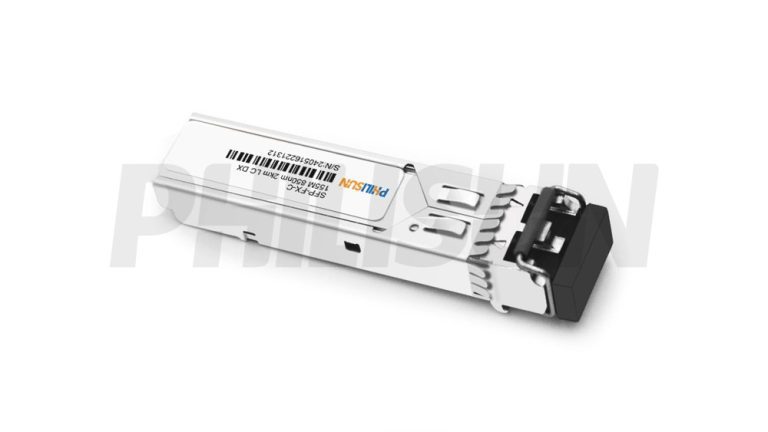
The SFP module is the original, providing 1 Gigabit per second (Gbps) data transmission. It is defined by the IEEE 802.3z standard and uses a single lane running at 1G for Gigabit Ethernet, Fiber Channel, and SONET applications.
What is an SFP+ Transceiver? (10G)
The SFP+ (Enhanced Small Form-factor Pluggable) boosts the speed of the single lane to 10 Gbps. Physically, it is identical to SFP, allowing easy density upgrades. It is based on the SFF-8431 standard and is essential for 10 Gigabit Ethernet (10GBASE-R).
What is an SFP28 Transceiver? (25G)
The SFP28 is the final single-lane iteration, delivering 25 Gbps. It maintains the exact physical size of SFP and SFP+ but uses superior electrical interfaces to achieve a 2.5x speed boost over SFP+. It is foundational for 25G Ethernet links that feed into 100G networks.
2. The QSFP Family: Parallelism for 40G and 100G
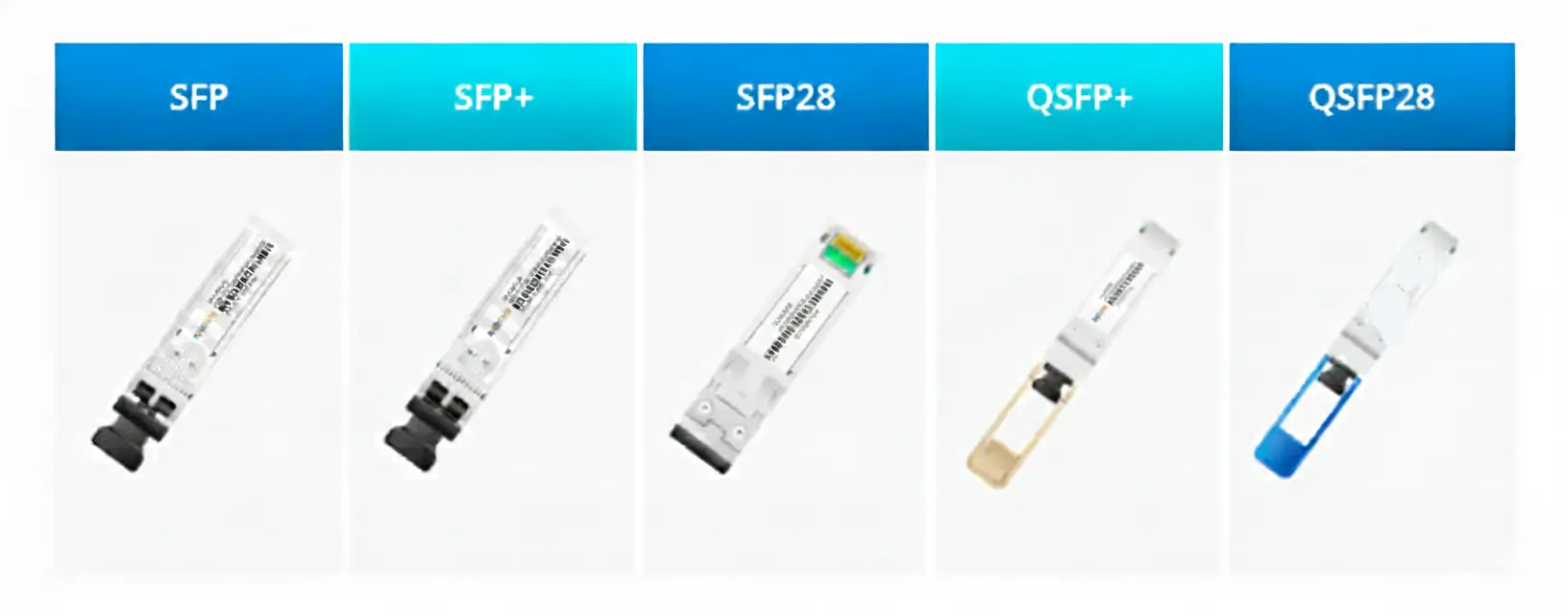
The QSFP (Quad Small Form-factor Pluggable) family is physically larger than SFP and achieves much higher bandwidth by employing four parallel data channels.
What is a QSFP+ Transceiver? (40G)
The QSFP+ module pioneered multi-lane fiber optics. It bundles four SFP+ lanes together (4 x 10G) to achieve 40 Gbps, typically using MPO/MTP connectors for parallel fiber links in aggregation layers.
What is a QSFP28 Transceiver? (100G)
The QSFP28 is the industry standard for 100G connectivity. It utilizes the optimized 25G lane rate from the SFP28, bundling four lanes (4 x 25G) to achieve a total bandwidth of 100 Gbps in the same QSFP footprint.
3. SFP vs SFP+ vs QSFP Pair-Wise Comparison
Understanding the subtle differences in physical architecture and compatibility between these modules is key to network planning.
SFP vs SFP+
The core difference between SFP and SFP+ lies in speed and compatibility standards, despite sharing the same physical dimensions. SFP is designed for 1 Gigabit Ethernet (100BASE or 1000BASE) and complies with IEEE 802.3z, while SFP+ is strictly for 10 Gigabit Ethernet and is based on SFF-8431. Crucially, an SFP+ port is backward compatible and can accept an SFP optic, but the resulting link speed will be capped at 1 Gbit/s. However, you should never plug a 10G SFP+ transceiver into a 1G SFP port, as this can damage the port or fail to establish a stable link due to power and signaling mismatches.
SFP+ vs SFP28
SFP+ and SFP28 share the exact same compact physical form factor, which maximizes port density in modern switch designs. The primary functional distinction is the speed they support: SFP+ is tied to 10G, whereas SFP28 is designed for 25G connections. Due to their identical size and mating-compatible pinouts, SFP28 ports are designed to accept SFP+ modules. When an SFP+ is inserted into an SFP28 port, the link will operate at the reduced speed of 10 Gbit/s, provided the host switch port is configured for 10G transmission. This backward compatibility is essential for phased upgrades in data centers. To ensure reliability during these upgrades, PHILISUN rigorously tests all SFP+ and SFP28 modules for guaranteed interoperability across mixed vendor hardware.
SFP+ vs QSFP+
This comparison moves from single-lane to multi-lane architecture. SFP+ is a single 10G channel, while QSFP+ (Quad SFP+) is an evolution that supports four parallel 10 Gbit/s channels, delivering a total of 40G throughput. This quad architecture means that one QSFP+ transceiver can replace four standard SFP+ transceivers and associated cabling, significantly increasing port density and potentially reducing overall system cost and complexity at the aggregation layer. QSFP+ modules often require MTP/MPO connectors for the multi-fiber links, unlike the Duplex LC used by SFP+.
SFP28 vs QSFP28
While their names suggest a direct relationship, SFP28 and QSFP28 transceivers differ significantly in size and operational principle. SFP28 is small and supports only one 25 Gbit/s lane. QSFP28 is the larger quad-form factor that achieves 100G by utilizing four separate 25 Gbit/s lanes (4x25G). Both are integral to 100G networks. The primary use case for SFP28 in a 100G environment is through a Breakout Solution: a single 100G QSFP28 port can be broken out into four individual 25G SFP28 ports using a special MPO-to-4xLC cable. This is the standard method for connecting a 100G core switch to 25G-enabled servers.
4. Physical Density: Connecting with LC vs. MPO Connectors
The choice between LC (Lucent Connector) and MPO (Multi-fiber Push On) connectors directly reflects the module’s architecture (single-lane vs. quad-lane) and significantly impacts cable management and port density in the data center.
- LC Connectors: The SFP, SFP+, and SFP28 form factors almost exclusively use Duplex LC connectors. This is because they only operate on a single channel (two fibers: one Tx, one Rx). LC connectors are small, reliable, and ideal for connecting individual servers or access switches at 1G, 10G, or 25G.
- MPO/MTP Connectors: The QSFP+ (40G) and QSFP28 (100G) modules rely heavily on MPO/MTP connectors. Since these modules operate across four parallel lanes (8 fibers: four Tx, four Rx), the MPO connector allows all eight fibers to be housed in a single ferrule, drastically increasing port density on core switches.
When Must I Use a QSFP to 4xSFP Breakout Cable?
You must use a QSFP to 4xSFP breakout cable—typically a 40G QSFP+ to 4x10G SFP+ or a 100G QSFP28 to 4x25G SFP28—when you need to connect a high-density, high-speed switch port (QSFP) to lower-speed, individual server ports (SFP family). This commonly occurs in the spine-leaf architecture:
- Leaf Switch Aggregation: A 100G QSFP28 port on a leaf switch connects upstream to the spine.
- Server Connectivity: The same leaf switch needs to connect to 4 separate servers, each requiring 25G SFP28 modules.
- The Solution: The breakout cable plugs into the QSFP28 port and splits into four separate 25G SFP28 outputs, maximizing the switch’s utilization and simplifying cabling.
5. Power Consumption and Thermal Management
As data rates increase and more parallel lanes are added, the power requirements—and resulting heat generation—scale dramatically.
- SFP Family (1G-25G): These single-channel modules typically consume under 2W, making thermal management straightforward.
- QSFP Family (40G-100G): QSFP+ and QSFP28 modules, running 4 parallel high-speed channels, require significantly more power, often between 3.5W and 5.5W. This high power draw necessitates advanced heat dissipation methods within the module and the host switch.
Why Do QSFP Modules Have Higher Thermal Requirements?
QSFP modules have higher thermal requirements primarily because of the increased component density and overall power dissipation from four parallel transmitter/receiver circuits. Higher speeds inherently require more complex signal processing and laser drivers. To maintain performance, the switch chassis must ensure efficient airflow across the modules. Using high-quality, thermally optimized QSFP modules, such as those rigorously tested by PHILISUN, is crucial to prevent overheating and ensure link stability in dense environments.
6. The Vendor Lock-in Challenge and Custom Coding Solutions
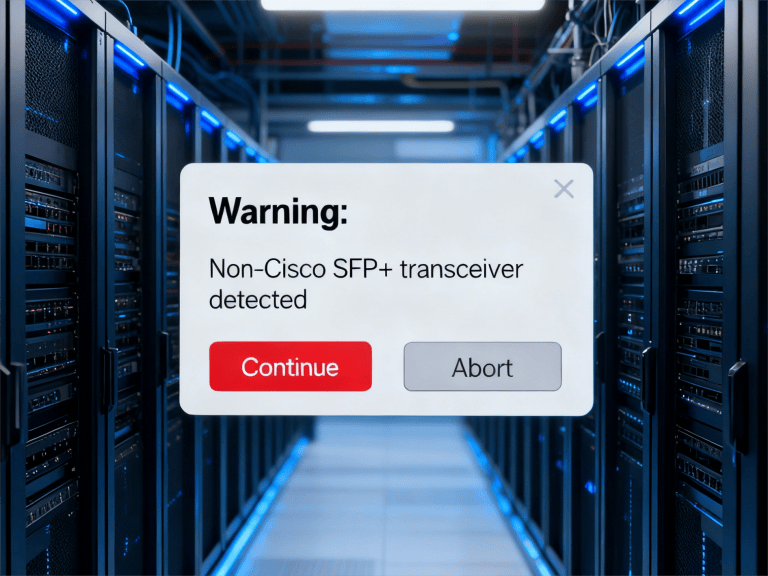
One of the most significant challenges in large-scale network deployment is vendor lock-in. Major network equipment manufacturers (OEMs) code their switches and routers to only recognize their own transceivers, often displaying “Non-Qualified Module” errors when third-party optics are inserted.
How Does PHILISUN Guarantee Compatibility with Major Brands?
PHILISUN overcomes the vendor lock-in challenge through proprietary custom coding and testing processes. Every module, from 1G SFP to 100G QSFP28, is:
- Coded: The module’s internal memory (A0h) is precisely written with the necessary identification data (vendor ID, part number, serial number) that mirrors the expected OEM module coding.
- Tested: The coded module is then physically inserted and run in the specific OEM switch (e.g., Cisco, Juniper, Arista) the customer intends to use.
- Guaranteed: This rigorous process ensures the module is recognized immediately, displays correct diagnostics via DDM (Digital Diagnostics Monitoring), and performs flawlessly, saving customers up to 80% compared to OEM pricing without compromising quality.
7. Reach and Media: Single Mode (LR) vs Multimode (SR) Applications
The application (short-reach within a data center or long-haul between buildings) determines whether you use Multi-Mode Fiber (MMF) or Single-Mode Fiber (SMF) and, consequently, which type of transceiver you need (SR vs. LR).
- Multimode (SR): Uses cheaper LEDs or VCSEL (Vertical-Cavity Surface-Emitting Laser) technology, paired with thicker MMF cable. Ideal for distances up to 300m (OM3/OM4 cable) within a single data center hall.
- Single Mode (LR): Uses DFB (Distributed Feedback) or EML (Electro-absorption Modulated Laser) technology, paired with thinner SMF cable. Necessary for distances from 2km up to 40km or more.
Understanding the Maximum Reach for SFP+ and QSFP28 Modules
The maximum reach is determined by the module designation:
| Form Factor | Designation | Technology/Fiber Type | Max Standard Reach | Typical Application |
| SFP+ (10G) | 10GBASE-SR | Multi-Mode (VCSEL) | 300m (on OM4) | Data Center server racks |
| SFP+ (10G) | 10GBASE-LR | Single-Mode (DFB) | 10 km | Campus or Metro Access |
| SFP28 (25G) | 25GBASE-SR | Multi-Mode (VCSEL) | 100m (on OM4) | Server-to-ToR switch links |
| SFP28 (25G) | 25GBASE-LR | Single-Mode (DFB) | 10 km | Long-distance 25G links |
| QSFP28 (100G) | 100GBASE-SR4 | Multi-Mode (VCSEL, Parallel) | 100m (on OM4) | High-speed intra-rack links |
| QSFP28 (100G) | 100GBASE-LR4 | Single-Mode (WDM/DFB) | 10 km | Data center interconnect (DCI) |
8. PHILISUN’s Complete Portfolio: Supporting All Form Factors
PHILISUN provides a one-stop source for all your optical transceiver needs, ensuring consistent quality and compatibility across all generations of networking hardware. Our portfolio includes solutions tailored for every stage of your network deployment:
- SFP/SFP+ (1G/10G) Solutions: Reliable, low-power modules for essential server, switch, and access connectivity. These form the backbone for initial server and endpoint connections. Find our SFP/SFP+ (1G/10G) Modules here.
- SFP28/QSFP28 (25G/100G) Solutions: High-performance modules, including SR and LR variants, designed for modern spine-leaf and data center aggregation layers. These are key to unlocking 100G network capacity. Explore our SFP28/QSFP28 (25G/100G) Modules now.
- QSFP-DD (400G/800G) Solutions: Next-generation optics offering unparalleled density and speed for the core network. Future-proof your infrastructure with our high-density, high-speed QSFP-DD (400G/800G) Modules.
9. Comprehensive Cross-Comparison Matrix
For quick reference, this matrix summarizes the seven critical differences between the form factors:
| Specification | SFP (1G) | SFP+ (10G) | SFP28 (25G) | QSFP+ (40G) | QSFP28 (100G) |
| 1. Max Data Rate | 1 Gbps | 10 Gbps | 25 Gbps | 40 Gbps | 100 Gbps |
| 2. Lane Configuration | 1 x 1G | 1 x 10G | 1 x 25G | 4 x 10G | 4 x 25G |
| 3. Form Factor Size | Small | Small | Small | Quad (Larger) | Quad (Larger) |
| 4. Power Draw (Typical) | < 1W | < 1.5W | < 2W | 1.5W – 3.5W | 3.5W – 5.0W+ |
| 5. Common Connector | Duplex LC | Duplex LC | Duplex LC | MPO/MTP or Duplex LC (BiDi) | MPO/MTP or Duplex LC (CWDM4/LR4) |
| 6. Breakout Support | No | No | No | Yes (4 x 10G SFP+) | Yes (4 x 25G SFP28) |
| 7. Backward Compatible? | To SFP | To SFP+ | To SFP+ | To QSFP+ | To QSFP+ (as 40G) |
| 8. Industry Standard | IEEE 802.3z | SFF-8431 | SFF-8472 / 8432 | SFF-8685 | SFF-8665 / 8636 |
Conclusion
The shift from SFP to QSFP represents a fundamental move from serial (single-lane) to parallel (quad-lane) data transmission, requiring careful consideration of everything from cooling capacity to fiber infrastructure (LC vs. MPO). Deploying a mixed-speed network is complex, and compatibility issues can halt entire data center deployments, costing time and budget.
PHILISUN ensures that you navigate this complexity with confidence. Our modules are not just alternatives; they are high-quality, fully tested solutions that provide seamless integration, whether you are managing temperature in a dense QSFP28 deployment or requiring custom coding for mixed-vendor hardware.