
When a critical 400G link fails to establish or performs intermittently, the root cause is almost always excessive fiber optic attenuation. Attenuation, the unavoidable loss of optical power as light travels through the cable, is a passive killer of bandwidth. In high-speed environments, where the optical link budget is measured in fractions of a decibel, diagnosing and eliminating unexpected loss is the network engineer’s most critical task. This field guide provides a systematic, step-by-step approach to troubleshooting and resolving the most common causes of high attenuation.
1. What Constitutes Excessive Fiber Optic Attenuation in the Field?
In practical terms, high fiber optic attenuation is simply any loss that exceeds the manufacturer-defined Optical Link Budget for that channel.
Understanding the Loss Threshold
Attenuation is quantified in decibels (dB). Every link budget is a summation of three primary loss components:
- Cable Loss: Inherent loss over distance (e.g., 0.2dB/km for single mode fiber).
- Insertion Loss (Connectors/Splices): The loss introduced at every discontinuity.
- Safety Margin: A small buffer for future degradation or thermal fluctuation.
If the measured total loss exceeds the calculated link budget—for instance, the measured attenuation is 2.5dB when the budget allows only 1.9dB—the link is in an alarm state, and troubleshooting must commence immediately.
Immediate Action Checklist: Did You Check the Obvious?
Before deploying an expensive OTDR, check the most common and easily corrected sources of high fiber optic attenuation:
- Contamination: Is the connector end-face clean? Contamination (dust, oil) is responsible for over 85% of all attenuation issues. Always Inspect, Then Clean, Then Connect.
- Macro-Bends: Are there any visible bends in the fiber or patch cord that violate the minimum bend radius (e.g., a cable sharply folded over a rack edge)?
- Mismatched Components: Are you attempting to mate an APC (8°) connector with a UPC (flat) connector? This creates an air gap, causing massive Insertion Loss.
2. How Can the OTDR Precisely Locate the Source of High Attenuation?
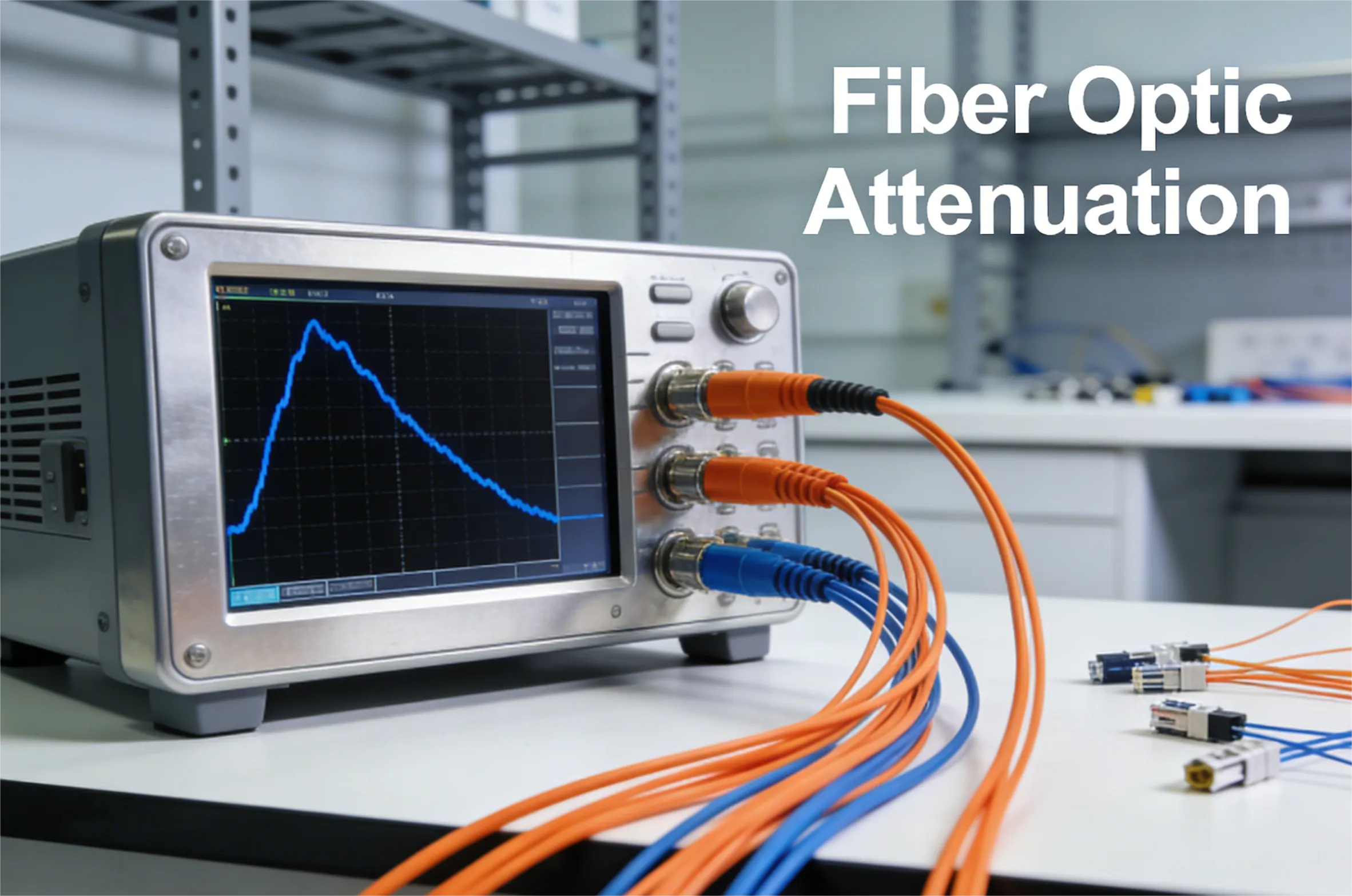
When simple visual inspection fails, the Optical Time Domain Reflectometer (OTDR) becomes the indispensable tool for diagnosing fiber optic attenuation. It functions like radar, sending a pulse of light and measuring the back-scattered and reflected light over time to map the entire link.
Interpreting the OTDR Trace
The OTDR trace graphically displays the power decay (slope) of the fiber and highlights discrete “events.”
- Segment Attenuation (The Slope): The gradual, downward slope of the trace represents the inherent loss of the fiber over distance (e.g., dB/km). A segment with an unusually steep slope indicates excessive continuous loss, likely caused by severe micro-bending (physical stress) across that span.
- Event Attenuation (The Jumps): A sudden vertical drop (event loss) in the trace indicates high Insertion Loss at a connector or splice point. This is where reflection and excessive loss are concentrated.
3. Decoding OTDR Signatures: Linking the Trace to the Physical Problem
The OTDR trace provides specific signatures that point directly to the physical cause of high fiber optic attenuation.
| OTDR Signature | Physical Problem | Corrective Action |
| Sudden, Large Drop (>0.5 dB) | Dirty or damaged connector/splice. | Inspect and meticulously clean the end-face; replace the connector if damage is confirmed. |
| Steep Slope Over a Long Segment | Micro-bending or macro-bending across the cable span. | Check cable ties, route cables to adhere to the bend radius; inspect for crushing pressure. |
| Gainer or Non-Reciprocal Event | Not an actual gain. Caused by mating two different fiber types or core diameters (e.g., OS2 to OM4). | Remediate the incorrect splice/connector to match the fiber types. |
| High Reflection Peak (Low RL) | Air gap or improper polish (e.g., trying to mate UPC to APC). | Re-mate with the correct polish type; ensure physical contact is made. |
4. Preventing Recurrence: Eliminating Systemic Attenuation Threats
Effective troubleshooting is about preventing high fiber optic attenuation from happening again. This requires a commitment to high-quality components and disciplined installation practices.
Component Selection to Control Insertion Loss
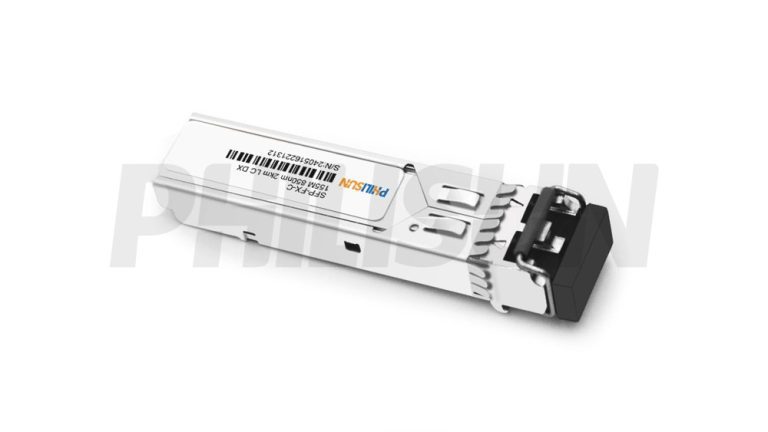
Standard-grade fiber connectors may have an Insertion Loss of up to 0.75dB. Using these in a three-component channel can push total loss past the 400G budget limit before distance is even factored in. This is where premium quality is essential. PHILISUN’s Ultra-Low Loss (ULL) MPO assemblies are factory-tested to guarantee Insertion Loss of <0.35dB per mate. By supplying both high-spec fiber optic transceivers and precision cabling, PHILISUN offers an end-to-end solution designed to virtually eliminate systemic attenuation.
Addressing Micro-Bending
Micro-bending (minute bends) increases fiber optic attenuation by causing light to leak into the cladding. This is often an installation issue.
- Avoid Over-Tightening: Use Velcro ties instead of zip ties to prevent crushing the cable jacket.
- Proper Routing: Ensure cables are not pinched where they enter trays or transit through panels.
5. Frequently Asked Questions (FAQ) on Attenuation
What is the acceptable maximum Insertion Loss for a single connector?
- The TIA/IEC standards vary, but for modern high-speed links, Ultra-Low Loss (ULL) components are mandated, typically requiring Insertion Loss to be less than 0.35dB per mated pair. Standard components allowing 0.75dB are often inadequate for multi-connector 400G channels.
What is the difference between Macro-bending and Micro-bending?
- Macro-bending involves visible bends that violate the fiber’s minimum bend radius (e.g., cable folds). Micro-bending involves microscopic, localized stress caused by manufacturing defects, tight cable ties, or uneven pressure, leading to continuous, gradual attenuation over a segment of fiber.
Can dirty connectors cause permanent damage?
- Yes. Repeatedly mating a contaminated connector can grind the dirt particles into the ferrule’s end-face, creating pits, scratches, and residue that permanently damage the core and cladding surface, resulting in chronic high Insertion Loss.
How does operating wavelength affect fiber optic attenuation?
- Attenuation is wavelength-dependent. Due to Rayleigh scattering, loss is significantly higher at shorter wavelengths (e.g., 850nm) than at longer wavelengths (e.g., 1550nm), which is why long-haul networks primarily use the 1550nm window.
Conclusion
Mastering fiber optic attenuation is non-negotiable for operating stable, high-speed networks. Field failures due to excessive loss are overwhelmingly caused by contamination, poor component quality, and improper handling.
Is high attenuation plaguing your network? Stop guessing and start solving. Consult with the PHILISUN engineering team today for guidance on selecting Tier 2 certified, Ultra-Low Loss components and transceivers that guarantee low fiber optic attenuation and maximize your link performance. Contact us for a rapid solution to your connectivity challenges.