
Every IT professional dreads the moment the lights flicker. But the real danger to sensitive servers and networking gear isn’t the blackout; it’s the insidious threat of constant power fluctuations—the dips, surges, and noisy spikes that silently degrade components over time.
In high-speed data environments, where precision components, such as 400G optical transceivers and high-density MPO cabling, are critical, power stability is paramount. If you think a simple battery backup will protect your mission-critical systems, you might be mistaken.
Choosing the right Uninterruptible Power Supply (UPS) topology is the difference between comprehensive protection and costly risk. We primarily deal with three major types: Offline (Standby), Line Interactive, and True Online (Double-Conversion). The Line Interactive UPS is the high-efficiency, mid-range workhorse that was engineered specifically to combat those frequent power quality issues. This comprehensive guide details the unique architecture of the Line Interactive UPS and provides a side-by-side comparison of all three topologies across key performance metrics.
Line Interactive UPS: Architecture and AVR Deep Dive
The Line Interactive topology is defined by its ability to engage actively with the utility power without immediately draining the battery.
A. Core Architecture and Power Flow
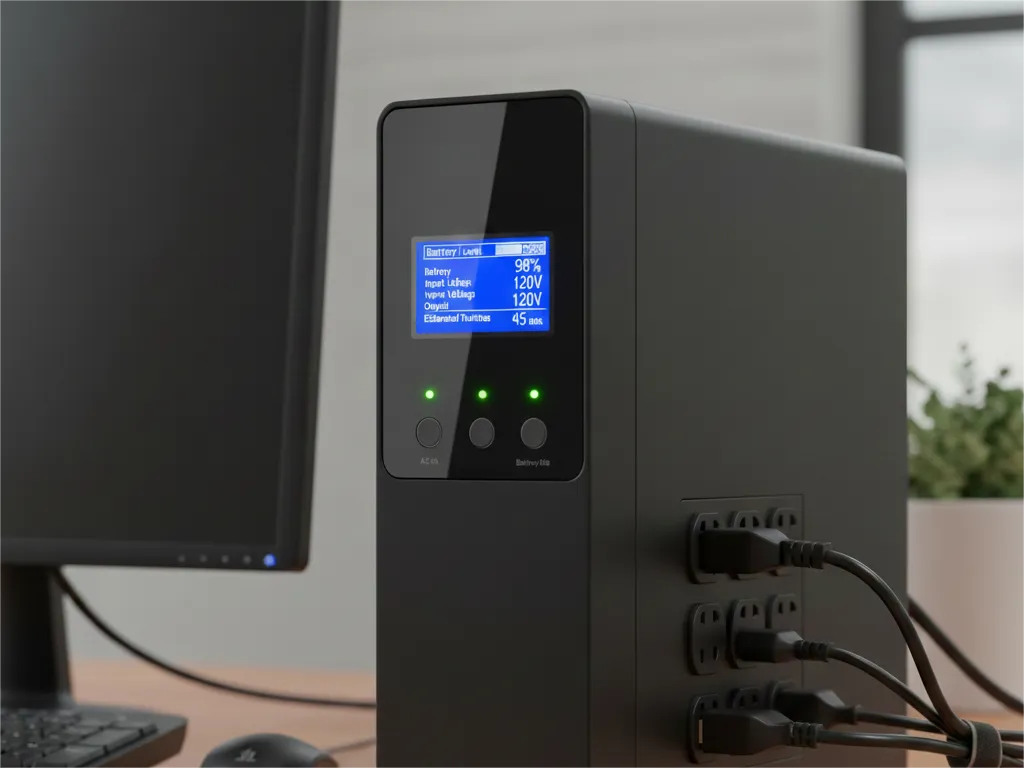
In a Line Interactive UPS, the primary path sees utility power flow directly to the protected load via a main circuit path called the bypass path. Crucially, the inverter/converter component is always connected to the output and is bidirectional. This means it can simultaneously charge the battery (AC to DC conversion) and immediately switch to powering the load (DC to AC conversion) when needed. Because the inverter is constantly engaged with the output line, this architecture is significantly more responsive than the simple standby design.
B. The Defining Feature: Automatic Voltage Regulation (AVR)
The key distinction of the Line Interactive model is the integration of the Automatic Voltage Regulator (AVR), typically implemented via a multi-tap buck-boost transformer. The AVR is the front-line defense against common power problems:
- Boost Function: If the incoming utility voltage experiences a sag (drops below the acceptable range, e.g., 100V), the AVR activates its boost tap. This tap increases the low input voltage back up to the required nominal level (e.g., 120V) without transferring to the battery.
- Buck Function: If the incoming utility voltage experiences a swell (spikes above the acceptable range, e.g., 135V), the AVR activates its buck tap. This tap reduces the high input voltage back down to the nominal level.
Critical Benefit: This automatic and immediate correction handles up to 90% of all recorded power quality issues, significantly extending battery service life and ensuring continuous, stable power delivery to the IT load. The battery is only reserved for true blackouts or brownouts where the voltage failure is too severe for the AVR’s correction window.
C. Output Waveform: Pure Sine Wave vs. Simulated Sine Wave
A major specification for Line Interactive UPS systems is their output waveform:
- Simulated Sine Wave (Stepped Approximation): Common in cheaper models, this outputs a stepped or square waveform when running on battery. While sufficient for older hardware, it can cause problems for modern equipment with Active Power Factor Correction (PFC) power supplies (common in high-end servers and workstations), leading to reduced efficiency, heat, and premature failure.
- Pure Sine Wave: Higher-end Line Interactive models offer a pure, smooth sinusoidal wave, identical to utility power. This is mandatory for all equipment utilizing Active PFC and is a non-negotiable requirement for server and networking infrastructure.
Comprehensive Comparison of UPS Topologies
Understanding the trade-offs between the three core topologies—Offline, Line Interactive, and True Online—is essential for proper infrastructure planning.
A. Offline (Standby) UPS
The simplest, lowest-cost solution. The inverter is dormant and only engages when utility power fails entirely. It offers minimal protection as it lacks an AVR, meaning all sags and swells must be passed through or handled by draining the battery. Protection is limited to blackouts and major surges, and the transfer time is often the longest and least predictable.
B. True Online (Double-Conversion) UPS
The highest protection level, suitable for mission-critical applications. Power is constantly processed through a rectifier and an inverter, providing continuous, regenerated power to the load. This ensures the load is completely isolated from all nine common power problems.
Key Advantage: Zero transfer time to battery power. The main trade-off is efficiency, as the continuous conversion generates heat and results in energy losses, leading to higher operational costs and cooling requirements.
C. Comparison Table: Line Interactive vs. Offline vs. Online
| Feature | Offline (Standby) | Line Interactive | True Online (Double-Conversion) |
| Primary Path | Utility Direct | Utility via AVR | Inverter/Battery (Always Active) |
| Voltage Correction | None | Yes (via AVR) | Yes (Continuous Conversion) |
| Transfer Time | 4-10 ms (Typical) | 2-8 ms (Typical) | 0 ms (Zero Interruption) |
| Efficiency | Highest (98%+) | High (95%+) | Lowest (90-94% due to heat) |
| Cost | Lowest | Medium | Highest |
| Best Application | Basic Desktops, Non-Critical Loads | SMB Servers, Network Gear | Mission-Critical Data Centers, Medical |
Strategic Selection: Choosing the Right Topology
When making a procurement decision, budget is critical, but it must be balanced against the risk associated with downtime and component failure:
- Low-Risk/Budget-Focused (Offline): Use for non-critical peripherals, basic home office setups, or devices with high tolerance for power variance.
- Mid-Range/High-Efficiency (Line Interactive): The optimal choice for server racks housing critical network components, including high-density fiber distribution from experts like PHILISUN (e.g., MPO patch panels and AOC/DAC cable assemblies). It provides 95%+ efficiency while handling the majority of power threats via AVR.
- Mission-Critical/Zero-Downtime (True Online): Necessary for medical devices, financial trading platforms, large data center cores, and any application where a 2ms transfer time is unacceptable.
Conclusion
The Line Interactive UPS has solidified its position as the industry’s default standard, achieving the best possible balance of safety, conditioning, and economy. It provides robust protection against the most frequent power fluctuations through AVR while ensuring the battery is ready for complete outages.
For IT professionals seeking a high-value solution that combines efficiency with reliable power conditioning for their small-to-medium business infrastructure, the Line Interactive topology is the clear frontrunner. When planning your infrastructure, remember that the reliability of your entire stack—from the UPS topology protecting it to the high-speed optical connectivity solutions provided by trusted fiber optics partners like PHILISUN—is interconnected. Choosing the right UPS protects your investment in high-performance networking components such as QSFP-DD transceivers and MPO trunk cables.
Frequently Asked Questions (FAQ)
1. Does a Line Interactive UPS provide pure sine wave power?
It depends on the specific model. Lower-cost Line Interactive units typically provide a Simulated Sine Wave (or modified square wave) when running on battery. Higher-end models, which are required for servers, Active PFC power supplies, and motorized equipment, offer Pure Sine Wave output. Always verify this specification before purchase for IT environments.
2. What is the difference between an AVR and an AVR-only power conditioner?
An AVR (Automatic Voltage Regulator) is a component that senses and corrects voltage levels. An AVR-only power conditioner performs this function continuously but does not include a battery backup. A Line Interactive UPS includes the AVR functionality plus a battery and inverter system, ensuring protection against both voltage issues and complete power outages.
3. What is the “transfer time” in a Line Interactive UPS?
Transfer time is the brief moment (typically 2 to 8 milliseconds) it takes for the UPS to switch from running on utility power (via the bypass path) to running on battery power (via the inverter). This short delay is generally imperceptible to most modern computers and servers due to the hold-up time of their internal power supplies.
4. Why is Line Interactive more efficient than Online UPS?
The Line Interactive UPS operates with high efficiency (often 95%+) because the utility power bypasses the battery and inverter for most of the time. The True Online UPS, however, is constantly converting power twice (AC to DC, then DC to AC), which results in continuous energy loss through heat, making it less efficient (typically 90-94%).