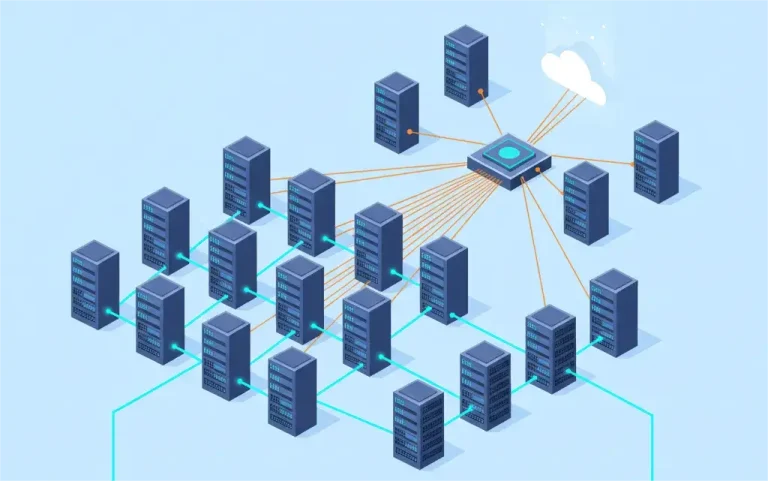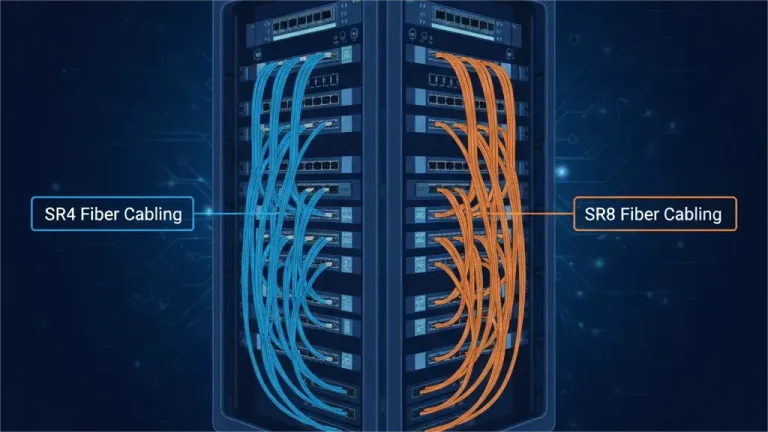

Choosing between CWDM vs DWDM starts with a broader question: how should your network use WDM (Wavelength Division Multiplexing) to carry more traffic over the same fiber pair? CWDM and DWDM are two common WDM families, and their differences in channel spacing translate directly into trade-offs around initial cost, maximum distance, capacity ceiling and operational complexity. This guide compares WDM, CWDM and DWDM in practical terms so network architects and procurement teams can choose the right optical transceiver and wavelength plan.

What Is WDM, and How Do CWDM and DWDM Fit?
WDM is the umbrella method of sending multiple optical wavelengths over the same single-mode fiber path. CWDM (Coarse Wavelength Division Multiplexing) and DWDM (Dense Wavelength Division Multiplexing) are two different ways to implement that idea: CWDM uses wider wavelength spacing for simpler, lower-cost deployments, while DWDM uses much tighter channel spacing for higher capacity and longer-reach transport designs.
| Technology | Role in a fiber network | Typical selection logic |
|---|---|---|
| WDM | The overall multiplexing approach: multiple wavelengths share the same fiber pair. | Use when fiber capacity needs to grow without pulling new fiber. |
| CWDM | A coarse WDM option with wider wavelength spacing and simpler optical control. | Best for cost-sensitive access, campus, metro edge and moderate channel-count links. |
| DWDM | A dense WDM option with tighter ITU frequency-grid planning and higher channel density. | Best for fiber-scarce, long-haul, DCI, metro core and high-capacity routes. |
In short, the question is not usually WDM vs CWDM vs DWDM as three equal choices. WDM is the category; CWDM and DWDM are implementation choices within that category. The right answer depends on route distance, fiber availability, channel count, budget and whether future scaling matters more than first-cost savings.
CWDM vs DWDM: Quick Selection Guide
Quick answer: choose CWDM when the network needs a lower-cost WDM upgrade with modest channel count and shorter metro or access reach. Choose DWDM when fiber is scarce, capacity must scale to many wavelengths, or the route needs long-haul, DCI or high-capacity transport planning.
| Decision point | CWDM is usually better when… | DWDM is usually better when… |
|---|---|---|
| Budget | The project needs lower module and filter cost. | The project can justify higher optics cost for more capacity. |
| Channel count | 8 to 18 channels are enough for the route. | 40, 80 or more channels may be needed on the same fiber pair. |
| Distance | Access, campus, metro edge or short metro routes are the main use case. | Metro core, long-haul, dark fiber or DCI routes need tighter optical control. |
| Fiber availability | Extra fiber is available if the route needs later expansion. | Fiber is limited and every wavelength must carry more value. |
| Operations | Simple deployment and lower power are priorities. | Capacity planning, wavelength discipline and future scaling are priorities. |
If you already know the distance and channel plan, the next decision is the module family. PHILISUN optical transceivers include CWDM and DWDM options for 10G, 16G, 25G and higher-speed transport planning.
If the WDM plan is part of a packet-optical transport build, use the companion POTN network architecture, optical modules and cabling guide to connect wavelength choice with transceiver form factors, link distance and cabling design.
Core Technical Differences: Wavelength Spacing and Laser Type
The financial disparity between CWDM and DWDM stems directly from one fundamental technical difference: wavelength spacing. This spacing dictates the complexity of the internal components, particularly the lasers.
What is the Fundamental Difference Between CWDM and DWDM Channel Spacing?
- CWDM’s Wide Channels: CWDM uses a wide channel separation of 20 nm (nanometers). This broad spacing is less demanding on component precision and thermal stability. CWDM traditionally offers 8 channels, expandable to 18 channels by utilizing the E-band (1360 nm to 1460 nm).
- DWDM’s Dense Channels: DWDM employs extremely narrow channel separations, typically 0.8 nm or 0.4 nm (based on the ITU-T grid). This density allows for 40, 80, or even 96+ channels to be packed into the C-band window, but requires high precision to prevent adjacent channel interference.
CWDM’s Wide Channel and Uncooled Laser Advantage
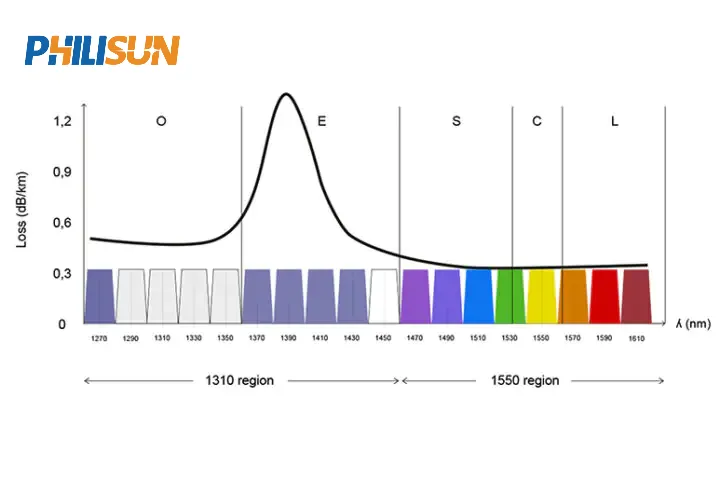
The wide 20 nm spacing of CWDM is generous enough to allow the system to tolerate significant drift in the laser’s wavelength due to ambient temperature fluctuations. Consequently, CWDM transceivers can utilize uncooled lasers.
Uncooled lasers are simpler, cheaper to manufacture, and consume less power. This is the primary reason CWDM is the go-to solution for initial low-capacity network deployments in access and metro environments where the priority is low upfront cost. While performance is reliable, the lack of temperature control limits the ultimate channel density and precision.
DWDM’s Dense Channel and Cooled Laser Necessity
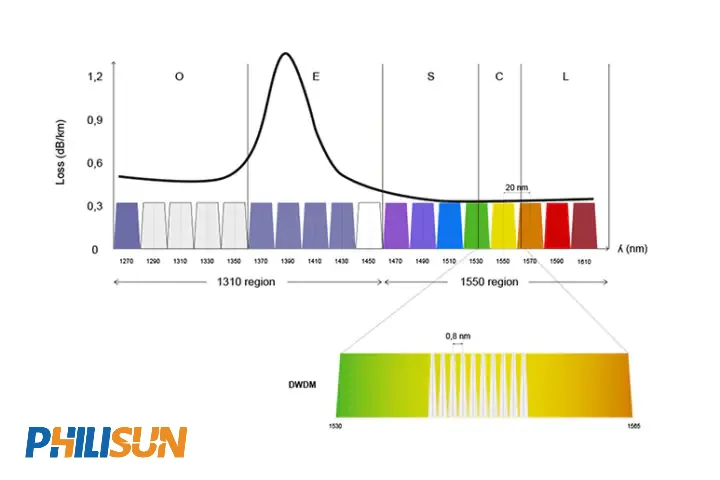
Conversely, DWDM’s dense grid requires the laser wavelength to remain highly stable, often within ±6 picometers (pm). To achieve this stability, DWDM transceivers incorporate a TEC (Thermoelectric Cooler), a device that actively maintains the laser diode’s temperature regardless of external conditions.
This active thermal management significantly increases the cost and complexity of the DWDM module, resulting in a higher initial capital expenditure (CapEx). However, this engineering is necessary to enable the high channel count required for core networks and long-haul transport and is crucial for maintaining signal quality over long distances.
The Cost Equation: Initial Investment vs. Long-Term Expense
The choice between the two technologies must be based on a thorough analysis, balancing the lower CapEx of CWDM against the lower long-term cost-per-bit achieved by DWDM.
Is CWDM Always the Most Cost-Effective Solution for Your Network?
For short-term, low-capacity needs (e.g., 8-16 channels up to 50 km), CWDM provides the clear cost winner due to low component costs and minimal power draw (OPEX). However, if your capacity needs double within 3-5 years, the cost of installing a second fiber pair (due to CWDM’s capacity limit) may quickly eliminate the initial CWDM savings. The decision must be viewed through the lens of bandwidth longevity.
Component Cost Breakdown: Transceiver Complexity and Filters
The component price variance is significant:
- Transceivers: A DWDM SFP+ module typically costs 3 to 5 times more than an equivalent CWDM SFP+ module due to the integrated TEC and required precision optics. When sourcing, prioritizing high-quality, third-party solutions can significantly lower this CapEx. For reliable 10G links under 80km, PHILISUN SFP-CWDM-10G Series Transceivers offer an optimal balance of cost and performance.
- MUX/DEMUX Filters: CWDM MUX/DEMUX filters are simpler and cheaper due to the 20 nm channel spacing, whereas DWDM filters require complex, highly precise thin-film filter technology, driving up the passive equipment cost.
Power Consumption and Operational Expense (OPEX)
The integrated TEC in a DWDM transceiver is an active power sink. While a DWDM network provides superior capacity, its overall power draw per channel is higher than CWDM. For massive Data Center Interconnects (DCI) where hundreds of transceivers are deployed, the cumulative OPEX from cooling and power consumption becomes a significant factor, favoring the passive nature of CWDM if capacity allows.
Application Alignment: Matching Technology to Network Tier
Optimal deployment relies on matching the technology’s capabilities (distance, capacity) to the network’s function (access, metro, core).
CWDM and DWDM Transceiver Selection Path
The best WDM architecture depends on the route, but the buying decision is still made at the module and channel level. Use the table below as a practical starting point before confirming the exact wavelength, reach and switch compatibility.
| Need | Typical module path | Planning note |
|---|---|---|
| Lower-cost 10G CWDM metro links | 10G CWDM LR SFP+, 10G CWDM ER SFP+ or 10G CWDM ZR SFP+ | Good for access and metro routes where channel count is limited and cost matters. |
| 16G or storage-related CWDM links | 16G CWDM SFP+ 10/40km | Useful when the network needs wavelength separation without a dense DWDM plan. |
| 25G CWDM access or mobile transport | 25G CWDM SFP28 10km | Check switch/NIC support, wavelength plan and optical budget before deployment. |
| 40G CWDM4 transport | 40GBASE-LR4 QSFP+ 10km or 40GBASE-ER4 QSFP+ 40km | CWDM4 optics can reduce fiber count compared with parallel multimode routes. |
| 10G DWDM long-distance links | 10G DWDM 100GHz ER, 10G DWDM 100GHz ZR, 10G DWDM 50GHz ER or 10G DWDM 50GHz ZR | Use when fiber is scarce, reach is longer, or the channel plan needs tighter spacing. |
| 25G DWDM transport | 25G DWDM C-Band SFP28 | Confirm wavelength grid, platform support and optical budget before ordering. |
For long-reach SFP+ planning, also compare the 10G SFP+ ER vs ZR guide. For routes built on leased or owned fiber, review the dark fiber and long-range transceiver guide.
CWDM’s Role in Access, Metro, and MDU Networks (Short Reach)
CWDM is perfectly suited for “last mile” and “middle mile” applications where traffic is relatively stable, and latency is not ultra-critical:
- Access Networks: Connecting enterprise buildings or cell towers within a 40 km radius.
- Metro Ring Networks: Short-distance rings where capacity is limited to 10G or less per service.
- Multi-Dwelling Unit (MDU) Interconnects: Delivering basic fiber services in urban environments.
CWDM’s low cost and simplicity of deployment make it the preferred choice for these localized, capacity-controlled environments.
DWDM’s Dominance in Core, Long-Haul, and Data Center Interconnect (DCI)
DWDM is mandatory where capacity and distance are non-negotiable requirements:
- Core Networks: Transporting signals across thousands of kilometers.
- Data Center Interconnect (DCI): Linking two major data centers with massive bandwidth (400G/800G) and requiring low latency over 100+ km.
- Long-Haul Transport: Applications requiring high-capacity, long-distance transmission, where signal amplification is essential.
Achieving High-Capacity Density and Future Scalability
If the forecast indicates a need for more than 16 channels or a data rate exceeding 25G per channel, the strategic advantage shifts decisively towards DWDM, as its superior density provides a clear, cost-effective path to scalability.
Maximum Channel Count Comparison (18 Channels vs. 80+ Channels)
CWDM’s maximum theoretical limit is 18 channels. Once this limit is reached, scaling further requires installing new dark fiber or upgrading the entire architecture, both of which are extremely expensive and disruptive.
DWDM, conversely, starts at 40 channels and scales easily to 80 or 96 channels, all within the existing fiber pair. This eliminates the need for expensive physical infrastructure changes, making the higher initial CapEx of DWDM a worthwhile investment for growth-oriented networks.
DWDM as the Foundation for 100G, 400G, and 800G Coherent Systems
Modern high-speed standards rely entirely on the precision and bandwidth provided by the DWDM C-band. Technologies like 400G-ZR and 800G Coherent optics, which achieve massive data rates over long distances, require the tight channel spacing and thermal stability inherent to DWDM.
Any network planning to deploy 100G, 400G, or 800G services over distances greater than 80 km must select DWDM as the underlying transport architecture. For reliable high-speed DCI links, sourcing precision components is paramount. PHILISUN SFP-DWDM-10G Series Transceivers are engineered for superior channel isolation, ensuring error-free operation in dense deployments.
What to Send for a CWDM or DWDM Recommendation
- Target data rate, such as 10G, 16G, 25G, 40G, 100G or higher.
- Required reach and actual fiber route length.
- Available fiber count and whether the route uses dark fiber, leased fiber or existing metro fiber.
- Preferred wavelength plan, or the number of channels required today and later.
- Switch, router or transport equipment model and vendor compatibility requirement.
- Connector path, expected insertion loss, patch panels, splices and any amplifier or dispersion constraints.
If the project includes access, metro, DCI or carrier transport, PHILISUN can help match optical transceivers and fiber optic network solutions to the route before you lock the wavelength plan.
CWDM vs DWDM FAQ
Is WDM the same as CWDM or DWDM?
No. WDM means Wavelength Division Multiplexing, the general technique of carrying multiple optical wavelengths over one fiber path. CWDM and DWDM are two WDM implementations: CWDM prioritizes simpler, wider-spaced channels, while DWDM prioritizes denser channel planning, higher capacity and longer-reach scaling.
Is CWDM cheaper than DWDM?
Usually yes. CWDM optics and filters are generally simpler and lower cost because the channels are spaced farther apart and often do not require the same thermal control as DWDM.
When should I choose DWDM instead of CWDM?
Choose DWDM when the route needs many wavelengths, long reach, better capacity scaling, or high-value transport on limited fiber. DWDM is often preferred for metro core, long-haul and DCI networks.
Can CWDM and DWDM run on the same single-mode fiber?
Both CWDM and DWDM commonly run over single-mode fiber, but the modules, filters, wavelengths and link budget must be matched to the same architecture.
Which is better for long-distance optical links?
DWDM is usually better for long-distance and high-capacity links because it supports denser channel spacing, tighter wavelength control and stronger scaling on limited fiber.
What information is needed to choose a CWDM or DWDM transceiver?
You need the port type, target speed, reach, wavelength or channel plan, fiber route loss, connector path, equipment brand and any compatibility or diagnostics requirements.
Conclusion
The choice between CWDM vs DWDM is ultimately an application and budget decision. CWDM is the cost-efficient champion for short, capacity-limited access networks, while DWDM is the mandatory, long-term strategic investment for core, long-haul, and DCI applications requiring massive scalability and high data rates (100G+). By precisely matching the technology’s cost, reach, and scalability to your business needs, you guarantee optimal network performance. Contact PHILISUN today for a detailed consultation on optimizing your WDM fabric and securing the best component choice for your network’s future.