
This guide focuses on fiber jacket and connector color codes: the visual details technicians use to identify fiber type, UPC/APC polish, MPO connector bodies and high-speed cabling risks in the field. For the complete 12-fiber strand sequence and full color chart, start with the Fiber Optic Color Code Chart.
Jacket and connector colors are fast visual cues, but they are not a replacement for the printed cable legend, transceiver datasheet, link budget or project documentation. Use color as the first check, then verify the exact fiber grade and connector specification.
Field Guide: What Each Visual Color Tells You
| Visual cue | What it usually identifies | What to verify |
| Cable jacket | Fiber category or installation environment | OS2, OM3, OM4, OM5, outdoor rating and printed legend |
| Connector body | Fiber type or assembly type | LC, SC, FC, MPO/MTP format and fiber mode |
| Connector boot or adapter | Polish and fiber type convention | UPC vs APC and single-mode vs multimode |
| MPO connector color | Multimode grade or single-mode assembly family | Fiber count, gender, polarity and insertion loss grade |
| Printed jacket legend | Final product identity | Fiber type, rating, fiber count, supplier and part number |
Fiber Jacket Color Code
Jacket color is useful in patching fields, racks and procurement checks because it gives a quick indication of fiber type. It is especially important when older multimode cables and newer high-speed multimode cables are present in the same room.
| Jacket color | Fiber type | Typical cabling role |
| Yellow | OS1 / OS2 single-mode | Longer-reach links, backbone cabling, telecom and data center interconnects |
| Orange | OM1 / OM2 multimode | Legacy multimode LAN and older enterprise links |
| Aqua | OM3, sometimes OM4 | Short-reach 10G, 40G and selected 100G multimode links |
| Violet | OM4 multimode | High-speed multimode data center links |
| Lime green | OM5 multimode | Wideband multimode and selected SWDM-aware designs |
| Black | Outdoor or protected jacket | Environmental protection; read the printed legend for fiber grade |
Connector Color Code: UPC, APC and Multimode
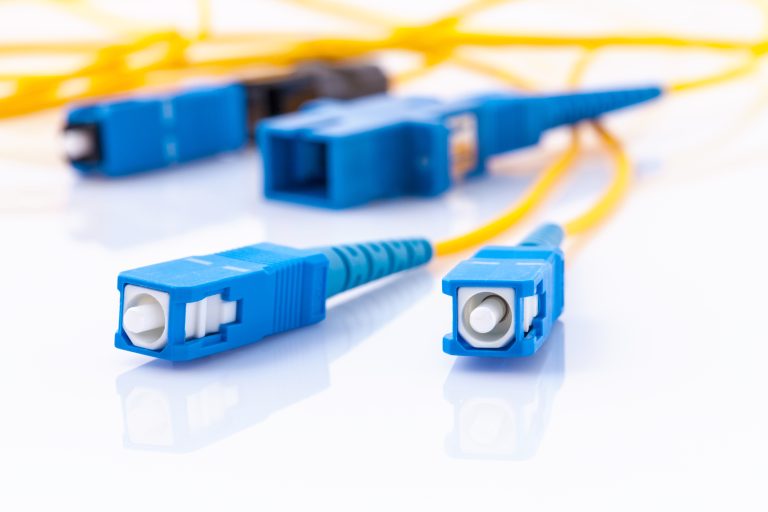
Connector colors reduce mating mistakes. The most important single-mode distinction is blue UPC versus green APC. These two polish styles should not be mixed because the end faces are shaped differently.
| Connector color | Typical meaning | Risk if misused |
| Blue | Single-mode UPC | High reflection or loss if mated to APC |
| Green | Single-mode APC | Wrong mating with UPC can damage end faces |
| Beige / black | Legacy multimode | May not support modern high-speed links |
| Aqua | OM3 or OM4 multimode | OM3/OM4 confusion if jacket legend is ignored |
| Violet | OM4 multimode | Assuming compatibility without checking distance |
| Lime green | OM5 multimode | Buying OM5 without SWDM or wideband need |
For a deeper connector selection workflow, see UPC, PC & APC Connectors and LC vs SC vs MPO.
MPO Connector Color Checks
In high-density MPO systems, connector body color is only one part of the specification. The technician must also confirm fiber count, polarity, gender, pinning, loss grade and the target transceiver standard.
- OM3 MPO assemblies: often aqua and used for short-reach multimode designs.
- OM4 MPO assemblies: often aqua or violet and widely used for 40G/100G multimode data center cabling.
- OM5 MPO assemblies: often lime green and relevant when the optical architecture uses wideband multimode capability.
- OS2 MPO assemblies: commonly yellow, but outdoor or armored designs may use black jackets with printed legends.
PHILISUN supports MPO trunk cables, MPO jumpers, MPO harness cables and MPO cassettes with project-specific polarity, fiber count and color requirements.
400G and 800G Procurement Red Flags
At 400G and 800G speeds, visual color checks are useful but insufficient. A cable can look correct while still failing the loss budget, polarity map or transceiver requirement.
- Do not assume every aqua cable is OM4; check the printed legend.
- Do not mix APC and UPC connectors in a single-mode path.
- Do not buy OM5 unless the optics or roadmap needs wideband multimode support.
- For MPO links, verify polarity and fiber count before ordering transceivers or cassettes.
- Confirm the link budget with the actual optical transceiver datasheet.
Fiber Jacket and Connector Color FAQ
Why can the MPO connector body color differ from the cable jacket?
The MPO connector body may follow fiber-type color conventions, while the cable jacket may be chosen for environment, branding or ruggedization. Always verify the printed jacket legend and part number.
Is a black fiber cable always single-mode?
No. Black often indicates an outdoor, ruggedized or protected jacket. It does not reliably identify OS2, OM3 or OM4 by itself.
Can green APC connectors connect to blue UPC ports?
No. Green APC and blue UPC connectors use different end-face geometry. Directly mating them can create high loss, high reflection and end-face damage.
Does OM5 color mean the cable is better than OM4?
Not always. OM5 is useful when the network design needs wideband multimode support. For many standard SR4 links, OM4 remains the common and cost-effective choice.
Conclusion
Fiber jacket and connector colors are fast field signals, but they work best when combined with printed legends, link budgets and clear procurement specifications. PHILISUN can help match cable color, fiber grade, connector polish, MPO structure and optical modules for reliable high-speed cabling.