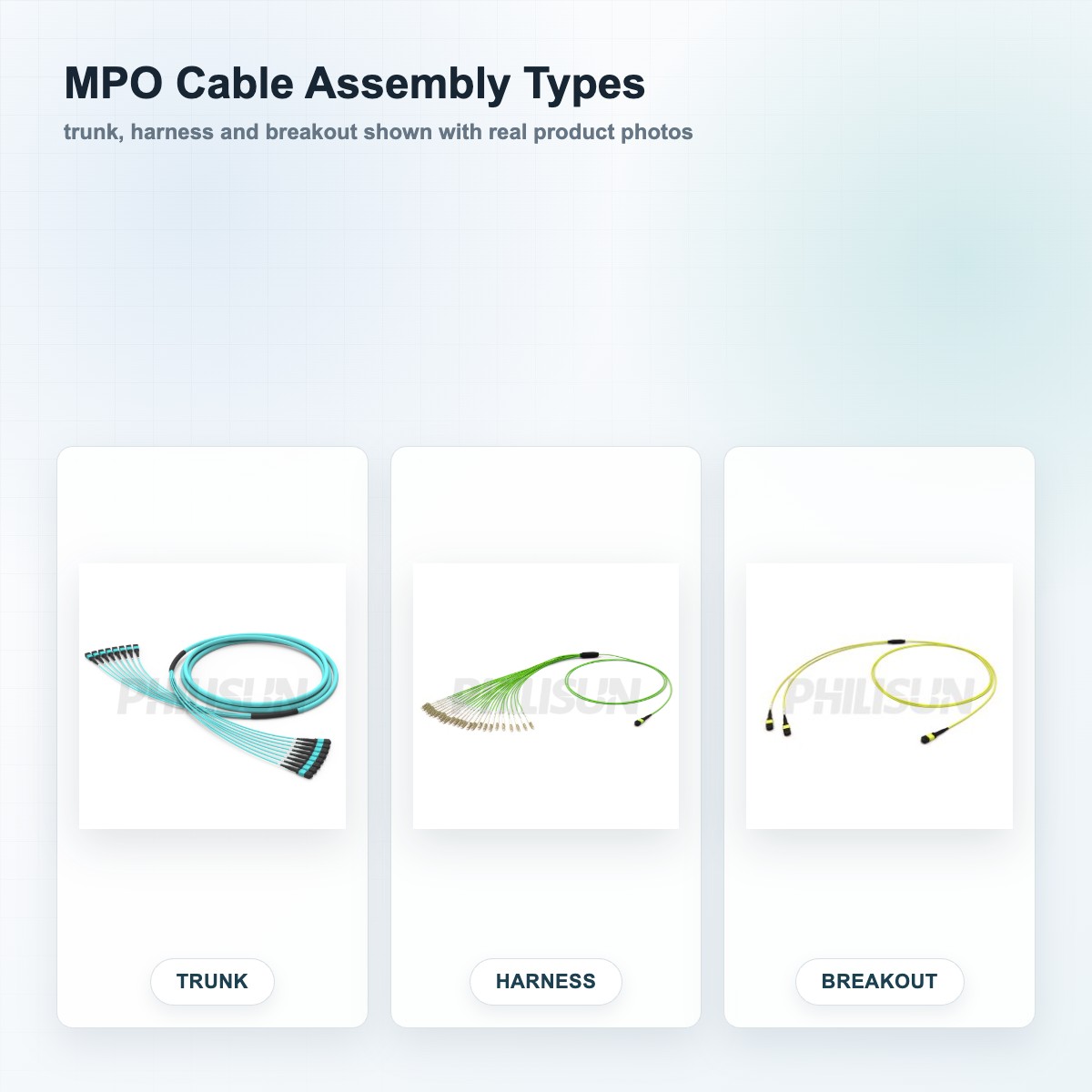

MPO trunk cables, MPO harness cables, and MPO breakout cables all help data centers build high-density fiber links, but they solve different cabling problems. A trunk cable is mainly used as a backbone between racks, cabinets, or patching areas. A harness cable usually fans one MPO connector out to several LC connectors. A breakout cable splits one higher-fiber-count MPO connection into smaller MPO connections, such as MPO-8 to two MPO-4 links or MPO-12 to two MPO-6 links.
The fastest way to choose is simple:
- Use an MPO trunk cable when you need a clean high-fiber-count backbone.
- Use an MPO harness cable when you need to connect MPO backbone cabling to duplex LC equipment or patch panels.
- Use an MPO breakout cable when you need to split parallel optical links or match one MPO interface to multiple smaller MPO interfaces.
For 40G, 100G, 400G, and 800G networks, the right choice depends on the fiber count, transceiver type, connector layout, polarity method, rack distance, and future expansion plan.
Fast Selection Rule
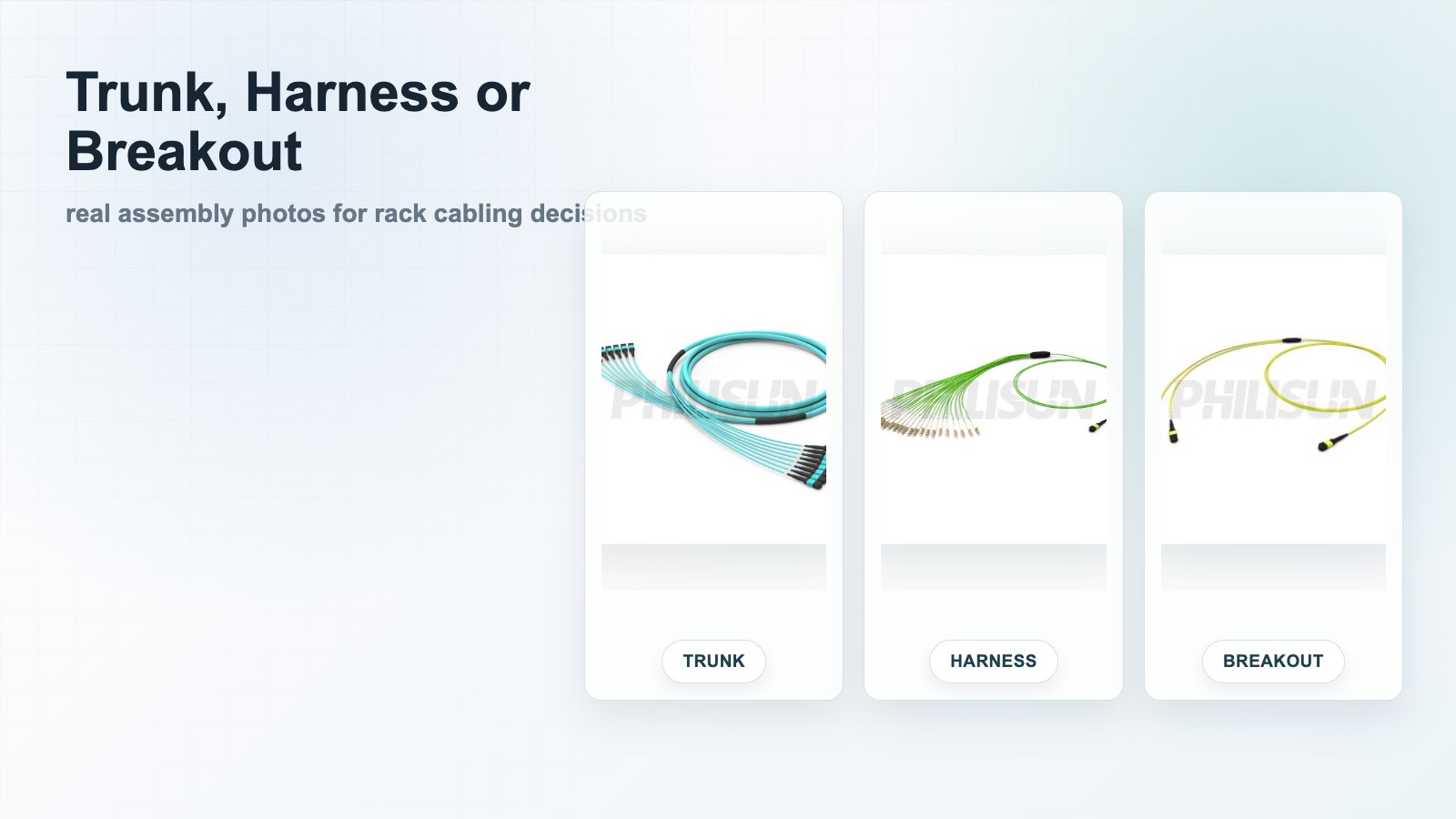
Use MPO trunk cables for backbone cabling, MPO harness cables for MPO-to-LC or MPO-to-SC fanout, and MPO breakout cables when one MPO path needs to split into smaller MPO channels.
Quick Comparison
| Cable type | Common connector layout | Best for | Typical use case |
|---|---|---|---|
| MPO trunk cable | MPO to MPO | Backbone cabling | High-density rack-to-rack or zone-to-rack fiber links |
| MPO harness cable | MPO to LC or SC | Fanout to duplex ports | Connecting MPO backbone to switch ports, patch panels, or transceiver interfaces that use duplex connectors |
| MPO breakout cable | MPO to multiple MPO connectors | Parallel link splitting | Splitting MPO-8, MPO-12, MPO-16, or MPO-24 links into smaller MPO channels |
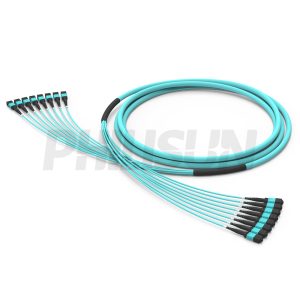
MPO Trunk Cable
Best for high-fiber-count backbone cabling between racks, panels, and distribution areas.
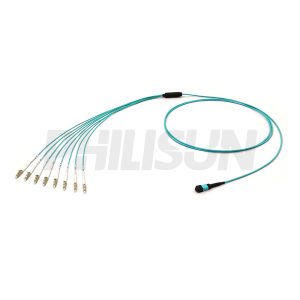
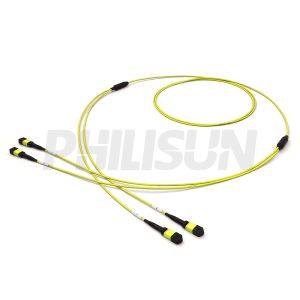
If you are building a structured cabling system, the trunk cable often forms the main pathway. Harness and breakout cables are then used near the equipment or patching area to convert that pathway into the connector format required by switches, transceivers, cassettes, or fiber panels.
What Is an MPO Trunk Cable?
An MPO trunk cable is a pre-terminated multi-fiber cable assembly with MPO connectors on both ends. It is designed to carry many fibers through a single compact connection, which makes it useful for high-density data center cabling.
MPO trunk cables are commonly used between:
- Main distribution areas and equipment racks
- Cross-connect zones and server cabinets
- Core, aggregation, and access network areas
- High-density fiber panels and MPO cassettes
- AI, HPC, cloud, and telecom infrastructure where fast deployment matters
The main advantage is density. Instead of installing many individual duplex patch cords, an MPO trunk can carry 12, 24, 48, 72, 96, 144, or more fibers through organized factory-terminated assemblies.
For data centers, this reduces field termination work, improves cable management, and makes future migration easier. A trunk can support today's link plan while leaving room for future 100G, 400G, or 800G upgrades if the fiber count and polarity are planned correctly.
Learn more on the PHILISUN MPO Trunk Cable page.
When Should You Use an MPO Trunk Cable?
Choose an MPO trunk cable when your main requirement is a clean, scalable fiber backbone.
Good use cases include:
- Connecting two fiber distribution panels
- Building rack-to-rack backbone links
- Deploying pre-terminated cabling in a new data center row
- Reducing installation time compared with field termination
- Preparing for higher-speed migration without recabling the whole pathway
MPO trunk cables are usually not the final short patch from the switch port to the transceiver. They are more often used as the structured cabling layer behind the patching system.
For dense backbone paths, high-fiber trunk options such as MPO 144-Fiber Trunk Cables can help reduce cable congestion between cabinets or distribution areas.
What Is an MPO Harness Cable?
An MPO harness cable is a fanout cable that connects one MPO connector to multiple individual connectors, most often LC connectors. It is also commonly called an MPO fanout cable.
For example, one MPO-12 connector may fan out to six duplex LC connectors. This lets an MPO backbone connect to equipment or panels that use duplex LC interfaces.
MPO harness cables are useful when the network needs a transition between high-density MPO cabling and traditional duplex fiber connections.
Common use cases include:
- Connecting MPO trunks to LC transceiver ports
- Breaking out backbone fibers to individual duplex channels
- Patching high-density fiber panels to switch or server equipment
- Supporting 10G, 25G, 40G, 100G, or other mixed-speed environments
- Simplifying fiber management near the equipment side
See PHILISUN MPO Harness Cable options for MPO to LC fanout configurations.
When Should You Use an MPO Harness Cable?
Choose an MPO harness cable when one end of the link is MPO and the other end needs duplex connectors.
This often happens when your structured cabling backbone is built with MPO trunks, but the active equipment still uses LC interfaces. The harness acts as the transition point.
Harness cables are especially useful in migration projects. A data center may use MPO trunks in the backbone to prepare for higher-density networking, while still connecting to current LC-based equipment. This allows the cabling system to support both present equipment and future upgrades.
Before ordering an MPO harness cable, confirm:
- MPO fiber count, such as MPO-8, MPO-12, or MPO-24
- Fanout connector type, such as LC UPC, LC APC, or SC
- Single-mode or multimode fiber
- Polarity method
- Male or female MPO connector gender
- Jacket type and length
- Required insertion loss grade
What Is an MPO Breakout Cable?
An MPO breakout cable splits one MPO connector into multiple smaller MPO connectors. Unlike an MPO harness cable, which usually fans out to LC or SC, an MPO breakout cable keeps the output side in MPO format.
Examples include:
- MPO-8 to two MPO-4 links
- MPO-12 to two MPO-6 links
- MPO-16 to two MPO-8 links
- MPO-24 to two MPO-12 links
Breakout cables are often used when parallel optical interfaces or high-speed ports need to be split into smaller channels. This is common in 400G and 800G cabling designs where the physical fiber layout must match the transceiver architecture.
PHILISUN provides MPO Breakout Cable assemblies for high-speed AI, HPC, and cloud data center cabling.
For example, the MPO8-2MPO4 Series supports MPO-to-MPO breakout applications where an 8-fiber MPO path needs to be divided into smaller MPO channels.
When Should You Use an MPO Breakout Cable?
Choose an MPO breakout cable when you need to split one parallel fiber connection into smaller MPO-based connections.
Good use cases include:
- Splitting high-density MPO links into smaller parallel optical channels
- Supporting 400G or 800G port breakout designs
- Connecting different MPO fiber counts in the same cabling system
- Matching transceiver lane requirements to the available fiber plant
- Building compact high-density links where LC fanout is not the right format
Breakout cables need careful planning because the fiber mapping must match the transceiver, polarity method, and switch breakout configuration.
Trunk vs Harness vs Breakout: The Selection Logic
The best way to choose is to look at the job the cable must perform.
If the cable is carrying many fibers through the backbone, choose a trunk cable. If the cable is converting MPO to LC or SC near the equipment, choose a harness cable. If the cable is splitting one MPO interface into multiple MPO interfaces, choose a breakout cable.
| Question | Best choice |
|---|---|
| Do you need a high-density backbone between racks or panels? | MPO trunk cable |
| Do you need MPO to LC or MPO to SC fanout? | MPO harness cable |
| Do you need MPO to multiple smaller MPO connectors? | MPO breakout cable |
| Do you need to prepare for future 400G or 800G migration? | MPO trunk cable, with correct fiber count and polarity |
| Do you need to connect MPO backbone cabling to LC equipment? | MPO harness cable |
| Do you need to split parallel optics into smaller channels? | MPO breakout cable |
How These Cables Fit 40G, 100G, 400G, and 800G Networks
High-speed networks make MPO planning more important because the connector and fiber count must match the optical module type.
For 40G and 100G SR4 links, MPO cabling is often used for parallel multimode fiber connections. For 100G LR4 or CWDM4 links, duplex LC single-mode cabling may be used instead. For 400G and 800G networks, MPO, MTP, OSFP, QSFP-DD, and parallel optical designs can introduce different fiber count requirements.
This is why the cable type should not be selected only by connector appearance. It should be selected based on:
- Transceiver form factor
- Optical standard
- Speed and lane count
- Fiber type
- Connector interface
- Reach
- Polarity method
- Breakout requirement
When a link is built around duplex transceivers, an MPO harness may be used to transition from backbone MPO to LC. When a link is built around parallel optics, MPO trunk and breakout assemblies may be more important.
Do Not Forget Polarity
Before You Order
Confirm fiber count, polarity, connector gender, fiber mode, jacket type, cable length, and the target transceiver standard. These details matter more than the cable name alone.
MPO cable selection is not only about connector type. Polarity controls how transmit and receive fibers align across the link. If the polarity is wrong, the physical cabling may look correct but the link may not come up.
Common MPO polarity methods include Type A, Type B, and Type C. The right choice depends on the full channel design, including patch cords, cassettes, trunk cables, transceivers, and equipment-side interfaces.
Before placing an order, confirm the polarity method with the network design or cabling standard used in your project.
For a deeper explanation, read the PHILISUN MPO Polarity Guide: Type A, B, and C Differences.
Ordering Checklist
Before ordering MPO trunk, harness, or breakout cables, prepare the following information:
- Cable type: trunk, harness, or breakout
- Fiber count: MPO-8, MPO-12, MPO-16, MPO-24, 48 fibers, 72 fibers, 96 fibers, 144 fibers, or custom
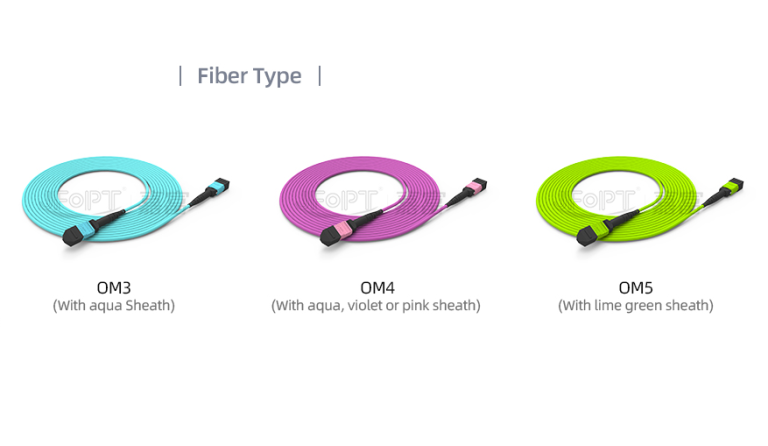
- Fiber mode: OS2 single-mode, OM3, OM4, or OM5 multimode
- Connector gender: male or female MPO
- Connector polish: UPC or APC where applicable
- Fanout connector type: LC, SC, or MPO
- Polarity method: Type A, Type B, Type C, or project-specific mapping
- Cable length and breakout leg length
- Jacket type: LSZH, OFNP, OFNR, or project requirement
- Insertion loss grade and test report requirement
- Target network speed: 40G, 100G, 200G, 400G, 800G, or mixed
- Application: data center, telecom, AI cluster, HPC, enterprise, or cloud network
This checklist helps avoid the most common MPO ordering mistakes: wrong gender, wrong polarity, wrong fiber count, wrong fanout layout, and wrong connector format.
Common Mistakes to Avoid
Mistake 1: Choosing by cable name only
The same word can be used differently by different suppliers. Always confirm the connector layout, fiber mapping, and application. For example, "breakout" may sometimes be used loosely, but an MPO-to-LC fanout and an MPO-to-MPO breakout are not the same assembly.
Mistake 2: Ignoring polarity
MPO polarity must be planned across the full channel. Do not select trunk, harness, or breakout cables separately without checking how they connect together.
Mistake 3: Underestimating future fiber count
A lower fiber count may work for the current link, but it may limit future upgrades. If a data center is moving toward 400G or 800G, plan the trunk backbone with migration in mind.
Mistake 4: Mixing single-mode and multimode assumptions
OS2, OM3, OM4, and OM5 are used for different distances and optical modules. Confirm the transceiver specification before selecting the cable.
Mistake 5: Forgetting test reports
For high-speed links, request insertion loss and return loss test data. Factory-tested assemblies reduce installation risk, especially in dense cabling environments.
Which MPO Cable Should You Choose?
Choose an MPO trunk cable if your main goal is a high-density, scalable backbone.
Choose an MPO harness cable if you need to fan out from MPO to LC or SC equipment-side connections.
Choose an MPO breakout cable if you need to split one MPO interface into multiple MPO interfaces for parallel optical channels or high-speed breakout applications.
If the project includes 100G, 400G, or 800G migration, do not choose the cable in isolation. Start with the transceiver type, target link speed, fiber plant, and rack layout. Then match the MPO cable assembly to that design.
PHILISUN offers MPO cable assemblies including trunk, harness, breakout, jumper, cassette, and enclosure solutions for high-density data center and telecom networks.
FAQ
What is the main difference between an MPO trunk cable and an MPO harness cable?
An MPO trunk cable usually has MPO connectors on both ends and is used as a backbone cable. An MPO harness cable usually has one MPO connector on one end and multiple LC or SC connectors on the other end for fanout to equipment or patching ports.
Is an MPO breakout cable the same as an MPO harness cable?
Not exactly. A harness cable usually fans out from MPO to LC or SC connectors. A breakout cable often splits one MPO connector into multiple smaller MPO connectors, which is useful for parallel optical links and port breakout designs.
Which cable is better for 400G and 800G networks?
It depends on the transceiver and link design. MPO trunks are useful for high-density backbone cabling, while MPO breakout cables can support parallel optical breakout requirements. MPO harness cables are useful when the equipment side requires LC or SC connections.
What information should I provide before ordering MPO cables?
Provide the cable type, fiber count, fiber mode, connector gender, polarity, length, jacket type, fanout layout, and target network speed. If possible, also provide the transceiver type and rack layout.
Can PHILISUN customize MPO trunk, harness, and breakout cables?
Yes. PHILISUN can support customized MPO cable assemblies based on fiber count, connector type, polarity, cable length, jacket, and application requirements. Share your link speed, rack distance, and equipment interface so the correct assembly can be recommended.
Need Help Choosing the Right MPO Cable?
If you are not sure whether your project needs an MPO trunk, harness, or breakout cable, send PHILISUN your network speed, transceiver type, rack layout, fiber count, polarity requirement, and connector interface.
Our team can help match the correct MPO cable assembly to your data center, telecom, AI, HPC, or enterprise network deployment.