Network procurement decisions are constantly driven by the need to balance cost, scalability, and performance. While 10 Gigabit Ethernet (10G) has become the new baseline for many enterprise backbones, the 1000BASE-SX SFP module remains an indispensable workhorse. This transceiver, designed for 1.25 Gigabit links over Multimode Fiber (MMF), offers an optimal combination of reliability and low Total Cost of Ownership (TCO). This guide compares the SFP module family and details why the highly mature 1000BASE-SX standard is often the most cost-effective and appropriate choice for the access layer and short-reach data center applications.
Understanding the SFP Module Family: The Evolution of Speed
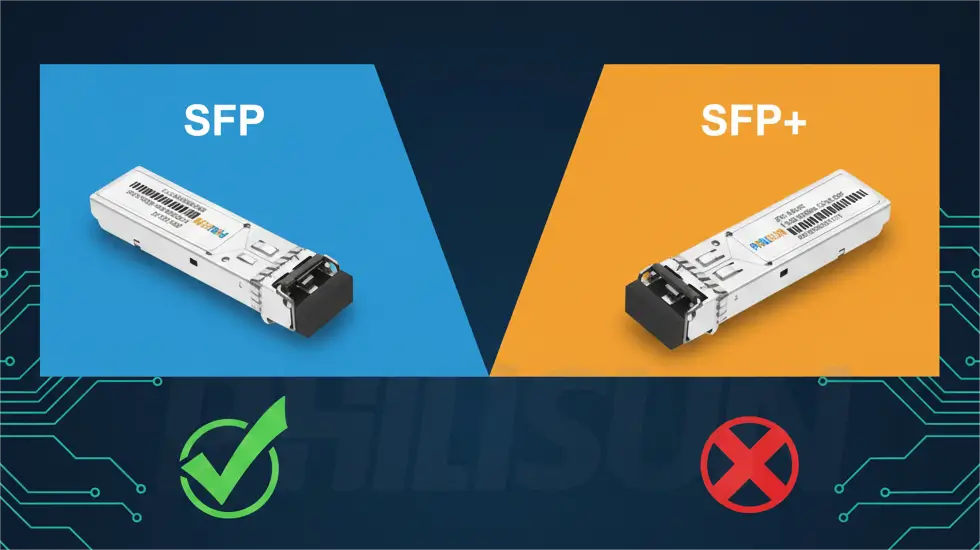
The SFP (Small Form-factor Pluggable) family is defined by standardized size and hot-swappable capability, but the data rate—and the electronics inside—have evolved dramatically to meet rising bandwidth demands.
SFP (1G): The Access Layer Workhorse
The original SFP module supports data rates up to 1.25 Gbps (Gigabit Ethernet). This module defined the industry standard for the compact, reliable, and hot-swappable form factor.
- Key Characteristics: It uses mature, cost-effective optics (like VCSEL for 1000BASE-SX or DFB for 1000BASE-LX).
- Primary Domain: It is the ideal and most cost-effective solution for the Access Layer of enterprise and campus networks, connecting end-user devices, legacy switches, and edge infrastructure where 1G speeds are sufficient. Its low power consumption is a significant operational benefit.
SFP+ (10G): Bridging the Aggregation Gap
The SFP+ module was a crucial development, supporting 10 Gbps (10 Gigabit Ethernet) in the same physical size as the SFP. This achievement was possible because the SFP+ standard shifted some of the complex signal processing (like clock and data recovery, CDR) functions onto the host board (the switch/router itself), allowing the module to remain small and power-efficient.
- Key Characteristics: It leverages the same form factor as SFP but requires stricter PCB layout on the host equipment.
- Primary Domain: SFP+ is the dominant module for the Aggregation and Core Layers of enterprise networks, providing the necessary bandwidth backbone without the bulk of older 10G standards like XFP.
SFP28 (25G): Enabling Modern Data Center Fabrics
The SFP28 module is the latest iteration in this physical form factor, supporting 25 Gbps over a single lane.
- Key Characteristics: It utilizes advanced electronics and higher-speed signaling protocols (like PAM4) to achieve 25G. SFP28 offers higher efficiency than channel-bonding four 10G links for the same bandwidth.
- Primary Domain: It is the fundamental building block for modern Spine-Leaf Data Center Architectures, specifically used to connect high-speed servers (25G/50G NICs) to the Leaf switches. The 25G ecosystem is crucial for maximizing server density and minimizing overall network latency.
The Technical and Cost Profile of 1000BASE-SX
The 1000BASE-SX standard (Short Wavelength) defines an incredibly efficient fiber link designed for Multimode Fiber (MMF).
Defining 1000BASE-SX and 850nm VCSEL
The 1000BASE-SX standard operates at the 850nm wavelength and utilizes a low-cost, low-power VCSEL (Vertical-Cavity Surface-Emitting Laser) light source. This short wavelength laser is perfectly optimized for Multimode Fiber, offering stable performance. Because the VCSEL is inexpensive and power-efficient, the 1000BASE-SX SFP module provides an excellent price point compared to 10G or 25G optics.
Multimode Fiber Compatibility and Maximum Reach
The effective range of the 1000BASE-SX SFP is dictated by the quality of the Multimode Fiber (MMF) used:
- OM1/OM2 (Older MMF): Up to 275 meters.
- OM3 (Laser Optimized MMF): Up to 500 meters.
- OM4 (High-Performance MMF): Up to 550 meters.
For the vast majority of intra-building campus connections and local access layers, the 550m reach capability provided by OM4 is more than adequate, making the 1000BASE-SX an easy technical choice.
Cost-Effectiveness and Optimized TCO
The choice of the 1000BASE-SX SFP module provides superior cost benefits in two primary ways:
- Module Cost: The module itself is significantly cheaper than its 10G (SFP+) or 25G (SFP28) counterparts due to the simple VCSEL technology.
- Power Consumption: Its lower power consumption reduces operational expenditure (OpEx) related to cooling and electricity over the lifetime of the network.
PHILISUN ensures that its 1000BASE-SX SFP modules offer low power draw and high reliability, directly contributing to a lower overall TCO for enterprise clients.
Why 1000BASE-SX Remains Essential for Enterprise
Despite the push for 10G, the 1000BASE-SX SFP module retains crucial roles in modern networking architecture.
Key Applications: Access Layer and Legacy Systems
The primary domain for the 1000BASE-SX SFP is the Access Layer, connecting individual workstations, network printers, or VoIP devices where 1G speeds are sufficient. It is also essential for integrating older Gigabit-capable systems and campus networks where MMF infrastructure is already in place. Its maturity ensures high interoperability across diverse vendor equipment.
PHILISUN’s 1000BASE-SX Module Specifications
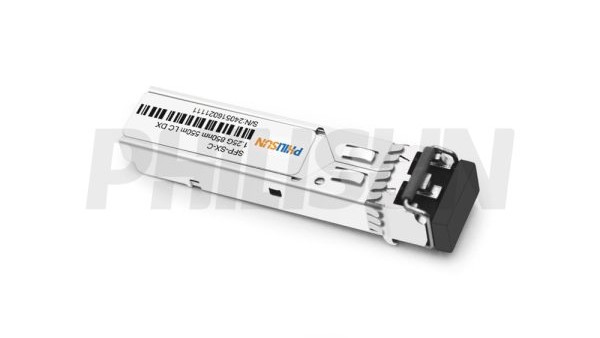
When procuring transceivers, B2B clients prioritize long-term reliability and guaranteed compatibility. PHILISUN meets this demand with its highly reliable 1.25G 850nm 550m LC Duplex SFP Module.
This specific transceiver is engineered to deliver:
- Optimal Performance: It guarantees 1.25G Gigabit Ethernet transmission using a high-quality 850nm VCSEL source.
- Extended Reach: The module is certified to achieve up to 550 meters over modern OM4 Multimode Fiber (MMF), covering the maximum distance required for most enterprise buildings and campus environments.
- Technical Compliance: It features the industry-standard LC Duplex connector interface and adheres strictly to the Multi-Source Agreement (MSA) specifications, ensuring seamless integration and full compatibility with major vendor platforms (Cisco, Juniper, etc.).
- Reliability: All PHILISUN modules include crucial Digital Diagnostics Monitoring (DDM) functionality, allowing network engineers to monitor parameters like optical power and temperature in real-time.
By offering products like this precisely specified 1.25G SFP, PHILISUN minimizes integration risks and lowers support costs, providing a reliable, cost-effective foundation for enterprise access layer networking.
Conclusion
The 1000BASE-SX SFP module remains the definitive choice for cost-effective, high-reliability Gigabit Ethernet over short to medium distances. While higher-speed standards like SFP+ and SFP28 are necessary for the core, the 1000BASE-SX provides the optimal balance of technical specification and low TCO required for the vast majority of enterprise access and aggregation links today.
Explore the specifications. Order the high-reliability PHILISUN 1.25G 850nm 550m LC Duplex SFP Module for your cost-effective enterprise networking needs!
FAQ
Q1: What is the maximum distance for the 1000BASE-SX SFP?
A1: The maximum distance is 550 meters when using high-quality OM4 Multimode Fiber (MMF).
Q2: What is the difference between SFP and SFP+?
A2: SFP supports 1 Gigabit speeds, while SFP+ supports 10 Gigabit speeds, although they share the same physical form factor.
Q3: What wavelength does the 1000BASE-SX use?
A3: It uses the short wavelength (short haul) 850nm, ideal for Multimode Fiber.
Q4: Is the 1000BASE-SX compatible with Single Mode Fiber (SMF)?
A4: No. For Single Mode Fiber, you would typically use the 1000BASE-LX SFP module.
Q5: What is the main advantage of using a VCSEL laser?
A5: VCSEL lasers are inexpensive to produce. They consume significantly less power than DFB lasers, contributing to the module’s low cost.