
The choice between Single Mode Fiber (SMF) and Multimode Fiber (MMF) is one of the most critical decisions facing network architects today. This decision directly impacts network speed, scalability, and long-term costs. While MMF has historically been dominant in shorter-reach enterprise Local Area Networks (LANs), the relentless demand for higher bandwidth (100G, 400G) and increased distance within data centers is forcing a strategic shift. This guide provides a technical deep dive into the core differences between SMF and MMF, helping you select the fiber that truly future-proofs your network.
Technical Fundamentals: Core Diameter and Light Path
The physical difference between the two fiber types dictates their performance envelope.
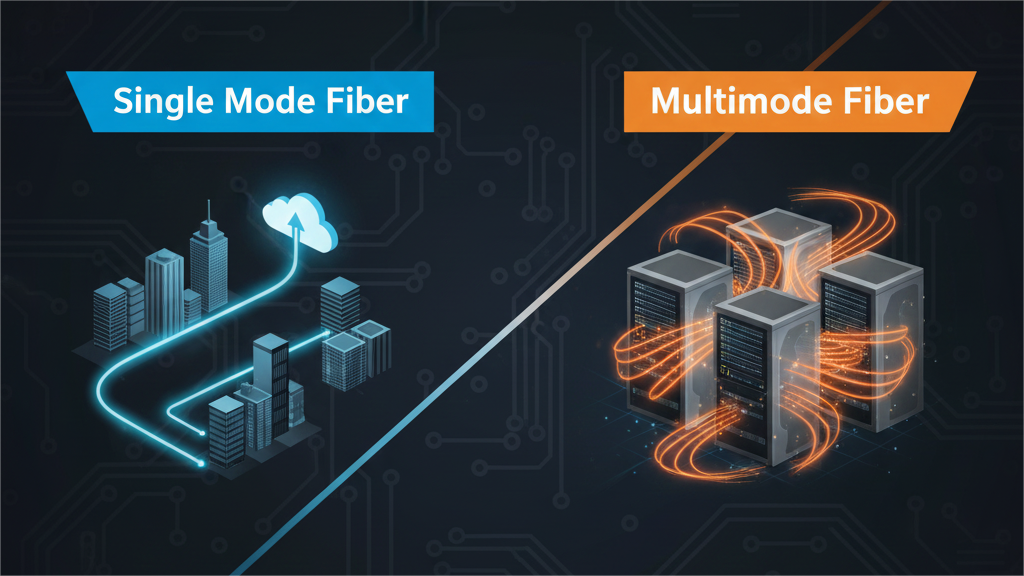
Defining Single Mode Fiber (SMF) and the Single Light Path
SMF (typically OS2 standard) has a tiny core diameter, usually around 9 µm. This narrow aperture forces the light signal to travel along a single, straight path. This action effectively eliminates Modal Dispersion (where light pulses stretch due to multiple light paths), allowing the signal to travel over vast distances—from 10 kilometers up to 80 kilometers—without significant distortion. SMF is the undisputed choice for long-haul and backbone connections.
Defining Multimode Fiber (MMF) and the Multiple Light Paths
MMF features a much wider core, typically 50 µm (OM3, OM4, OM5). This allows multiple rays (or modes) of light to be launched simultaneously. While this makes MMF cheaper and easier to work with, the varying path lengths cause the light pulse to spread out over distance, leading to modal dispersion. This limits MMF’s effective reach, though its lower equipment cost remains attractive for short links.
Wavelength and Light Source Differences
MMF relies on cheaper VCSELs (Vertical-Cavity Surface-Emitting Lasers) operating at 850nm. SMF requires more expensive, high-precision DFB/DML lasers at 1310nm or 1550nm to focus the light into the small core and ensure the single path is maintained.
Performance and Distance Comparison
When designing a network, architects must weigh equipment costs against performance scalability.
Distance Limitations and Bandwidth-Distance Product
| Fiber Type | Max Distance (40G/100G) | Key Limitation |
| Multimode (OM4) | 150m (100G) | Modal Dispersion |
| Single Mode (OS2) | 10km – 40km (100G) | Transceiver Power/Cost |
As data rates increase (e.g., from 10G to 100G), the maximum reliable distance for MMF shrinks dramatically, while SMF maintains its long-haul capability.
Cost Analysis: Transceivers vs. Cable Infrastructure
While MMF cable is often cheaper than SMF cable, the cost structure is reversed for the equipment. SMF transceivers (due to the precision lasers) are significantly more expensive than MMF VCSEL transceivers. Network planners must calculate the Total Cost of Ownership (TCO) across the entire link. For this calculation, PHILISUN provides high-quality, certified SMF and MMF transceivers that meet industry standards, allowing architects to accurately budget for link performance.
Insertion Loss and Link Budget Planning
Every splice, connector, and meter of fiber adds insertion loss (IL), reducing the signal strength. SMF generally has a lower inherent loss, making it easier to manage the link budget—the total allowable signal loss before the receiver fails.
Application Scenarios and Industry Standards
The fiber type dictates its role within the network topology.
Multimode Fiber Standards: OM3, OM4, and OM5
- OM3/OM4: Standard choices for 10G and 40G short-reach links within the same rack or row.
- OM5: The newest standard, optimized for SWDM (Shortwave Wavelength Division Multiplexing), extending 40G/100G distances slightly by utilizing four different wavelengths. PHILISUN specializes in providing the precision MPO cabling necessary to ensure OM5 performance adheres to standards.
Single Mode Fiber Applications: The Core Network and DCI
SMF is the undisputed choice for:
- Data Center Core/Spine: Connecting core switches and aggregation points.
- Data Center Interconnect (DCI): Linking separate campus buildings or facilities.
- 400G+ Links: As higher speeds require pristine signal integrity.
Bi-Directional (BiDi) Technology
BiDi transceivers allow two-way communication over a single strand of fiber (typically SMF), effectively doubling fiber utilization and reducing cable count.
Conclusion: Making the Right Fiber Investment
For short, static links (e.g., server rack access), MMF (OM4/OM5) remains a viable, cost-effective choice. However, for any link that might one day scale beyond 150 meters or require 400G bandwidth, Single Mode Fiber is the clear strategic imperative.
Optimize your network’s TCO and future-proof your infrastructure with certified SMF and MMF solutions. Contact PHILISUN for expert consultation and high-performance fiber optic products.
FAQ
Q1: What determines the maximum distance for Multimode Fiber?
A1: Modal dispersion, which is the spreading of light pulses due to multiple paths, limits MMF’s effective distance, especially at higher data rates (e.g., 40G/100G).
Q2: Which fiber type is typically more expensive to deploy?
A2: Single Mode (SMF) has higher initial equipment costs because its transceivers require expensive, precision lasers (DFB/DML).
Q3: What is the main benefit of OM5 fiber?
A3: OM5 is optimized for Shortwave Wavelength Division Multiplexing (SWDM), allowing multiple wavelengths to be transmitted simultaneously to extend distance slightly for 40G/100G.
Q4: Can I mix Single Mode and Multimode fiber on the same link?
A4: No. You must use media converters to transition between them, as their core sizes and light sources are fundamentally incompatible.
Q5: Why is Single Mode fiber considered “future-proof”?
A5: Its narrow core virtually eliminates dispersion, allowing it to support current and future technologies (e.g., 800G, 1.6T) simply by upgrading the optical transceiver electronics, not the cable itself.