
In the world of optical networking, even the smallest connection detail can make a big difference in performance. One of those crucial details is the type of connector polish — whether it’s a PC (Physical Contact), UPC (Ultra Physical Contact), or APC (Angled Physical Contact) connector. Each type of connector determines how efficiently light passes between fibers and how much reflection (or return loss) occurs at the connection point.
Selecting the right connector ensures stable transmission, minimal signal loss, and long-term reliability — especially in high-bandwidth environments like data centers or telecom backbones.
As a trusted manufacturer of fiber-optic connectivity products, PHILISUN provides a complete line of precision-engineered connectors and assemblies. Designed for superior performance, PHILISUN’s fiber connector solutions meet strict international standards and deliver exceptional stability for optical transceiver systems in modern networks.
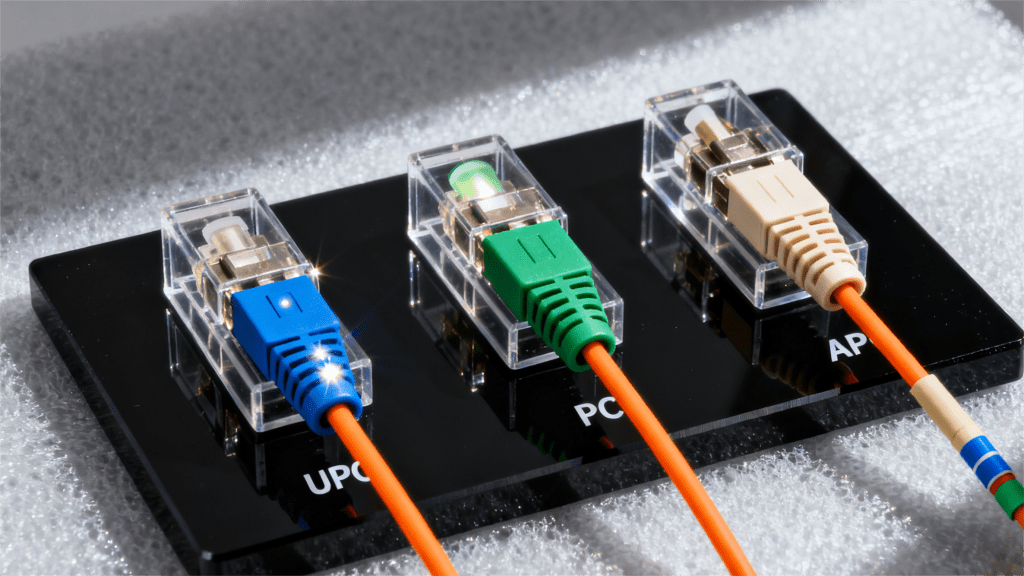
What Is a PC Connector?
The PC (Physical Contact) connector was developed as an improvement over the early “flat” fiber connectors, which often left an air gap between fiber ends, resulting in high reflection. PC connectors solved this by introducing a slightly curved (domed) ferrule end-face, ensuring physical contact between fibers.
This design greatly reduces back reflection compared to flat connectors and has become a standard for early single-mode and multimode networks.
Applications:
- Common in older LANs and multimode fiber installations
- Still used in legacy networks where compatibility is required
Pros:
- Affordable and easy to produce
- Better optical performance than flat connectors
Cons:
- Higher return loss compared to modern UPC or APC connectors
- Not suitable for ultra-high-speed or long-distance systems
What Is a UPC Connector?
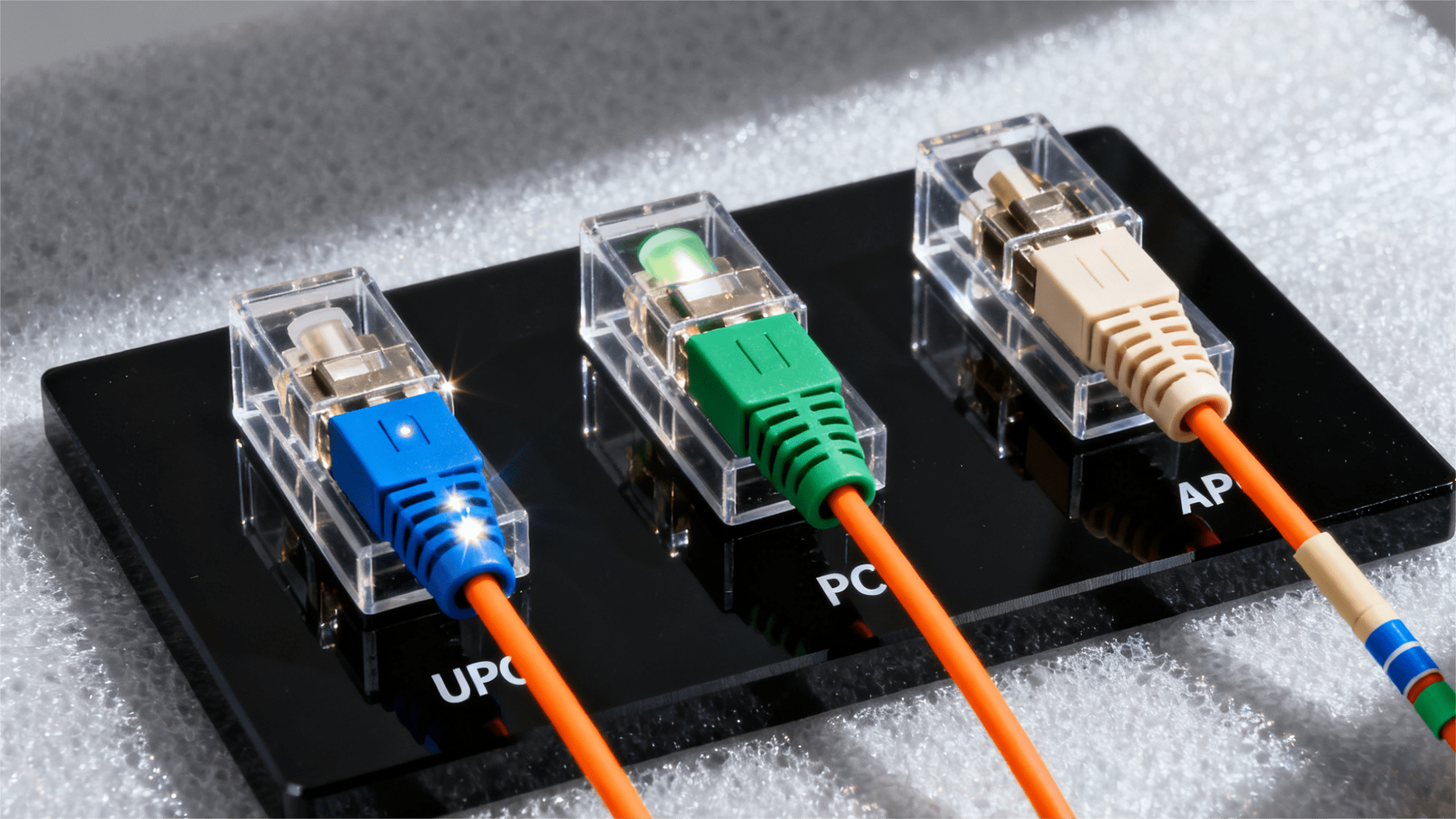
The UPC (Ultra Physical Contact) connector is a refined version of the PC design. Through advanced polishing techniques, the UPC connector achieves a more precise end-face surface with lower insertion loss and better return loss (typically −50 dB or better).
UPC connectors are recognized by their blue color, a standard identifier across the industry. They are widely used in digital signal transmission systems, including Ethernet, telecom, and high-speed data centers where minimizing reflection is essential.
Applications:
- Data centers and optical transceivers
- Digital communication systems (Ethernet, SONET, SDH)
- FTTH (Fiber to the Home) equipment
Pros:
- Lower return loss than PC connectors
- Ideal for digital networks
- Widely compatible and standardized
Cons:
- Still has some reflection; not ideal for analog or RF-over-fiber systems
What Is an APC Connector?
The APC (Angled Physical Contact) connector takes optical performance a step further by introducing an 8-degree angled ferrule end-face. This slight angle directs reflected light into the cladding rather than back toward the light source, reducing return loss to −60 dB or better.
APC connectors are easily identifiable by their green color and are the preferred choice for applications that require ultra-low reflection — such as analog signal transmission, CATV, 5G backhaul, and passive optical networks (PON).
Applications:
- 5G and RF-over-fiber systems
- CATV and broadcast
- Long-distance telecom and FTTH networks
Pros:
- Extremely low return loss (best optical performance)
- Prevents reflection issues in analog or high-frequency systems
Cons:
- Slightly higher cost due to angled polish
- Not interchangeable with UPC/PC connectors (mismatched connections cause severe signal degradation)
Comparison: PC vs. UPC vs. APC Connectors
| Feature | PC Connector | UPC Connector | APC Connector |
| End-Face Type | Curved | Ultra-smooth curved | 8° angled |
| Return Loss | −30 dB | −50 dB | −60 dB or better |
| Insertion Loss | ~0.3 dB | ~0.2 dB | ~0.3 dB |
| Color Code | None/Beige | Blue | Green |
| Application | Legacy systems | Digital networks | Analog / High-frequency |
| Interchangeable? | No | Yes (with UPC) | No |
| Typical Use Case | Multimode LAN | Data center / optical transceiver | 5G, CATV, telecom |
Mixing connector types — for example, using an APC connector with a UPC adapter — can cause serious signal reflection and performance issues. Always match connector types across your patch panels, adapters, and optical transceiver modules.
How to Choose the Right Connector for Your Network
Selecting between PC, UPC, and APC connectors depends largely on your network type, signal characteristics, and performance requirements. Here’s a simplified guide:
- PC Connectors – Suitable for legacy or short-distance multimode applications.
- UPC Connectors – The standard choice for data centers and optical transceiver-based networks where digital signals dominate.
- APC Connectors – The top choice for analog systems such as 5G networks, RF transmission, and FTTH that demand minimal back reflection.
If your network includes high-speed transceivers or dense patching environments, UPC and APC connectors from PHILISUN ensure reliable, high-performance operation under demanding conditions.
PHILISUN Fiber Connector Solutions
PHILISUN manufactures high-precision PC, UPC, and APC connectors optimized for modern optical networks. Each connector is polished using advanced 3D geometry control, guaranteeing stable insertion loss, exceptional durability, and repeatable performance.
Designed to integrate seamlessly with optical transceiver modules, PHILISUN connectors are widely deployed in data centers, FTTH networks, and 5G backhaul systems. The company also offers custom connector assemblies tailored to specific transmission requirements and cable architectures — ensuring perfect compatibility and long-term reliability.
Common FAQs about Fiber Connector Types
1. Can I mix UPC and APC connectors in one link?
No. Mixing UPC and APC connectors causes severe reflection loss and degraded performance. Always use matching polish types throughout a network.
2. Why are UPC connectors blue and APC connectors green?
The color coding helps technicians quickly identify connector types. Blue for UPC, green for APC — ensuring correct matching during installation.
3. Which connector type is best for optical transceivers?
UPC connectors are most commonly used with optical transceivers, as they provide excellent performance for digital data transmission.
4. Are APC connectors always better than UPC?
Not necessarily. APC connectors perform better in analog or long-distance applications, but UPC connectors are optimal for short-range digital links like data centers.
5. Does PHILISUN offer custom connector solutions?
Yes. PHILISUN provides OEM and ODM fiber connector solutions with tailored polish types, color coding, and cable configurations to fit your network design.
Conclusion
Whether you’re upgrading a data center, deploying 5G backhaul, or managing an enterprise network, choosing the right fiber connector type — PC, UPC, or APC — is vital for maintaining signal integrity and ensuring long-term network reliability.
PHILISUN delivers a comprehensive range of high-precision fiber connectors designed to meet diverse application needs. With a commitment to quality, consistency, and global standards compliance, PHILISUN ensures every connection in your optical system performs flawlessly.