
A common mistake in fiber deployment is treating every curve the same. Violating the Fiber Bend Radius (MBR) is the single fastest way to induce attenuation, exhaust your link budget, and compromise signal integrity. MBR is not a single value; rather, the industry defines two critical limits—often referred to as the “Min and Max”—that engineers must respect during different phases of deployment. This practical guide clarifies the crucial difference between the minimum bend radius required during cable installation versus the long-term, static radius. We provide the essential MBR calculation formula and highlight how modern durable fiber types solve this critical engineering challenge.
1. Why Two Limits Exist: Macrobending and Microbending Loss
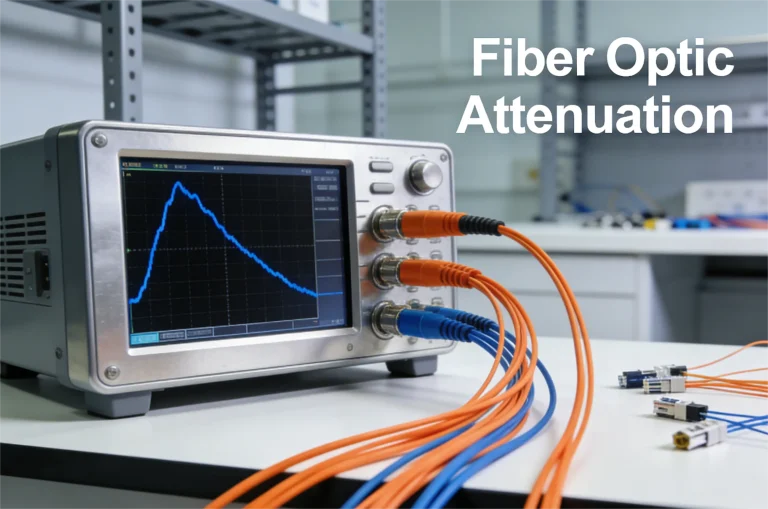
What happens to light when a fiber is bent too tightly? The primary problem is Attenuation, the loss of optical power. This loss is significantly increased by physical bending. To understand the need for two MBR limits, we must differentiate between two types of loss:
- Macrobending (The Visible Threat): This is the loss caused by violating the cable’s MBR, leading to light energy escaping the core and leaking into the cladding. This causes immediate, high loss, and often catastrophic link failure.
- Microbending (The Chronic Threat): This is the loss caused by microscopic pressure, stress, or minor irregularities (e.g., tight cable ties or uneven spools). It leads to chronic, low-level attenuation that is difficult to diagnose but can compromise the tight link budgets required for 400G networks.
2. Defining “Min” and “Max”: Installation vs. Long-Term MBR
How do the TIA standards define the two key MBR limits? The terms “Min” and “Max” effectively refer to the tighter (minimum static) and looser (maximum installation stress) MBR limits, respectively.
| MBR Limit Type | Commonly Referred to as… | When Does This Apply? | Why Does This Limit Exist? |
| Installation MBR | Maximum Stress Radius (Looser/Larger Bend) | During pulling or routing, when the cable is under maximum tensile stress. | To protect the entire cable assembly (jacket, buffer tubes, and fibers) from mechanical damage during installation. |
| Long-Term MBR | Minimum Static Radius (Tighter/Smaller Bend) | After installation, the cable is secured and resting statically in a tray or rack. | To prevent chronic macrobending and microbending loss during the cable’s operational life. |
3. Practical Calculation: Determining the MBR Limits
The required bend radius is directly proportional to the physical size of the cable. The Cable Outer Diameter (OD) is the key input for the standard MBR calculation.
| MBR Limit | Calculation Factor (TIA Rule of Thumb) | Formula |
| Installation MBR (“Max”) | 20 × Cable Outer Diameter (OD) | MBRinstall ≈ 20 × OD |
| Long-Term MBR (“Min”) | 10 × Cable Outer Diameter (OD) | MBRstatic ≈ 20 × OD |
Example: For an outdoor backbone cable with a 10mm OD:
The Installation MBR (“Max”) is 20 × 10mm = 200mm.
The Long-Term MBR (“Min”) is 10 × 10mm = 100mm.
Mandate: Always refer to the cable manufacturer’s technical datasheet for the precise MBR value, as it may be stricter than the general rule of thumb.
4. Reducing the “Min”: Bend-Insensitive Fiber (BIF) and Durability
How do we overcome the traditional “Min” bend radius limit in high-density areas? Modern fiber technology provides the answer.
- The BIF Solution: Bend-Insensitive Fiber (BIF), defined by ITU-T G.657 standards, contains a reflective “trench” around the fiber core. This trench traps light that attempts to escape during bending, dramatically reducing attenuation.
- Durability and Performance: BIF technology effectively reduces the Long-Term MBR (“Min”) to values as low as 5mm or 7.5mm (compared to 30mm for standard fiber). This resilience is crucial for protecting the tight link budgets of 400G and 800G systems from chronic microbending loss.
- PHILISUN Integration: PHILISUN integrates this advanced BIF technology into its high-density patch cords and MPO assemblies. By using BIF, PHILISUN ensures that its compact products maintain maximum durability and performance even in the most space-constrained data center environments.
5. Management Tactics: Preventing MBR Violations in Cabinets
What are the best practices for cable routing to respect the MBR limits?
- Installation Practice: Adhere strictly to the 20× OD rule during deployment, and never rely on the Long-Term MBR during pulling.
- Microbending Prevention: To avoid the chronic loss associated with microbending, never use tight plastic zip ties; instead, use wide, non-cinching Velcro straps to secure cables.
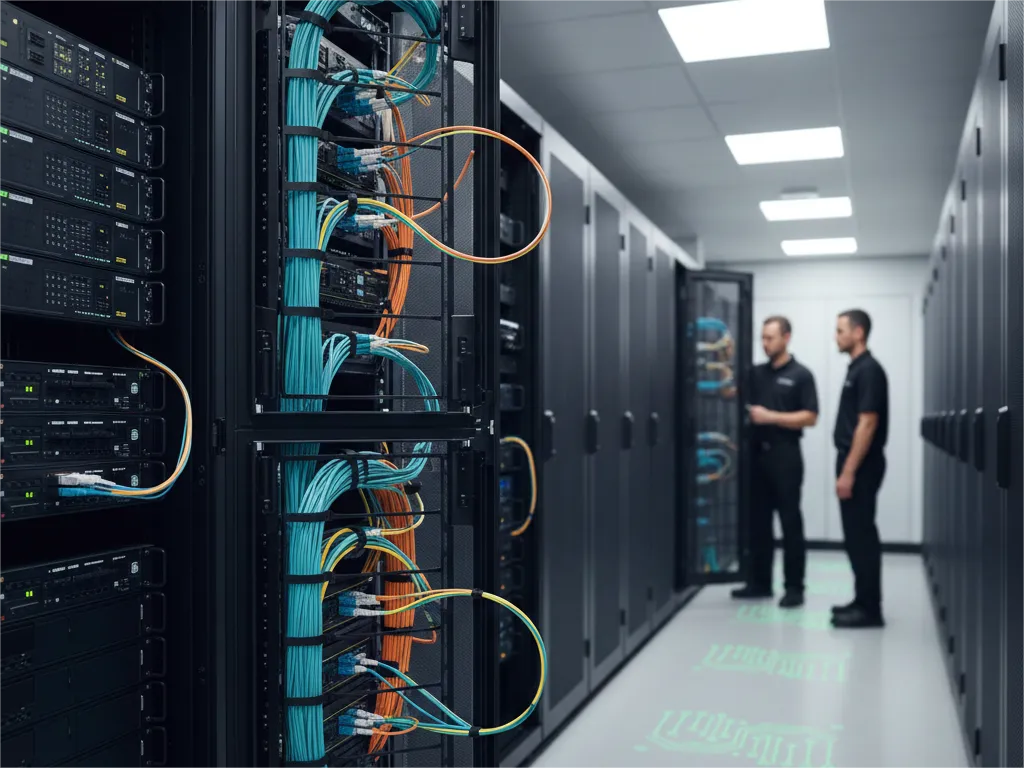
- Proper Routing Components: Utilize cable management systems (vertical rings, spools, and cable channels) specifically designed to maintain the required MBR in static rack environments.
6. Conclusion
Understanding the Min and Max bend radius is essential for signal integrity. The larger Installation MBR protects the fiber during deployment, while the tighter Long-Term MBR governs its final, static placement.
Need high-density cables you can trust?
PHILISUN provides a complete range of certified, Bend-Insensitive Fiber (BIF) solutions and MPO assemblies, engineered to exceed the toughest MBR requirements in any data center environment. Contact us today for a consultation on cable management solutions.
7. Frequently Asked Questions (FAQ) on Fiber Bend Radius
What is the MBR for standard single mode fiber?
Standard Single Mode Fiber (G.652) typically requires a Long-Term MBR of 10× the cable OD, which usually results in a minimum radius of 30mm for a typical 3mm patch cord. In contrast, Bend-Insensitive Fiber (G.657) can safely handle an MBR of 7.5mm or 5mm.
What happens if I violate the MBR?
Violating the MBR can result in two outcomes:
- Immediate Link Failure: High Macrobending loss that exceeds the link budget.
- Permanent Damage: Stress fractures or damage to the fiber and buffer tube, leading to chronic high attenuation and premature cable failure.
Does the cable jacket size affect MBR?
Yes. The MBR is calculated based on the cable’s Outer Diameter (OD), not the fiber core size. Thicker cables require a larger, more relaxed bend radius (e.g., backbone cable) than thin patch cords to protect the components and strength members inside.
Can BIF be used in long-haul networks?
Yes. Modern BIF (G.657) is backward compatible and functionally equivalent to standard Single Mode Fiber (G.652) over long distances. It is increasingly being adopted everywhere, especially in high-density or residential (FTTx) applications where bending stress is common.