

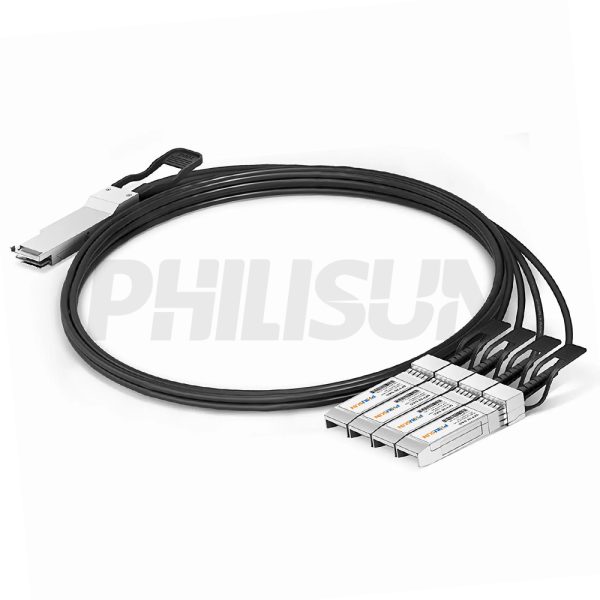
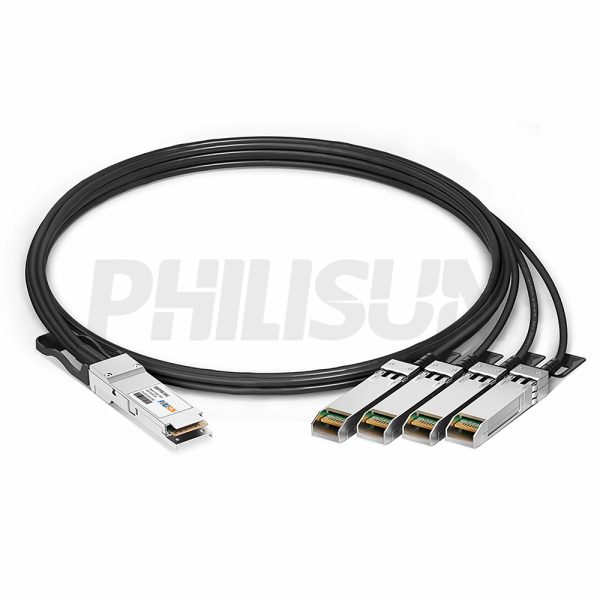
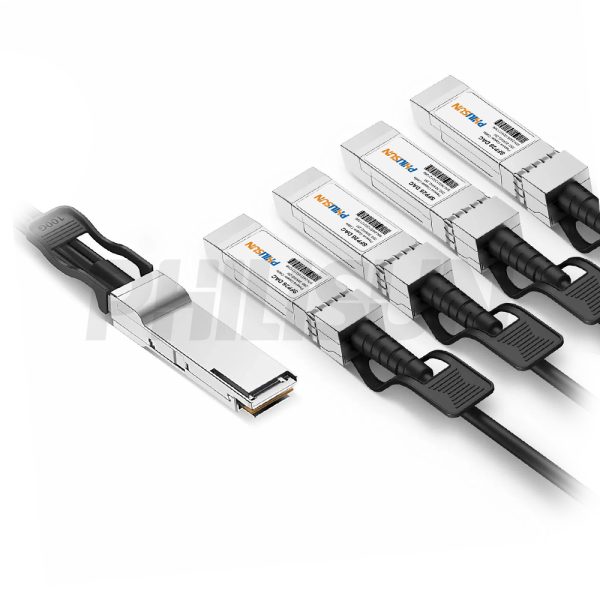
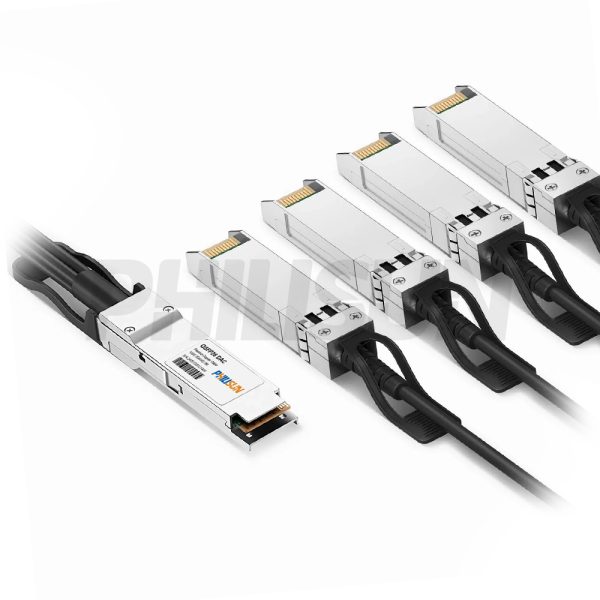
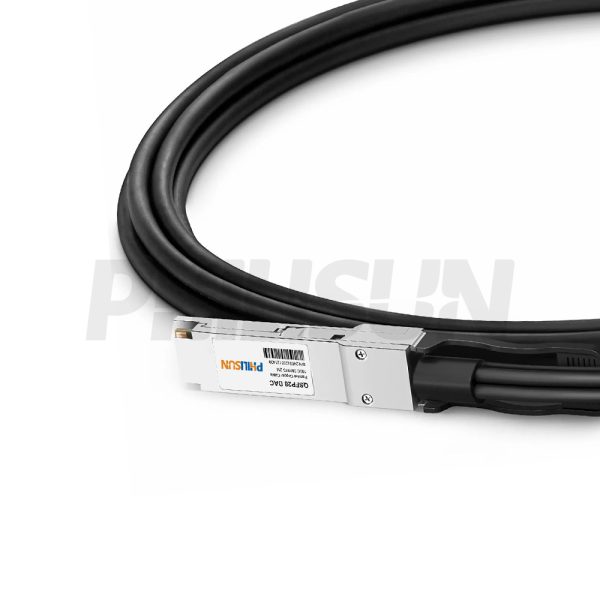
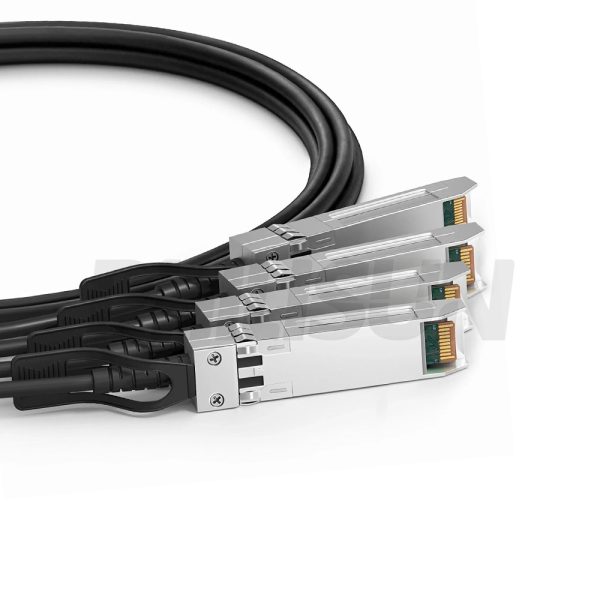
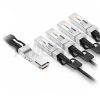
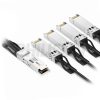
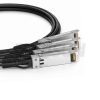
100G QSFP28 to 4×25G SFP28 Passive Direct Attach Copper Twinax Cable (DAC)
Compliant with IEEE 802.3、SFF-8665、SFF-8636、QSFP28 MSA standard
Switch to Switch
Switch to GPU
- High Quality
- Factory Outlet
- Satisfaction Guarantee
- Global Shipping
| SPECIFICATIONS | |||
|---|---|---|---|
| Cable End Connector A | QSFP28 | Cable End Connector B | 4×SFP28 |
| Jumper Type | Direct-Attach Breakout | Data Rate | 100G |
| Aggregate Bit Rate | 103.125Gbps | Lane Bit Rate | 25.78125Gbps |
| Number of Channels | 4 | Single Channel Rate | 25G |
| Minimum Bend Radius | 5X Cable OD -Single, 10X Cable OD - Repeated | Factory Brand | PHILISUN |
| Attenuation | 26AWG:10dB/8.5m maximum 30AWG:8.4dB/5.5m maximum | Bit Error Rate | ≤10-12 |
| Shield | Braid/Foil | Wire AWG | 26AWG/30AWG |
| Cable Type | Passive Twinax | Cable OD | 30AWG: 12.0mm 26AWG: 14.0mm |
| Cable Colour/Material | Black PVC(OFNR) | Cable Length Selection | 0.5-5 meter |
| Protocols | IEEE 802.3bj/QSFP28 MSA/100GEBASE-CR4 /SFP28 MSA/SFF-8402/SFF-8432/SFF-8665 | Application Scenarios | 100 to 4x25Gigabit Ethernet (100GbE) |
| Supply Voltage | 3.3V | Power Dissipation | <0.125W |
| Operating Temperature | 0 to 70℃ (32 to 158℉) | Storage Temperature | -40 to 85℃ (-40 to 185℉) |
PRODUCT PRESENTATION
The PHILISUN 100G QSFP28 to 4x25G SFP28 Passive Direct Attach Copper Twinax Cable (DAC) is an essential Breakout Cable solution, segmenting a single 100G port into four 25G SFP28 links. This Passive Copper DAC Cable is compliant with the IEEE 802.3, SFF-8665, SFF-8636, and QSFP29 MSA standard, ensuring wide compatibility for Server Interconnects. It delivers Ultra-Low Latency and is highly Cost-Effective for maximizing port density in Data Center racks, supporting scalable Switch to Switch connections and high-throughput paths from Switch to GPU systems.
DAC SERIES PRODUCTS
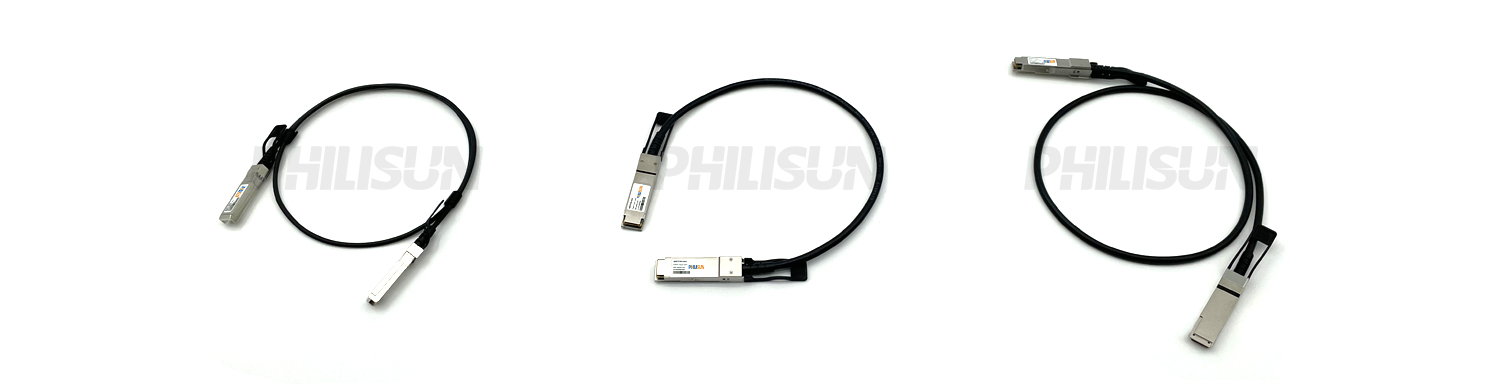
PRODUCTION & TESTING EQUIPMENT

PERFORMANCE PARAMETER
| Absolute Maximum Ratings | |||||||||
| Parameter | Min. | Max. | Unit | ||||||
| Supply voltage | -0.3 | 3.6 | V | ||||||
| Data input voltage | -0.3 | 3.6 | V | ||||||
| Control input voltage | -0.3 | 3.6 | V | ||||||
| Recommended Operating Environment | |||||||||
| Parameter | Symbol | Min. | Typ. | Max. | Unit | ||||
| Caseoperating Temperature | TC | 0 | – | +70 | ℃ | ||||
| Supply Voltage | VCCT, R | +3.13 | 3.3 | +3.47 | V | ||||
| Power Dissipation | PD | – | – | 0.1 | W | ||||
| Operating relative humidity | – | 5 | – | 85 | % | ||||
| Electrical Characteristics | |||||||||
| Parameter | Min. | Typ. | Max. | Unit | |||||
| Characteristic impedance | 90 | 100 | 110 | Ω | |||||
| Time delay | – | – | 4.5 | ns/m | |||||
| Time delay skew (in the same pair) | – | – | 10 | ps | |||||
| Time delay skew (pair to pair) | – | – | 50 | ps | |||||
| High Speed Characteristics | |||||||||
| Parameter | Symbol | Min | Typ. | Max | Unit | Note | |||
| Differential Impedance | RIN, P-P | 90 | 100 | 110 | Ώ | – | |||
| Insertion loss | SDD21 | 8 | – | 22.48 | dB | At 12.8906 GHz | |||
| Differential Return Loss | SDD11 SDD22 | 12.45 | – | See 1 | dB | At 0.05 to 4.1 GHz | |||
| 3.12 | – | See 2 | dB | At 4.1 to 19 GHz | |||||
| Common-mode tocommon mode output return loss | SCC11 SCC22 | 2 | – | – | dB | At 0.2 to 19 GHz | |||
| Differential to common-mode return loss |
SCD11 SCD22 |
12 | – | See 3 | dB | At 0.01 to 12.89 | |||
| 10.58 | – | See 4 | At 12.89 to 19 GHz | ||||||
| Differential to common Mode Conversion Loss |
SCD21-IL | 10 | – | See 5 | dB | At 0.01 to 12.89 | |||
| – | – | At 12.89 to 15.7 | |||||||
| 6.3 | – | At 15.7 to 19 GHz | |||||||
| Channel Operating Margin | COM | 3 | – | – | dB | – | |||
| Notes: 1.Reflection Coefficient given by equation SDD11(dB) < 16.5 – 2×SQRT(f ), with finGHz 2.Reflection Coefficient given by equation SDD11(dB) < 10.66 – 14×log10(f/5.5), with finGHz 3.Reflection Coefficient given by equation SCD11(dB) < 22 – (20/25.78)*f, with finGHz 4.Reflection Coefficient given by equation SCD11(dB) < 15 – (6/25.78)*f, with finGHz 5.Reflection Coefficient given by equation SCD21(dB) < 27 – (29/22)*f, with finGHz |
|||||||||
QSFP28 Module Pad Layout
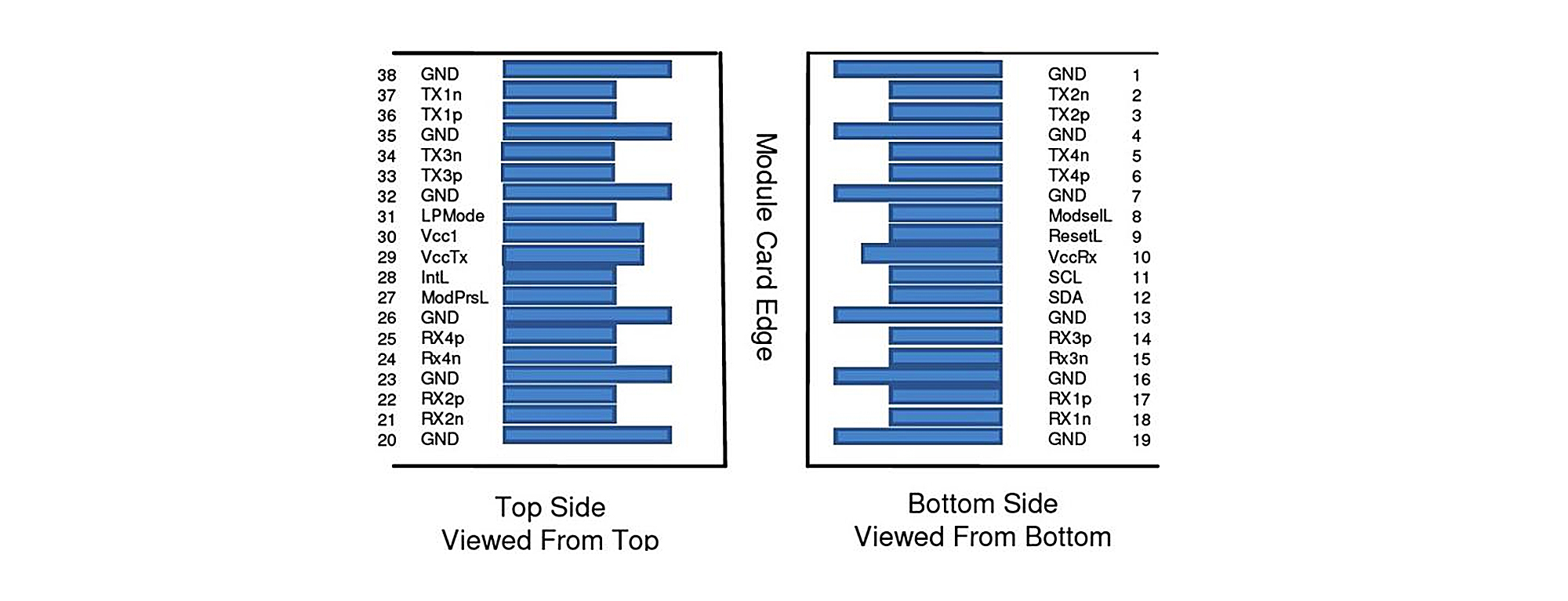
| PIN | Logic | Symbol | Name/Description | Note | |||||
| 1 | GND | GND | Ground | 1 | |||||
| 2 | CML-I | Tx2n | Transmitter Inverted Data | – | |||||
| 3 | CML-I | Tx2p | Transmitter Non-Inverted | – | |||||
| 4 | – | GND | Ground | 1 | |||||
| 5 | CML-I | Tx4n | Transmitter Inverted Data | – | |||||
| 6 | CML-I | Tx4p | Transmitter Non-Inverted | – | |||||
| 7 | – | GND | Ground | 1 | |||||
| 8 | LVTTL-I | ModSelL | Module Select | – | |||||
| 9 | LVTTL-I | ResetL | Module Reset | – | |||||
| 10 | – | Vcc Rx | +3.3V Power Supply | 2 | |||||
| 11 | LVCMOSI/O | SCL | 2-wire serial interface | – | |||||
| 12 | LVCMOSI/O | SDA | 2-wire serial interface data | – | |||||
| 13 | – | GND | Ground | 1 | |||||
| 14 | CML-O | Rx3p | Receiver Non-Inverted | – | |||||
| 15 | CML-O | Rx3n | Receiver Inverted Data | – | |||||
| 16 | – | GND | Ground | 1 | |||||
| 17 | CML-O | Rx1p | Receiver Non-Inverted Data | – | |||||
| 18 | CML-O | Rx1n | Receiver Inverted Data | – | |||||
| 19 | – | GND | Ground | 1 | |||||
| 20 | – | GND | Ground | 1 | |||||
| 21 | CML-O | Rx2n | Receiver Inverted Data | – | |||||
| 22 | CML-O | Rx2p | Receiver Non-Inverted Data | – | |||||
| 23 | – | GND | Ground | 1 | |||||
| 24 | CML-O | Rx4n | Receiver Inverted Data | – | |||||
| 25 | CML-O | Rx4p | Receiver Non-Inverted Data | – | |||||
| 26 | – | GND | Ground | 1 | |||||
| 27 | LVTTL-O | ModPrsL | Module Present | – | |||||
| 28 | LVTTL-O | IntL | Interrupt | – | |||||
| 29 | – | Vcc Tx | +3.3V Power supply | 2 | |||||
| 30 | – | Vcc1 | +3.3V Power supply | 2 | |||||
| 31 | LVTTL-I | LPMode | Low Power Mode | – | |||||
| 32 | – | GND | Ground | 1 | |||||
| 33 | CML-I | Tx3p | Transmitter Non-Inverted | – | |||||
| 34 | CML-I | Tx3n | Transmitter Inverted Data | – | |||||
| 35 | – | GND | Ground | 1 | |||||
| 36 | CML-I | Tx1p | Transmitter Non-Inverted | – | |||||
| 37 | CML-I | Tx1n | Transmitter Inverted Data | – | |||||
| 38 | Tx1p | GND | Ground | 1 | |||||
| Notes: 1.GND is the symbol for signal and supply (power) common for the QSFP28 module. All are common within the QSFP28 module and all module voltages are referenced to this potential unless otherwise noted. Connect these directly to the host board signal-common ground plane. 2.VccRx, Vcc1 and VccTx are the receiver and transmitter power supplies and shall be applied concurrently. Requirements defined for the host side of the Host Edge Card Connector are listed in Table 6. Recommended host board power supply filtering is shown in Figure4. VccRx, Vcc1 and VccTx may be internally connected within the QSFP28 Module module in any combination. The connector pins are each rated for a maximum current of 500mA. |
|||||||||
SFP28 Pin Descriptions
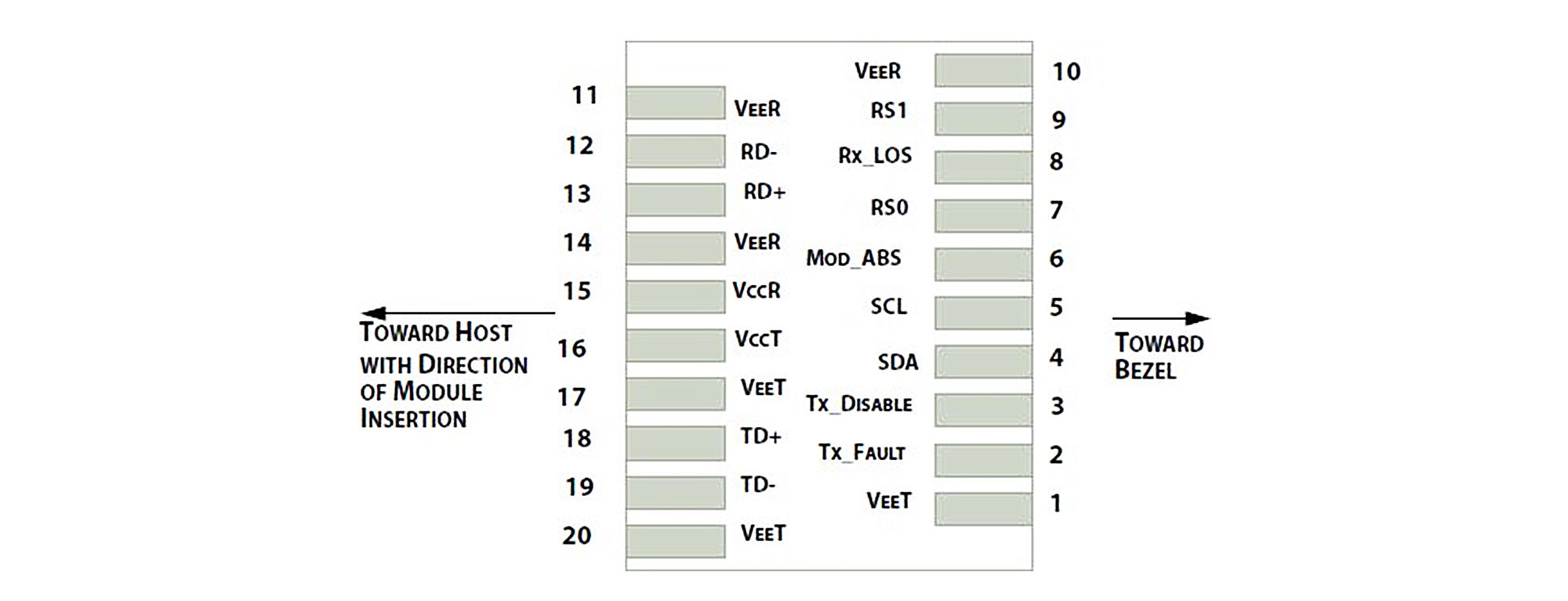
| PIN | Logic | Symbol | Name/Description | Note | |||||
| 1 | – | VeeT | Transmitter Ground | – | |||||
| 2 | LV-TTL-O | TX_Fault | N/A | 1 | |||||
| 3 | LV-TTL-I | TX_DIS | Transmitter Disable | 2 | |||||
| 4 | LV-TTL-I/O | SDA | Tow Wire Serial Data | – | |||||
| 5 | LV-TTL-I | SCL | Tow Wire Serial Clock | – | |||||
| 6 | – | MOD_DEF0 | Module present, connect | – | |||||
| 7 | LV-TTL-I | RS0 | N/A | 1 | |||||
| 8 | LV-TTL-O | LOS | LOS of Signal | 2 | |||||
| 9 | LV-TTL-I | RS1 | N/A | 1 | |||||
| 10 | – | VeeR | Reciever Ground | – | |||||
| 11 | – | VeeR | Reciever Ground | – | |||||
| 12 | CML-O | – | Reciever Data Inverted | – | |||||
| 13 | CML-O | RD+ | Reciever Data | – | |||||
| 14 | – | VeeR | Reciever Ground | – | |||||
| 15 | – | VccR | Reciever Supply 3.3V | – | |||||
| 16 | – | VccT | Transmitter Supply 3.3V | – | |||||
| 17 | – | VeeT | Transmitter Ground | – | |||||
| 18 | CML-I | TD+ | Transmitter Data | – | |||||
| Notes: 1.Signals not supported in SFP28 Copper pulled-downto VeeT with 30K ohms resistor. 2.Passive cable assemblies do not support LOS and TX_DIS. |
|||||||||
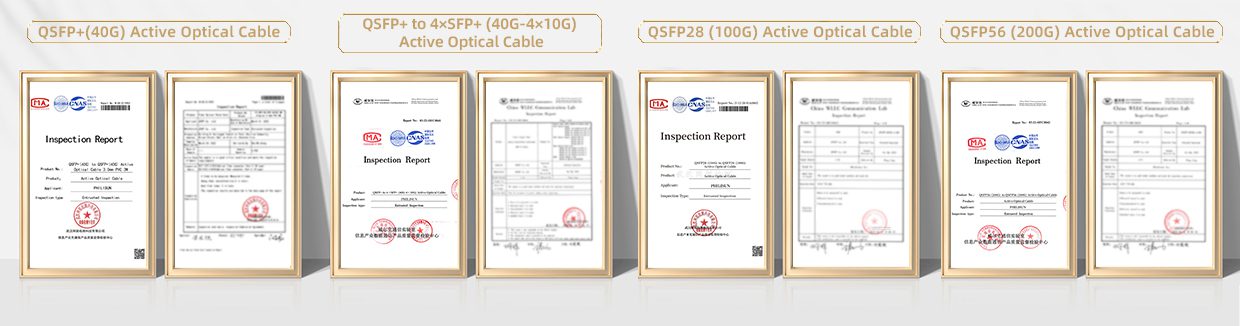
PRODUCT CERTIFICATION
COMPATIBLE BRANDS

CONFIGURATION INFORMATION
Related products
-
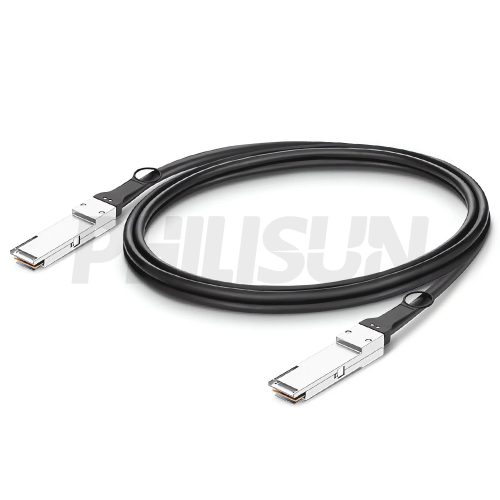
100G QSFP28 to QSFP28 Passive Direct Attach Copper Twinax Cable (DAC)
Compliant with IEEE 802.3、SFF-8662、QSFP28 MSA standard
Switch to Switch
Switch to GPU -
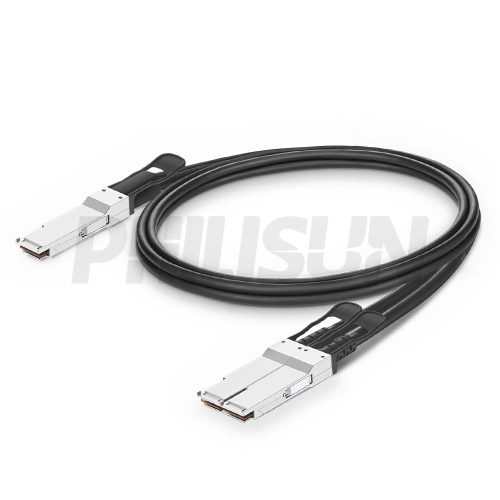
100G QSFP28 to 2×50G QSFP28 Passive Direct Attach Copper Twinax Cable (DAC)
Compliant with IEEE 802.3、SFF-8665、SFF-8636、QSFP28 MSA standard
Switch to Switch
Switch to GPU