
Choosing between CWDM vs DWDM is a pivotal strategic decision for any network architect or procurement manager. While both Coarse Wavelength Division Multiplexing (CWDM) and Dense Wavelength Division Multiplexing (DWDM) utilize the same fiber plant, their differences in channel spacing translate directly into trade-offs regarding initial cost, maximum distance, and capacity ceiling. This guide clarifies the commercial and technical factors, helping you select the technology that best maximizes long-term network efficiency and prepares your infrastructure for guaranteed future growth.

Core Technical Differences: Wavelength Spacing and Laser Type
The financial disparity between CWDM and DWDM stems directly from one fundamental technical difference: wavelength spacing. This spacing dictates the complexity of the internal components, particularly the lasers.
What is the Fundamental Difference Between CWDM and DWDM Channel Spacing?
- CWDM’s Wide Channels: CWDM uses a wide channel separation of 20 nm (nanometers). This broad spacing is less demanding on component precision and thermal stability. CWDM traditionally offers 8 channels, expandable to 18 channels by utilizing the E-band (1360 nm to 1460 nm).
- DWDM’s Dense Channels: DWDM employs extremely narrow channel separations, typically 0.8 nm or 0.4 nm (based on the ITU-T grid). This density allows for 40, 80, or even 96+ channels to be packed into the C-band window, but requires high precision to prevent adjacent channel interference.
CWDM’s Wide Channel and Uncooled Laser Advantage
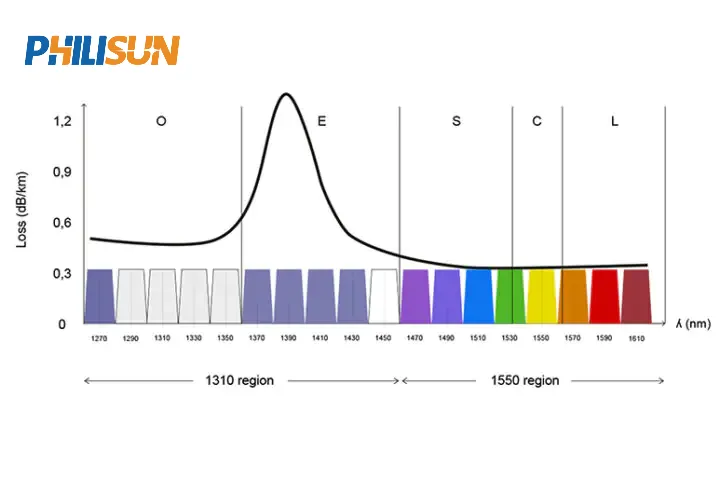
The wide 20 nm spacing of CWDM is generous enough to allow the system to tolerate significant drift in the laser’s wavelength due to ambient temperature fluctuations. Consequently, CWDM transceivers can utilize uncooled lasers.
Uncooled lasers are simpler, cheaper to manufacture, and consume less power. This is the primary reason CWDM is the go-to solution for initial low-capacity network deployments in access and metro environments where the priority is low upfront cost. While performance is reliable, the lack of temperature control limits the ultimate channel density and precision.
DWDM’s Dense Channel and Cooled Laser Necessity
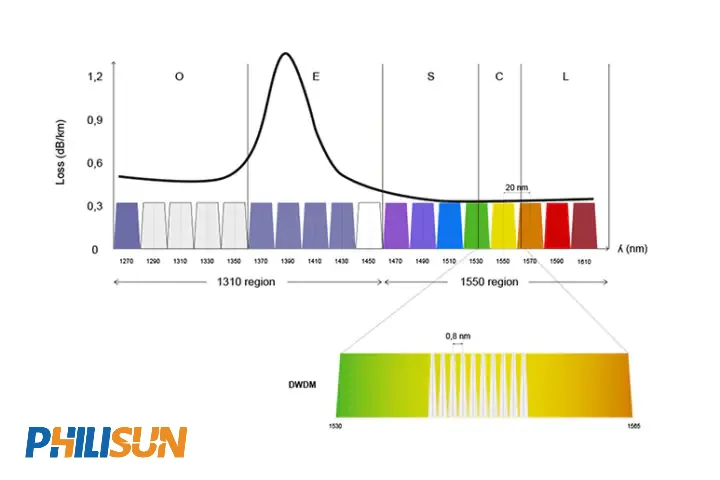
Conversely, DWDM’s dense grid requires the laser wavelength to remain highly stable, often within ±6 picometers (pm). To achieve this stability, DWDM transceivers incorporate a TEC (Thermoelectric Cooler), a device that actively maintains the laser diode’s temperature regardless of external conditions.
This active thermal management significantly increases the cost and complexity of the DWDM module, resulting in a higher initial capital expenditure (CapEx). However, this engineering is necessary to enable the high channel count required for core networks and long-haul transport and is crucial for maintaining signal quality over long distances.
The Cost Equation: Initial Investment vs. Long-Term Expense
The choice between the two technologies must be based on a thorough analysis, balancing the lower CapEx of CWDM against the lower long-term cost-per-bit achieved by DWDM.
Is CWDM Always the Most Cost-Effective Solution for Your Network?
For short-term, low-capacity needs (e.g., 8-16 channels up to 50 km), CWDM provides the clear cost winner due to low component costs and minimal power draw (OPEX). However, if your capacity needs double within 3-5 years, the cost of installing a second fiber pair (due to CWDM’s capacity limit) may quickly eliminate the initial CWDM savings. The decision must be viewed through the lens of bandwidth longevity.
Component Cost Breakdown: Transceiver Complexity and Filters
The component price variance is significant:
- Transceivers: A DWDM SFP+ module typically costs 3 to 5 times more than an equivalent CWDM SFP+ module due to the integrated TEC and required precision optics. When sourcing, prioritizing high-quality, third-party solutions can significantly lower this CapEx. For reliable 10G links under 80km, PHILISUN SFP-CWDM-10G Series Transceivers offer an optimal balance of cost and performance.
- MUX/DEMUX Filters: CWDM MUX/DEMUX filters are simpler and cheaper due to the 20 nm channel spacing, whereas DWDM filters require complex, highly precise thin-film filter technology, driving up the passive equipment cost.
Power Consumption and Operational Expense (OPEX)
The integrated TEC in a DWDM transceiver is an active power sink. While a DWDM network provides superior capacity, its overall power draw per channel is higher than CWDM. For massive Data Center Interconnects (DCI) where hundreds of transceivers are deployed, the cumulative OPEX from cooling and power consumption becomes a significant factor, favoring the passive nature of CWDM if capacity allows.
Application Alignment: Matching Technology to Network Tier
Optimal deployment relies on matching the technology’s capabilities (distance, capacity) to the network’s function (access, metro, core).
CWDM’s Role in Access, Metro, and MDU Networks (Short Reach)
CWDM is perfectly suited for “last mile” and “middle mile” applications where traffic is relatively stable, and latency is not ultra-critical:
- Access Networks: Connecting enterprise buildings or cell towers within a 40 km radius.
- Metro Ring Networks: Short-distance rings where capacity is limited to 10G or less per service.
- Multi-Dwelling Unit (MDU) Interconnects: Delivering basic fiber services in urban environments.
CWDM’s low cost and simplicity of deployment make it the preferred choice for these localized, capacity-controlled environments.
DWDM’s Dominance in Core, Long-Haul, and Data Center Interconnect (DCI)
DWDM is mandatory where capacity and distance are non-negotiable requirements:
- Core Networks: Transporting signals across thousands of kilometers.
- Data Center Interconnect (DCI): Linking two major data centers with massive bandwidth (400G/800G) and requiring low latency over 100+ km.
- Long-Haul Transport: Applications requiring high-capacity, long-distance transmission, where signal amplification is essential.
Achieving High-Capacity Density and Future Scalability
If the forecast indicates a need for more than 16 channels or a data rate exceeding 25G per channel, the strategic advantage shifts decisively towards DWDM, as its superior density provides a clear, cost-effective path to scalability.
Maximum Channel Count Comparison (18 Channels vs. 80+ Channels)
CWDM’s maximum theoretical limit is 18 channels. Once this limit is reached, scaling further requires installing new dark fiber or upgrading the entire architecture, both of which are extremely expensive and disruptive.
DWDM, conversely, starts at 40 channels and scales easily to 80 or 96 channels, all within the existing fiber pair. This eliminates the need for expensive physical infrastructure changes, making the higher initial CapEx of DWDM a worthwhile investment for growth-oriented networks.
DWDM as the Foundation for 100G, 400G, and 800G Coherent Systems
Modern high-speed standards rely entirely on the precision and bandwidth provided by the DWDM C-band. Technologies like 400G-ZR and 800G Coherent optics, which achieve massive data rates over long distances, require the tight channel spacing and thermal stability inherent to DWDM.
Any network planning to deploy 100G, 400G, or 800G services over distances greater than 80 km must select DWDM as the underlying transport architecture. For reliable high-speed DCI links, sourcing precision components is paramount. PHILISUN SFP-DWDM-10G Series Transceivers are engineered for superior channel isolation, ensuring error-free operation in dense deployments.
Conclusion
The choice between CWDM vs DWDM is ultimately an application and budget decision. CWDM is the cost-efficient champion for short, capacity-limited access networks, while DWDM is the mandatory, long-term strategic investment for core, long-haul, and DCI applications requiring massive scalability and high data rates (100G+). By precisely matching the technology’s cost, reach, and scalability to your business needs, you guarantee optimal network performance. Contact PHILISUN today for a detailed consultation on optimizing your WDM fabric and securing the best component choice for your network’s future.