
Struggling to choose the right cable for your 40G or 100G data center upgrade? Selecting the wrong fiber—OM3 fiber vs OM4 fiber—can severely limit link distance, degrade performance, and force expensive re-cabling later. This essential guide provides clear, data-driven answers and technical comparisons. Stop risking your infrastructure budget; confidently choose the correct multimode fiber to future-proof your high-speed network. We will explore the technical nuances and operational trade-offs to show exactly why the superior performance of OM4 fiber often justifies the slight increase in cost, securing your data center’s future readiness. For guaranteed performance and certified quality, professionals trust PHILISUN fiber assemblies.
What is the Core Technical Difference Between OM3 Fiber and OM4 Fiber?
The decision between OM3 fiber vs OM4 fiber multimode fiber hinges on one core technical specification: bandwidth. Both are Laser-Optimized Multimode Fiber (LOMMF) designed for use with inexpensive 850 nm Vertical-Cavity Surface-Emitting Lasers (VCSELs). However, the difference in manufacturing precision directly impacts performance.
The key differentiator is the Effective Modal Bandwidth (EMB), measured in MHz·km. EMB quantifies the fiber’s ability to transmit multiple light modes without severe signal dispersion, which causes data loss over distance. Higher EMB means the signal can travel farther before modal dispersion corrupts the data pulse, thereby supporting higher speeds over longer links.
The comparison below illustrates the significant technical leap from OM3 fiber to OM4 fiber:
| Specification | OM3 Multimode Fiber | OM4 Multimode Fiber |
| Fiber Diameter | 50/125 µm | 50/125 µm |
| EMB @ 850 nm (Minimum) | 2000 MHz·km | 4700 MHz·km |
| Maximum Attenuation @ 850 nm | 3.5 dB/km | 3.5 dB/km |
| Attenuation at 1300 nm | 1.5 dB/km | 1.5 dB/km |
| ISO/IEC Standard | ISO 11801 OM3 | ISO 11801 OM4 |
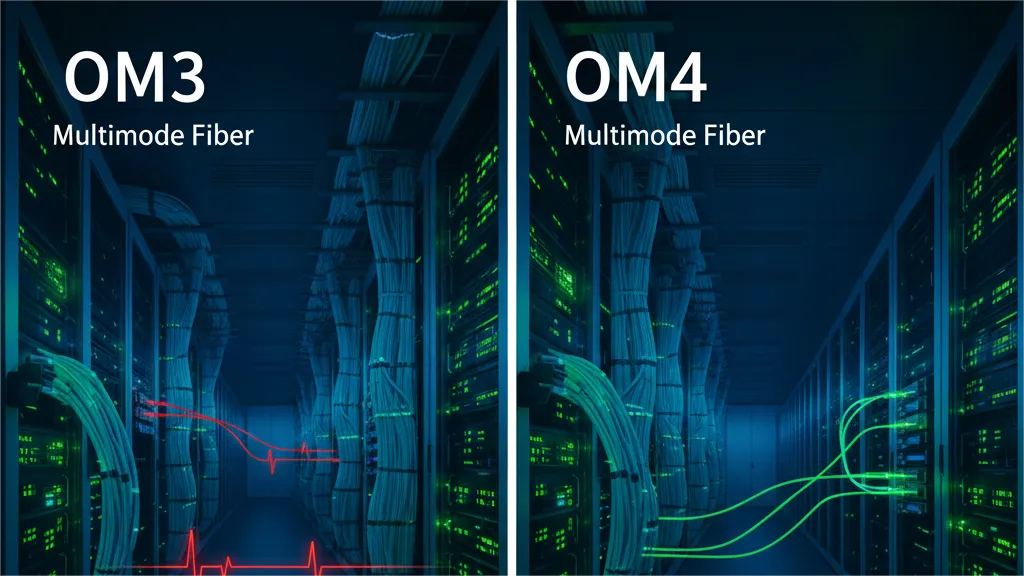
As the data shows, OM4 fiber offers more than double the effective modal bandwidth of OM3 fiber. This enhanced bandwidth is achieved through stricter control over the refractive index profile during manufacturing, leading directly to the extended reach required for modern data center backbones.
Which Fiber Goes Further? OM3 Fiber vs OM4 Fiber Distance Limits at High Speeds
Selecting the appropriate multimode fiber is primarily a calculation of required speed versus maximum distance. For data center topologies, the link distance performance of OM3 fiber vs OM4 fiber determines where each fiber type can be reliably deployed.
A. Distance Performance Quick Reference Table
The following table uses industry-standard IEEE specifications for maximum link distances on various Ethernet protocols:
| Ethernet Standard | Multimode Fiber Type | Maximum Distance (m) |
| 10GBASE-SR | OM3 | 300 m |
| OM4 | 550 m | |
| 40GBASE-SR4 | OM3 | 100 m |
| OM4 | 150 m | |
| 100GBASE-SR4 | OM3 | 70 m |
| OM4 | 100-125 m | |
| 400GBASE-SR8 | OM3 | 50 m |
| OM4 | 70 m |
B. Is OM3 Fiber Sufficient for 10GBASE-SR Links?
For many smaller organizations or simple intra-rack connections, OM3 fiber is often sufficient and remains a cost-effective choice.
- OM3 Fiber Suitability: If your longest link distance for 10 Gigabit Ethernet (10GBASE-SR) is 300 meters or less, OM3 fiber is a perfectly viable and budget-friendly option. It is excellent for server-to-Top-of-Rack (ToR) switch links and short backbone segments.
- OM4 Fiber Value Proposition: However, in large corporate campuses or data centers spanning multiple adjacent buildings, OM4 fiber offers substantial value. By extending the 10GBASE-SR reach to 550 meters, OM4 fiber allows for consolidated infrastructure and reduces the need for expensive fiber-to-fiber repeaters or single-mode transceivers, simplifying network design.
C. When Must I Choose OM4 Fiber for 40G and 100G Ethernet?
The true necessity of OM4 fiber becomes apparent when deploying high-density 40G and 100G network tiers, which are foundational to modern spine-and-leaf data center architectures.
- OM3 Fiber Limitations: While OM3 fiber technically supports 40GBASE-SR4 up to 100 meters, this short reach is highly restrictive. For 100GBASE-SR4, the limit drops further to a tight 70 meters. This distance barely covers the path across a medium-sized facility, leaving almost no performance margin for patching or complex routing.
- OM4 Fiber Superiority: OM4 fiber significantly alleviates these constraints. By extending the reach to 150 meters for 40G and 100–125 meters for 100G, OM4 fiber ensures that data center managers have the flexibility to deploy spine and aggregate switches across larger areas. Choosing OM4 fiber vs OM3 fiber in this context is less about saving money and more about guaranteeing the physical reliability and reach of the core network. This added performance margin is critical for highly reliable, large-scale deployments.
OM3 Fiber vs OM4 Fiber: Is the Higher Cost Worth the Future-Proofing?
When evaluating the cost of OM3 fiber vs OM4 fiber, it is essential to look beyond the initial purchase price of the cable itself and consider the total cost of ownership (TCO) over a decade.
A. Initial Cost Analysis
Typically, OM4 fiber multimode fiber cable is approximately 15% to 25% more expensive per meter than OM3 fiber. However, this marginal cost increase often fades when considering the total bill of materials for a high-speed link:
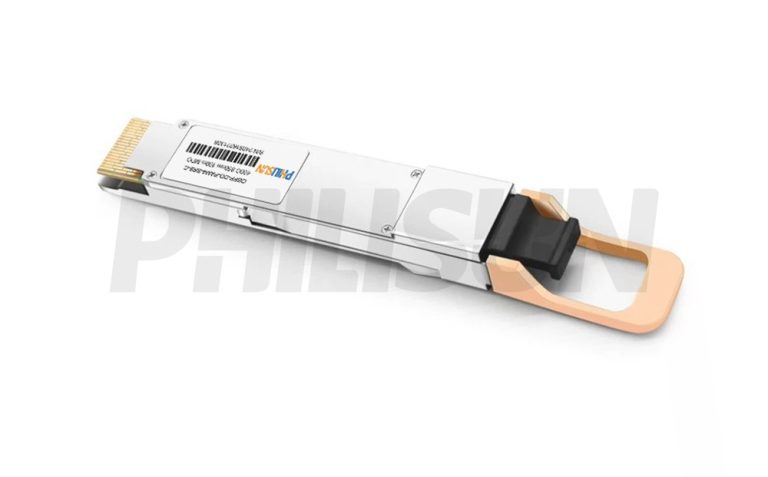
- Transceivers: The primary cost driver is the SFP+/QSFP+ transceiver. Since both OM3 fiber and OM4 fiber use the same 850 nm VCSEL transceivers (like 40GBASE-SR4), the cable choice has almost zero impact on transceiver price.
- Installation Labor: The labor cost to install and terminate the cable vastly outweighs the small difference in cable cost. Re-cabling an entire data center due to insufficient reach is exponentially more expensive than buying OM4 fiber initially.
B. Deployment Strategy and Future-Proofing
Choosing OM4 fiber is a strategic investment in future-proofing. Data center lifecycles are long, often 10 to 15 years, and speed upgrades (e.g., migrating from 10G to 40G/100G/400G) are inevitable.
- Avoid Rip-and-Replace: A well-designed OM4 fiber infrastructure can handle 40G and 100G today and provide a pathway to 400G links (up to 70m with 400GBASE-SR8) without needing to replace the physical cabling. Conversely, an OM3 fiber infrastructure might meet today’s 10G needs but could necessitate a complete, expensive “rip-and-replace” when the upgrade to 100G is mandated. PHILISUN specializes in pre-terminated OM4 solutions, ensuring every link meets the 4700 MHz·km standard and is factory-tested for guaranteed, hassle-free deployment, eliminating on-site termination risk.
- Case Study Example: Consider a large cloud provider that selected OM4 fiber for its core infrastructure in 2012. While the initial OM4 fiber cable purchase was slightly higher than OM3 fiber, the superior 4700 MHz·km EMB allowed them to seamlessly transition their entire spine-and-leaf network from 10G to 40G, and later to 100G, using the same physical fiber plant. This decision saved millions in subsequent re-cabling projects.
Conclusion
The choice between OM3 fiber vs OM4 fiber is a fundamental architectural decision for any high-speed network. It boils down to prioritizing budget versus longevity and performance margin.
| Need/Scenario | Recommended Fiber | Rationale |
| Short Distances (< 70m) / 10G Focus | OM3 | Most cost-effective solution for intra-rack or access layer links. |
| Long 10G Links (up to 550m) | OM4 | Required to maximize 10G distance limits, useful for campus backbones. |
| 40G/100G Core and Aggregation Links | OM4 | Essential for meeting 100m+ distance requirements and providing critical performance margin for signal integrity. |
| Future-Proofing / 400G Planning | OM4 | Provides better EMB (4700 MHz·km) and the necessary performance headroom for next-generation speeds. |
Final Recommendation: While OM3 fiber remains acceptable for short-distance 10G links, the minimal additional cost of OM4 fiber is justified in almost all modern data center deployments. OM4 fiber delivers the high Effective Modal Bandwidth required for reliable 40G and 100G transmission and ensures your fiber plant can support the inevitable bandwidth increases of the coming decade. Choose OM4 fiber to build a robust, scalable, and future-ready network infrastructure.
Ready to secure your network’s future?
PHILISUN offers a complete range of certified OM4 fiber assemblies, trunk cables, and cassettes, all meeting the 4700 MHz·km standard required for 100G+ deployments. Contact a PHILISUN expert today to customize your OM4 solution and guarantee your link performance.
Frequently Asked Questions (FAQ)
Q1: Can OM3 fiber and OM4 fiber be mixed?
Yes, they can be physically connected. However, the overall link performance and maximum transmission distance will be limited by the lower-performing fiber—in this case, OM3 fiber. The link will adhere to the distance specifications of OM3 fiber. Therefore, mixing them is highly discouraged in high-speed applications.
Q2: Why are multimode fibers limited in distance compared to single-mode (OS2)?
Multimode fiber is limited by modal dispersion. Because light travels down the fiber core through multiple paths (modes), the different paths cause the light pulses to spread out over distance, eventually overlapping and becoming unreadable. Single-mode fiber (OS2) uses a much narrower core (8–10 µm), forcing light to travel along a single path, eliminating modal dispersion and allowing for transmission over many kilometers. OM3 fiber and OM4 fiber manage this dispersion better than older OM1/OM2, but they cannot eliminate it entirely.