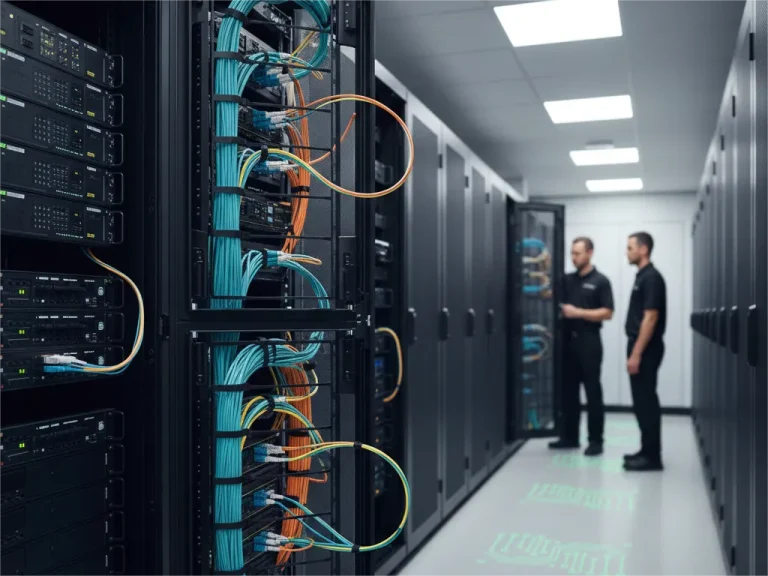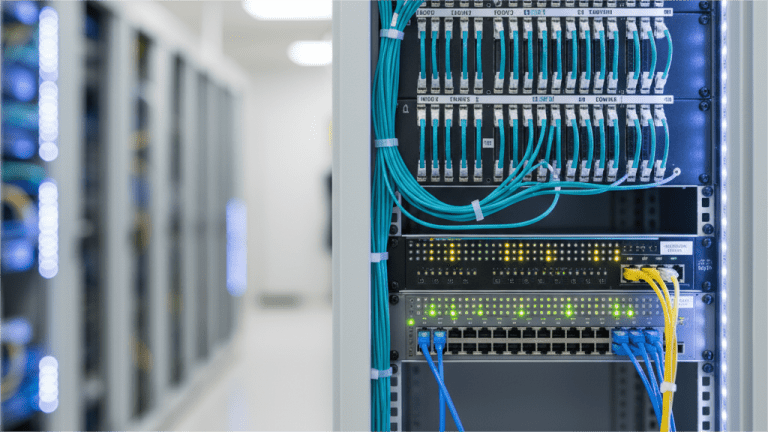

The fiber optic cable is the foundational infrastructure of the modern digital world, serving as the high-speed nervous system for everything from global telecommunications to hyper-scale data center interconnects. Unlike traditional copper cables that transmit data using slow electrical pulses, fiber optics uses light—enabling unparalleled speed, capacity, and security. Understanding the core mechanics and structure of these cables is essential for any network architect or IT professional seeking to build a robust, future-proof network capable of handling 400G speeds and beyond.
The Core Technology: How Light Carries Data
A fiber optic strand functions as a waveguide, allowing light to travel vast distances with minimal energy loss.
Anatomy of a Fiber Optic Cable: Core, Cladding, and Jacket
A fiber strand has three primary structural layers. The central Core, typically made of high-purity glass, is the pathway for the light signal. Surrounding the core is the Cladding, a glass layer with a lower refractive index. This critical difference forces light rays to bounce back into the core, a phenomenon known as Total Internal Reflection, which guides the light without significant leakage. The outer Jacket provides physical protection against moisture, crushing, and environmental hazards.
Light Sources and Wavelengths in Fiber Optic Communication
The light signal is generated by specific semiconductor devices. VCSELs (Vertical-Cavity Surface-Emitting Lasers) are used for shorter-reach Multimode applications, often operating at 850nm. For long-distance Single Mode links, high-precision DFB (Distributed Feedback) lasers are used, primarily operating at 1310nm or 1550nm due to lower inherent glass attenuation at those wavelengths.
Key Performance Metrics: Attenuation, Dispersion, and Bandwidth
The quality of a fiber link is judged by how well it handles the signal over distance:
- Attenuation: Measures the loss of light power (signal strength) over the length of the cable, typically measured in dB/km.
- Dispersion: Describes the spreading of the light pulse as it travels. Modal Dispersion affects Multimode fiber due to multiple light paths, while Chromatic Dispersion is primarily a concern for long-haul Single Mode links.
- Bandwidth: The total information capacity a fiber can transmit, directly limited by the level of dispersion and attenuation.
Essential Types and Industry Standards
Fiber is categorized primarily by the diameter of its core, which dictates its performance envelope.
Distinguishing Single Mode (OS2) and Multimode (OM) Fiber Types
| Fiber Type | Core Diameter | Light Path | Typical Use Case |
| Single Mode (SMF/OS2) | 9m | Single Ray | Long-Haul, Data Center Core, 400G+ |
| Multimode (MMF/OM) | 50m | Multiple Rays | Short-Reach (LAN, ToR), up to 500m |
Single Mode eliminates modal dispersion, allowing it to carry massive amounts of data over tens of kilometers. Multimode is cheaper for short distances but is limited by modal dispersion. PHILISUN provides fully tested MPO/MTP assemblies for both SMF (OS2) and high-tier MMF (OM4/OM5) standards.
Fiber Jacket Standards: LSZH vs. Plenum vs. PVC
The outer jacket must meet safety codes for the installation location:
- Plenum: Required for installation in air-handling spaces (plenums) in North America due to its fire-retardant, low-smoke properties.
- LSZH (Low Smoke Zero Halogen): Preferred in data centers and crowded spaces globally. It emits minimal smoke and no toxic gases when exposed to fire.
Common Connector Types: LC, SC, MPO/MTP
Connectors ensure precise physical alignment between fiber ends:
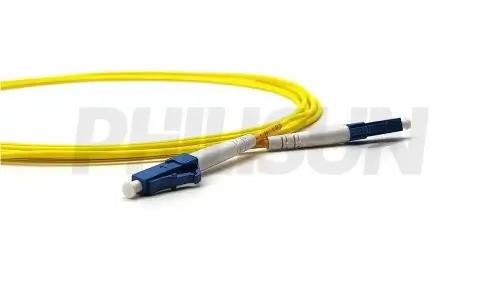
- LC (Lucent Connector): The current standard for high-density single-fiber connections in patch panels and transceivers.
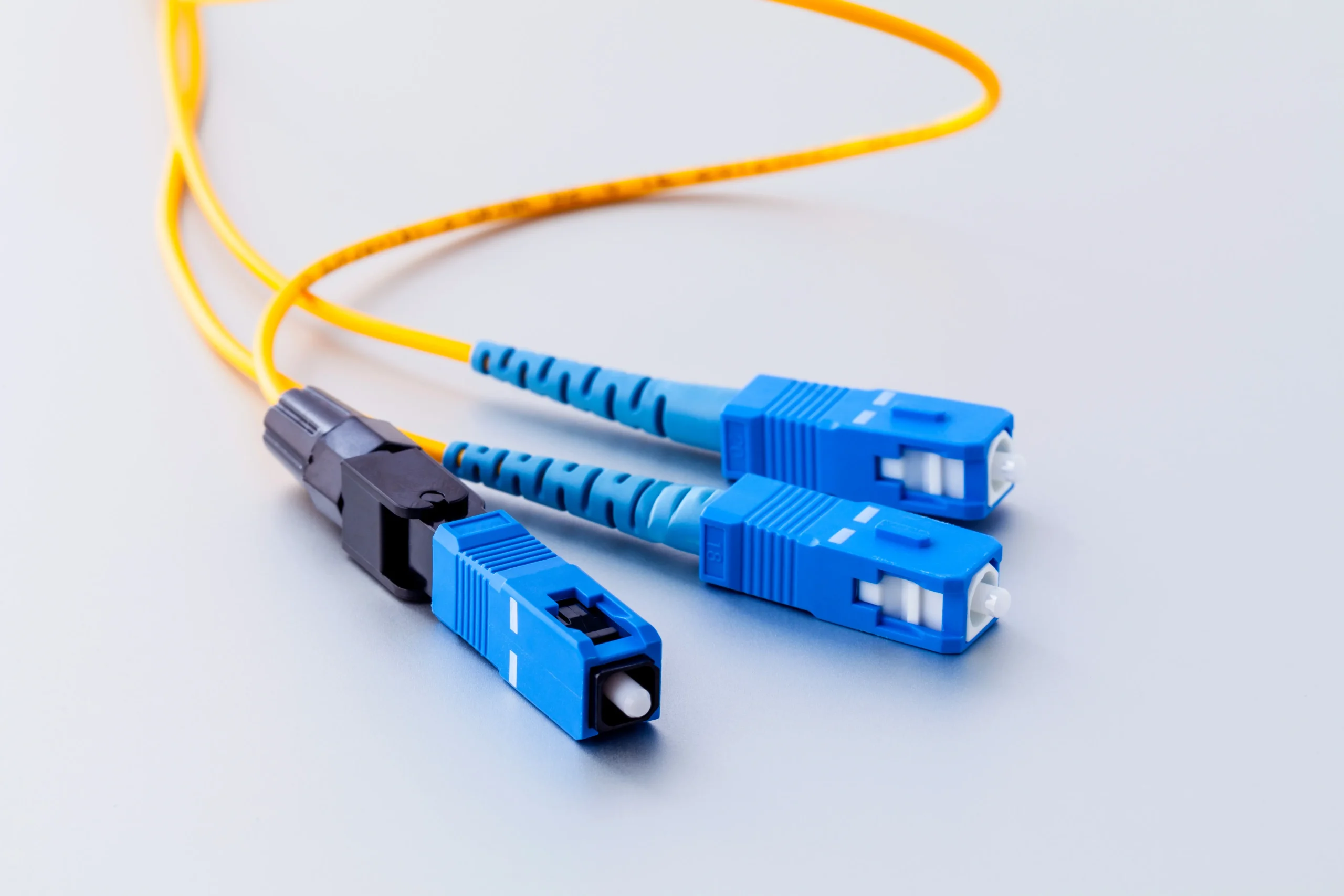
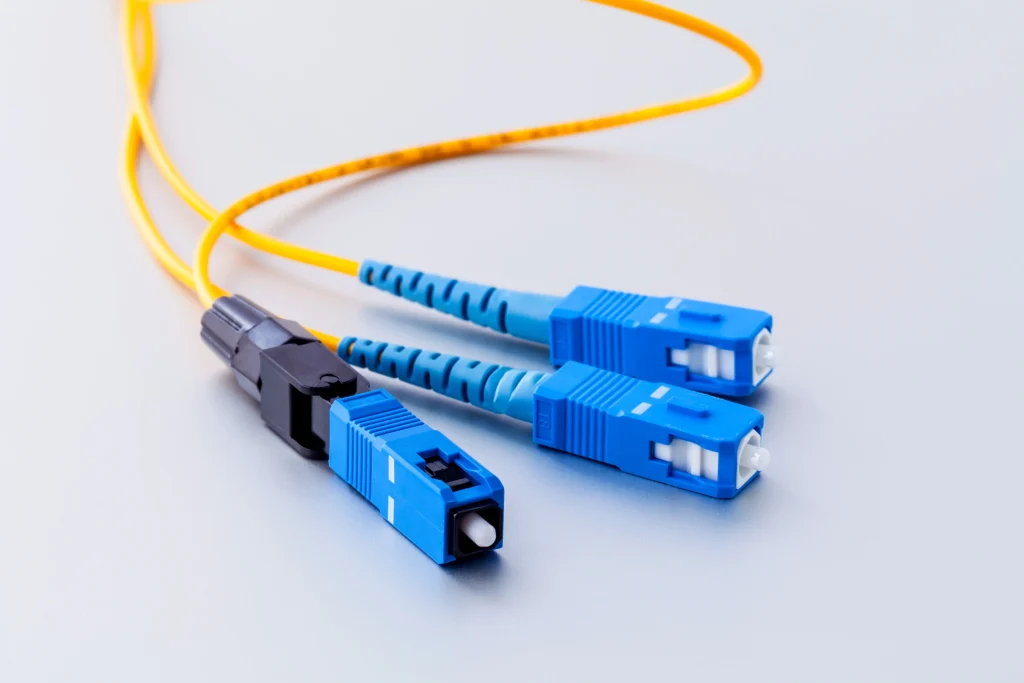
- SC (Subscriber Connector): A larger, older standard.
- MPO/MTP: Essential multi-fiber connectors used for parallel optics in 40G, 100G, and 400G+ data center applications (e.g., connecting a QSFP-DD module).
Applications: Where Fiber Optics Outperforms Copper
Data Center and Storage Area Network (SAN) Applications
Fiber is mandatory for low-latency and high-density links in the data center, supporting the Spine-Leaf architecture and protocols like Fibre Channel and RoCE (RDMA over Converged Ethernet) across switches.
Long-Haul Telecommunications and Submarine Cables
SMF forms the foundation of global connectivity, enabling massive, long-distance networks. Submarine cables, which span oceans, rely entirely on the low attenuation properties of single mode fiber.
Fiber-to-the-Home (FTTH) and Last-Mile Connectivity
Fiber optics enables gigabit-level internet services by replacing legacy copper infrastructure, primarily through Passive Optical Networks (PON).
Conclusion: The Future Dependency on Fiber Infrastructure
Why Fiber is Essential for 400G and Beyond
As signaling techniques like PAM4 demand an extremely clean optical channel, the quality of the fiber optic cable becomes the single most important factor. Future speeds like 800G and 1.6T cannot be achieved without high-grade, low-loss fiber infrastructure. PHILISUN is committed to supplying the certified, low-attenuation fiber required to support these next-generation speeds.
Summary of Fiber Advantages (Speed, Security, Reliability)
Fiber provides superior speed, is immune to electromagnetic interference (EMI), and offers superior security against tapping. It is the only reliable choice for building scalable, high-performance networks.
For high-performance, fully tested fiber optic solutions, trust PHILISUN.
Frequently Asked Questions (FAQ)
Q1: What is Total Internal Reflection (TIR)?
A1: TIR is the principle where light reflects inward at the core/cladding boundary, enabling light transmission down the fiber core.
Q2: What is the main difference between fiber and copper?
A2: Fiber uses light (photons) for higher bandwidth and lower latency; copper uses electrical signals (electrons).
Q3: What is the main use difference between LC and MPO connectors?
A3: LC is for single-fiber (duplex) connections. MPO is for multi-fiber parallel links necessary for 100G/400G modules.
Q4: What are the three common operating wavelengths?
A5: 850nm (Multimode), 1310nm (Single Mode), and 1550nm (Single Mode long-haul).