
The question of fiber optic speed is often misinterpreted: the glass itself moves data at the speed of light, but the achievable network data rate is dictated by the components connected to it. For data center architects and procurement managers, this distinction is crucial. Network bottlenecks are rarely the fiber; they are the result of outdated, low-quality, or improperly chosen transceivers, AOCs, or DACs. This guide dismantles the theoretical limits of fiber and provides a component-centric protocol for maximizing data throughput, ensuring your infrastructure meets current 400G standards and is ready for the 800G transition.
The Physics of Fiber Optic Speed: Theoretical vs. Practical
Understanding the theoretical capabilities of a fiber strand is the first step in diagnosing practical limitations. While the fiber medium has virtually limitless bandwidth, the usable data rate is always constrained by current technology.
What is the Theoretical Maximum Fiber Optic Speed?
If a single strand of fiber could be perfectly insulated from physical noise and dispersion, its theoretical bandwidth would be staggering—potentially tens of petabits per second. This capacity is determined by the maximum number of wavelengths (colors of light) that can be pulsed down the fiber simultaneously.
The reality, however, is that this massive theoretical capacity must be balanced against real-world factors like optical noise, receiver sensitivity, and dispersion (signal degradation over distance). For long-haul links, the maximum achievable data rate is often limited by the signal-to-noise ratio (SNR) that a receiver can decode reliably.
The Speed of Light Paradox: Latency vs. Data Rate
When discussing fiber optic speed, it’s vital to distinguish between data rate (how many bits per second, measured in Gbps/Tbps) and latency (how long it takes for a bit to travel, measured in milliseconds).
Data Rate depends on the sophistication of the transceivers and modulation. Latency, however, is a fundamental physical constant. Light travels more slowly in glass (silica fiber) than in a vacuum. This difference creates a fixed, unavoidable latency of approximately 5 microseconds per kilometer (µs/km). For high-frequency trading or HPC environments, minimizing cable length is the only way to minimize latency, regardless of the data rate.
How Wavelength Division Multiplexing (WDM) Achieves Multi-Terabit Capacity
WDM is the technology that allows networks to approach the theoretical capacity of fiber. Instead of sending one signal wavelength down the fiber, WDM uses multiple distinct laser wavelengths (channels) simultaneously.
- DWDM (Dense Wavelength Division Multiplexing): Used in long-haul networks, DWDM can cram 40, 80, or even 120+ unique channels into the C-band window. If each channel carries a 100G signal, an 80-channel DWDM system achieves 8 Tbps on a single fiber pair.
- CWDM/LWDM: Used in metro and data center networks, these systems offer fewer channels but are more cost-effective for shorter distances.
WDM proves that the fiber itself is not the bottleneck; the bottleneck lies in the electronic components required to generate, modulate, demultiplex, and decode these hundreds of synchronized light signals.
The Bottleneck: How Transceivers and Modulation Set the Speed
For practical networking, the electronic components at the ends of the fiber strand—specifically the transceivers and active cables—are the true governors of fiber optic speed. They determine the data rate at which the electrical signal is converted into and out of.
Why Components, Not Glass, Limit Achievable Fiber Optic Speed
The moment a packet hits a fiber network, it must be converted from an electrical signal (copper trace, host interface) into an optical signal (laser pulse). The speed of this conversion and the density of the information encoded onto the laser are the practical limits.
Modern optics leverage complex technologies like Forward Error Correction (FEC) to clean up the dirty signal received over the distance. Without sophisticated optics to handle dispersion and noise, the effective data rate must drop to maintain a reliable Bit Error Rate (BER).
The Role of Electrical Interface: DACs and AOCs
For short-reach interconnects (crucial within the rack or across neighboring racks), the component choice immediately limits the speed:
- DAC (Direct Attach Cable): This is a passive or active copper cable. Its speed is limited by the electrical properties of the copper wire (signal loss, crosstalk). Passive DACs are restricted to 3m or less at 100G and below.
- AOC (Active Optical Cable): An AOC eliminates the electrical bottleneck by converting the electrical signal to optical and back again within the cable assembly. This allows it to achieve 400G/800G speeds reliably over spans up to 100 meters, dramatically extending the distance while maintaining the high data rate defined by the transceivers housed within the cable ends.
Decoding Modulation: NRZ, PAM4, and Coherent Optics (400G/800G)
The highest gains in fiber optic speed come from advanced modulation techniques that pack more bits into each laser pulse:
- NRZ (Non-Return to Zero): Older technique where the signal is either ‘on’ (1) or ‘off’ (0). Each pulse transmits 1 bit.
- PAM4 (Pulse Amplitude Modulation, Level 4): The industry standard for 100G, 200G, 400G, and 800G. PAM4 uses four distinct signal levels, allowing it to transmit 2 bits per pulse. This effectively doubles the data rate without having to double the laser signaling speed (baud rate).
- Coherent Optics: Primarily for long-haul and metro links, these modules modulate both the phase and amplitude of the light, allowing for extremely dense encoding, achieving data rates up to 800G and 1.2T over massive distances.
Why High-Quality Transceivers are Essential for Signal Integrity
The more bits you cram into a signal pulse (like with PAM4), the more susceptible the signal becomes to noise and jitter. High-quality transceivers must contain superior Digital Signal Processors (DSPs) and high-linearity optics to accurately encode and decode these complex signals. A poorly manufactured transceiver may introduce too much jitter, forcing the use of aggressive FEC, which adds latency and consumes bandwidth.
Real-World Fiber Optic Speed Standards (Current Market)
The industry typically measures fiber optic speed by the established data rate standards defined by IEEE and MSA groups. These standards dictate not the physical limit of the fiber, but the practical, interoperable component data rates.
Data Center Fiber Optic Speed Standards: From 11G to 800G
Today’s network standards represent rapid jumps in data rate:
| Standard | Max Data Rate | Modulation Type | Primary Use Case |
| 10GBASE-SR/LR | 10 Gbps | NRZ | Edge/Access Layer |
| 100GBASE-SR4/LR4 | 100 Gbps | NRZ/PAM4 | Leaf/Spine Layer |
| 400GBASE-DR4/FR4 | 400 Gbps | PAM4 | Core/Interconnect |
| 800G DR8/FR4 | 800 Gbps | PAM4 | AI/ML Fabrics |
The 100G/200G Transition: Initial Use of Parallel Optics (MPO)
The jump to 100G often involved parallel optics, such as 100GBASE-SR4, which splits the signal across 4 separate fibers (4x25G NRZ), typically terminated with MPO connectors. While effective, this increased fiber density. The transition to single-lambda 100G (using PAM4) was critical for managing fiber sprawl.
Achieving 400G Fiber Optic Speed: Breakout vs. Single-Lambda
The 400G transition presented two main architecture choices, both reliant on high-performance components:
- 400G Breakout: Using a 400G transceiver to connect to four separate 100G ports (4x100G). This requires high-quality MPO connectivity.
- 400G Single-Lambda: Using four 100G PAM4 wavelengths carried over one fiber pair (e.g., 400G-DR4/FR4). This maximizes fiber efficiency but demands superior optical and electronic performance from the module.
PHILISUN offers a comprehensive portfolio of 400G transceivers and Active Optical Cables (AOCs), engineered with cutting-edge PAM4 DSPs to guarantee low latency and industry-leading performance, ensuring you maximize your network’s fiber optic speed potential across all required architectures.
Maximizing Performance: Active and Passive Solutions
To truly guarantee the rated fiber optic speed, network designers must strategically deploy the right component for the right application and distance.
Selecting the Right Connectivity to Guarantee Rated Fiber Optic Speed
System failure often occurs not because of poor fiber, but because a cable type was pushed beyond its guaranteed performance envelope. Selecting the right product is an engineering decision, not a purchasing compromise.
DACs (Direct Attach Cables)
DACs are preferred for short, in-rack connections due to their low power consumption and extremely low latency. However, their electrical limits mean that as data rates increase, their maximum usable length drops sharply. For 400G and 800G, passive DACs are often limited to 1.5-2 meters.
AOCs (Active Optical Cables)
For connections ranging from 3 meters up to 100 meters (e.g., Top-of-Rack to End-of-Row), AOCs provide the optimal balance. By incorporating transceivers at both ends, the signal travels optically through the cable, eliminating the insertion loss and crosstalk inherent to copper. This ensures that the fiber optic speed defined by the host interface (e.g., 400G) is maintained over a longer, more reliable distance without signal degradation.
Transceivers (Optical Modules)
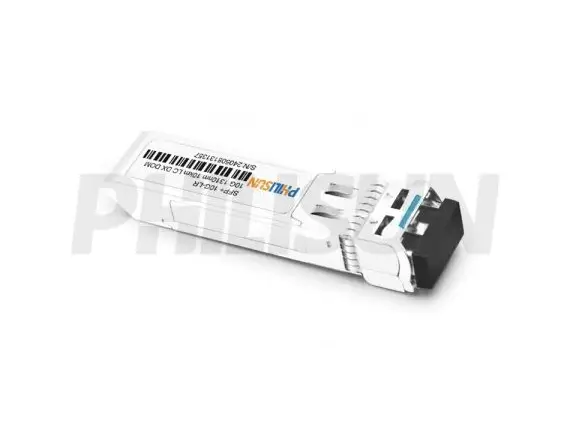
Optical transceivers are the most flexible solution, defining both the data rate and the maximum supported distance (ranging from 100m up to 80km). Transceivers must adhere to strict thermal management and power consumption guidelines while delivering a flawless optical signal. This is where manufacturing quality becomes non-negotiable, particularly at higher speeds where minor imperfections can translate to massive BER issues.
Future-Proofing: Preparing for 800G and Beyond
As AI clusters, machine learning, and GPU-intensive fabrics drive bandwidth demands, 400G is becoming the baseline, with 800G becoming mandatory for core links. Future-proofing your network requires preparation today.
The Future of Fiber Optic Speed: 800G, 1.6T, and Beyond
The next generation of fiber optic speed is already here with 800G components, often achieved using 8x100G PAM4 lanes or highly advanced modulation techniques. The subsequent leap to 1.6T will likely involve a combination of even higher-density WDM, highly efficient Silicon Photonics, and advanced packaging to manage thermal constraints.
High-Density Fiber and Low-Loss MPO: The Physical Layer Foundation
The physical infrastructure must be ready. Deploying low-loss MPO trunk cables and cassettes is essential, as the insertion loss budget for 800G and 1.6T links is tighter than ever. A poorly polished MPO connection that was acceptable at 100G will guarantee failure at 800G.
Ensuring Zero-Error Rate (BER) at Extreme Speeds
As speeds rise, the tolerance for signal noise shrinks. The quality of the components defining the electrical-to-optical conversion is the single greatest determinant of long-term reliability. PHILISUN invests heavily in high-precision component testing and advanced DSP implementation. We want to make sure that our 800G transceivers deliver a reliable signal with minimal jitter, protecting your network’s integrity even under the most demanding workloads.
Secure Your Bandwidth Future with PHILISUN Reliability
While the theoretical fiber optic speed is near infinite, the practical speed is always limited by the active components used to modulate and decode the light. Maximizing your network’s data rate requires precision-engineered transceivers, AOCs, and DACs that can handle complex PAM4 and coherent signaling without introducing noise or jitter. By choosing tested, standards-compliant products, you eliminate the component bottleneck and secure reliable high bandwidth. Contact PHILISUN today for a detailed consultation on optimizing your 400G and 800G fabric and guaranteeing the highest possible fiber optic speed for your infrastructure.