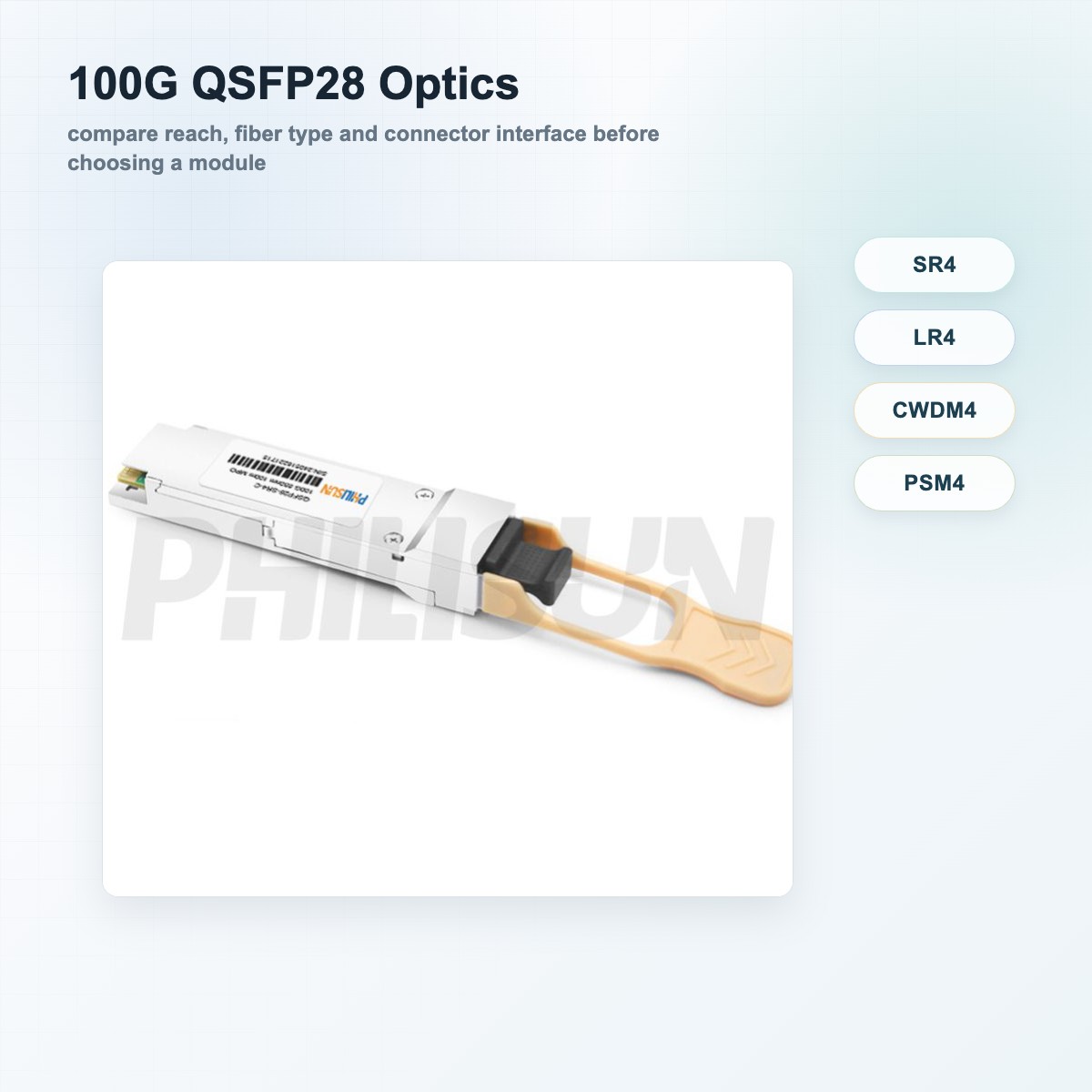

100G QSFP28 transceivers can look similar from the outside, but SR4, LR4, CWDM4, and PSM4 are built for different fiber plants, connector layouts, reach requirements, and budgets. Choosing the wrong type can lead to a link that will not connect, a fiber plant that cannot support the module, or unnecessary cost in a high-density data center.
The quick answer:
- 100GBASE-SR4 is usually the best fit for short multimode fiber links inside a data center.
- 100GBASE-LR4 is used for longer single-mode duplex LC links, commonly up to 10 km.
- 100G CWDM4 is a common cost-effective single-mode duplex LC option for shorter 2 km style links.
- 100G PSM4 uses parallel single-mode fiber over MPO, often for 500 m style data center links.
If you are not sure which module is right, start with distance, fiber type, connector interface, and switch compatibility. PHILISUN Optical Transceivers can support 100G QSFP28 deployment planning for data center, telecom, AI, HPC, and enterprise networks.
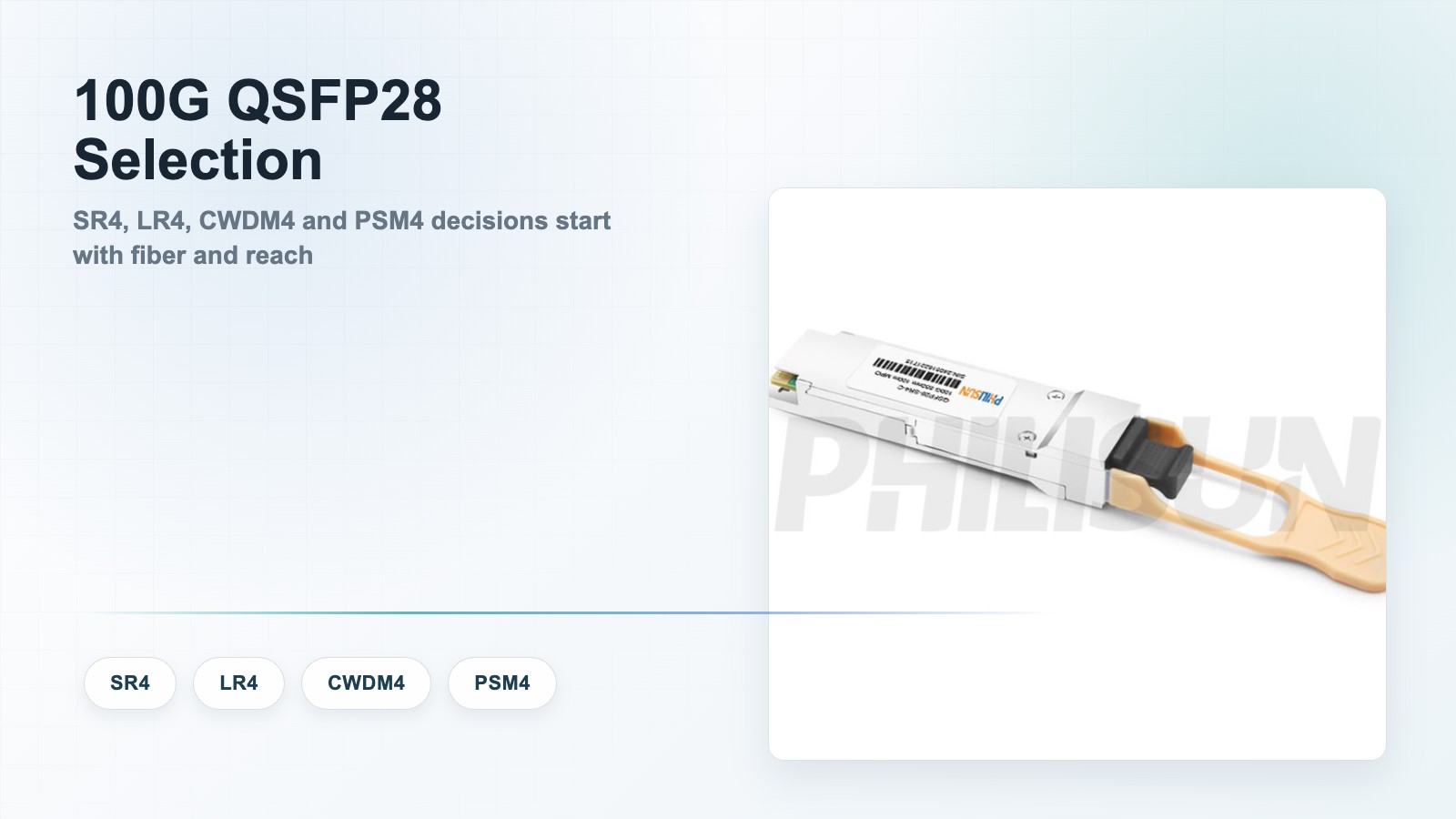
Fast Selection Rule
Use SR4 for short multimode MPO links, LR4 for longer duplex LC single-mode links, CWDM4 for cost-effective 2 km class single-mode links, and PSM4 when the design uses parallel single-mode MPO cabling.
Quick Comparison
| 100G QSFP28 type | Fiber type | Connector | Typical reach | Best use case |
|---|---|---|---|---|
| SR4 | Multimode fiber, usually OM3 or OM4 | MPO/MTP | Short data center links | Short rack-to-rack or row-level links |
| LR4 | Single-mode fiber, OS2 | Duplex LC | Long-reach links, commonly 10 km | Campus, metro, carrier, and long data center links |
| CWDM4 | Single-mode fiber, OS2 | Duplex LC | Medium-reach links, commonly 2 km | Cost-sensitive single-mode data center links |
| PSM4 | Single-mode fiber, OS2 | MPO/MTP | Parallel single-mode links, commonly 500 m | Short single-mode parallel fiber architectures |
This table is a starting point. The final decision should also include transceiver coding, DOM/DDM support, temperature range, optical budget, switch platform, and whether the link uses existing fiber or a new cabling design.
What Is a 100G QSFP28 Transceiver?
QSFP28 is a compact transceiver form factor for 100G Ethernet and related high-speed network applications. A 100G QSFP28 module normally uses four 25G electrical lanes on the host side. The optical side depends on the module type.
Some 100G QSFP28 modules use parallel fiber lanes. Others use wavelength multiplexing over a duplex fiber pair. This is why the connector and fiber plant are so important.
Common 100G QSFP28 optical types include:
- 100GBASE-SR4
- 100GBASE-LR4
- 100G CWDM4
- 100G PSM4
- 100G ER4 and ZR-style long-reach variants
- 100G BiDi or other vendor-specific options
This article focuses on SR4, LR4, CWDM4, and PSM4 because these four choices cover many real-world data center and enterprise 100G links.
For a broader transceiver form factor overview, read the PHILISUN SFP Module Guide.
100GBASE-SR4: Short-Reach Multimode MPO Links
100GBASE-SR4 is designed for short-reach multimode fiber. It is commonly used inside data centers where the link distance is short and the cabling system is built with OM3 or OM4 multimode fiber.
SR4 uses parallel optics. Instead of one transmit fiber and one receive fiber, the link uses multiple transmit and receive lanes. This is why SR4 normally uses an MPO/MTP connector rather than duplex LC.
SR4 is a good fit when:
- The link is inside the same data center or equipment room.
- The fiber plant is OM3 or OM4 multimode.
- The switch or patching system uses MPO/MTP interfaces.
- You need a short, high-density 100G connection.
- The target reach is within the multimode fiber distance budget.
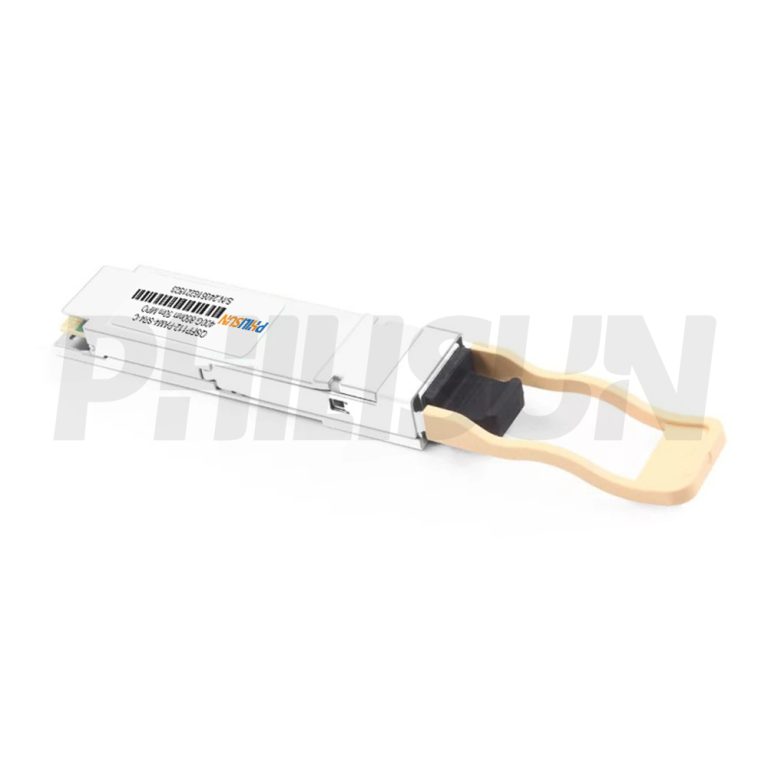
PHILISUN offers products such as 100GBASE-SR4 QSFP28 850nm 100m DOM MPO8/12 MMF Transceiver for short-reach data center links.
SR4 Planning Notes
SR4 planning is not only about distance. You also need to confirm MPO polarity, fiber count, connector gender, and whether the cabling system uses MPO-8, MPO-12, cassettes, or direct MPO trunk paths.
For cabling design, see PHILISUN MPO Cable Assemblies and the MPO Fiber Count Guide.
100GBASE-LR4: Longer Single-Mode Duplex LC Links
100GBASE-LR4 is designed for longer single-mode fiber links. It typically uses a duplex LC connector and OS2 single-mode fiber. LR4 modules use wavelength multiplexing so multiple optical lanes can travel over one transmit fiber and one receive fiber.
LR4 is a strong choice when the link is too long for SR4 or CWDM4, or when the fiber plant is already built around duplex single-mode cabling.
LR4 is commonly considered when:
- The link needs longer reach than a short data center interconnect.
- The fiber plant is OS2 single-mode fiber.
- Duplex LC cabling is preferred or already installed.
- The network requires a standards-based long-reach 100G option.
- The budget can support higher-cost optics compared with short-reach modules.
LR4 can be overqualified for short links. If the link is only a few hundred meters or around 2 km, CWDM4 or PSM4 may be more cost-effective depending on the cabling design and switch support.
100G CWDM4: Cost-Effective Single-Mode 2 km Style Links
100G CWDM4 is widely used in data centers that need single-mode reach without the full cost of LR4. It usually uses duplex LC connectors and OS2 single-mode fiber. CWDM4 is often selected for approximately 2 km style links, depending on the exact module specification and vendor design.
CWDM4 can be a good fit when:
- The link is longer than multimode SR4 can support.
- The network uses duplex single-mode fiber.
- The required reach is shorter than LR4-class long-reach needs.
- Cost efficiency matters in a high-port-count data center.
- The switch supports the CWDM4 module coding and optical specification.
CWDM4 is often compared directly with SR4 because both are popular in data centers. For a focused comparison, read PHILISUN 100GBASE-SR4 vs 100GBASE-CWDM4 Transceivers.
100G PSM4: Parallel Single-Mode MPO Links
100G PSM4 uses parallel single-mode fiber. Like SR4, it uses parallel lanes. But unlike SR4, it is built for single-mode fiber rather than multimode fiber.
PSM4 is often used when a network wants single-mode reach but prefers a parallel fiber architecture. It commonly uses an MPO/MTP connector and multiple single-mode fibers.
PSM4 can make sense when:
- The fiber plant is OS2 single-mode.
- The link distance is longer than typical multimode SR4 needs.
- The cabling design can support MPO/MTP parallel single-mode paths.
- You want a different cost or architecture option from duplex LC CWDM4 or LR4.
- The patching system is designed around parallel fiber lanes.
The tradeoff is cabling complexity. PSM4 may require more fibers than CWDM4 or LR4, so it should be planned together with MPO polarity, connector gender, and fiber mapping.
SR4 vs LR4 vs CWDM4 vs PSM4: How to Choose
The best 100G QSFP28 transceiver is usually determined by four questions.
1. What fiber type is installed?
If the installed fiber is OM3 or OM4 multimode, SR4 is often the first option to check. If the installed fiber is OS2 single-mode, LR4, CWDM4, or PSM4 may be more suitable.
Do not mix assumptions. A multimode SR4 module is not a replacement for a single-mode LR4 module, even if the QSFP28 form factor looks the same.
2. What connector is available?
SR4 and PSM4 usually use MPO/MTP connectors because they rely on parallel fibers. LR4 and CWDM4 usually use duplex LC because they carry multiple wavelengths over a transmit and receive fiber pair.
This connector difference affects the patch panel, cassette, trunk cable, harness cable, and test plan.
3. How far is the link?
For very short data center links over multimode fiber, SR4 is often economical and simple. For single-mode links around 2 km, CWDM4 is often considered. For longer single-mode links, LR4 is commonly selected. For parallel single-mode cabling, PSM4 may fit certain data center designs.
Always check the exact module datasheet and optical budget. The general category tells you the design direction, but the exact reach depends on the product.
4. What does the switch accept?
A 100G port may reject an optic if the coding, EEPROM profile, speed, DOM/DDM reporting, or vendor compatibility is wrong. This is especially important for Cisco, Arista, Juniper, NVIDIA, HPE, Dell, and other switch platforms.
If you see an unsupported module warning, read PHILISUN SFP Module Not Recognized: Causes and Fixes.
Selection Table by Scenario
| Scenario | Recommended direction |
|---|---|
| Short 100G link over OM3 or OM4 multimode fiber | Start with 100GBASE-SR4 |
| 100G link over duplex OS2 single-mode fiber around 2 km | Consider 100G CWDM4 |
| Longer 100G single-mode duplex LC link | Consider 100GBASE-LR4 |
| Parallel single-mode fiber design with MPO/MTP cabling | Consider 100G PSM4 |
| Existing LC patch panels and duplex single-mode cabling | Compare CWDM4 and LR4 |
| Existing MPO trunks or high-density parallel cabling | Compare SR4 and PSM4 based on fiber type |
| Switch compatibility is uncertain | Confirm coding and DOM/DDM before ordering |
Cost and Cabling Tradeoffs
SR4 can be cost-effective for short multimode links, but it requires MPO/MTP cabling. LR4 can support longer distances but normally costs more. CWDM4 can reduce cost for shorter single-mode duplex links, while PSM4 may reduce optical complexity but requires more fibers.
In practice, the lowest-cost module is not always the lowest-cost link. You need to include:
- Module cost
- Patch panel and cassette cost
- Fiber trunk or patch cord cost
- Available fiber count
- Installation and testing time
- Switch compatibility risk
- Future migration path to 200G, 400G, or 800G
For a broader speed migration view, read PHILISUN QSFP28 vs QSFP-DD: 100G vs 400G Transceiver Guide.
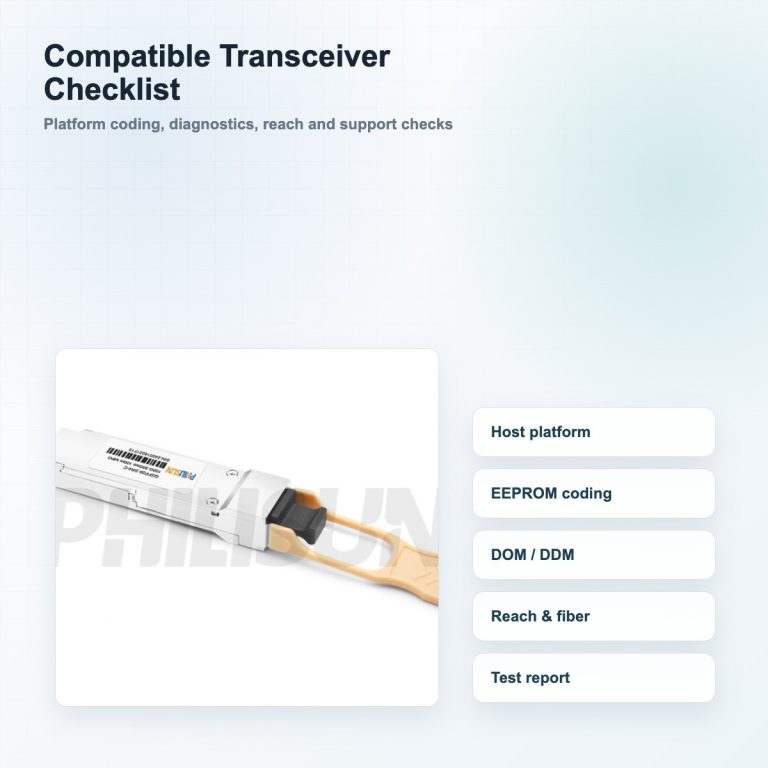
Compatibility Checklist Before Ordering
Before ordering a 100G QSFP28 module, prepare this information:
- Switch brand and model
- Port speed and breakout mode, if any
- Required transceiver type: SR4, LR4, CWDM4, PSM4, or another option
- Fiber type: OM3, OM4, or OS2
- Connector type: MPO/MTP or duplex LC
- Link distance
- Temperature range
- DOM/DDM monitoring requirement
- Vendor coding requirement
- Existing patch panel, trunk cable, cassette, or jumper layout
- Quantity and delivery requirement
- Whether a test report is required
These details help avoid common problems such as unsupported optics, wrong connector type, insufficient optical budget, or mismatched fiber plant.
Common Mistakes to Avoid
Mistake 1: Choosing by form factor only
QSFP28 tells you the module form factor. It does not tell you the optical reach, fiber type, connector, or compatibility profile. SR4, LR4, CWDM4, and PSM4 all require different planning.
Mistake 2: Ignoring connector layout
An SR4 module with an MPO connector cannot plug into a duplex LC patch cord. A CWDM4 or LR4 module with duplex LC does not use the same cabling path as an MPO-based SR4 or PSM4 link.
Mistake 3: Overbuying reach
Longer reach is not always better. LR4 can be useful for long links, but it may be unnecessary for a short data center connection where SR4 or CWDM4 is more practical.
Mistake 4: Forgetting switch coding
Even when the optical specification is correct, the switch may still reject a module that is not coded correctly. Confirm compatibility before ordering, especially for locked or strict platforms.
Mistake 5: Planning optics without cabling
The transceiver and cabling system must be planned together. A correct optic can still fail if polarity, fiber count, connector gender, or patch path is wrong.
Which 100G QSFP28 Module Should You Choose?
Choose 100GBASE-SR4 when you need a short-reach multimode MPO/MTP link inside a data center.
Choose 100GBASE-LR4 when you need a longer single-mode duplex LC link.
Choose 100G CWDM4 when you need a cost-effective single-mode duplex LC link around the 2 km class.
Choose 100G PSM4 when your design uses parallel single-mode MPO/MTP cabling.
If the decision is not obvious, start with the installed fiber type, connector, link distance, and switch model. These four details usually narrow the choice quickly.
FAQ
Is QSFP28 the same as 100G?
QSFP28 is a form factor commonly used for 100G, but the optical specification still matters. A QSFP28 SR4 module is not the same as a QSFP28 LR4, CWDM4, or PSM4 module.
Does SR4 use LC or MPO?
100GBASE-SR4 normally uses an MPO/MTP connector because it is a parallel multimode optical design.
Does LR4 use single-mode fiber?
Yes. 100GBASE-LR4 is normally used with OS2 single-mode fiber and duplex LC connectors.
Is CWDM4 the same as LR4?
No. Both often use duplex LC single-mode fiber, but they are different optical specifications with different reach and cost profiles.
When should I use PSM4?
Use PSM4 when the project is based on parallel single-mode cabling and an MPO/MTP interface is preferred or required.
Can PHILISUN provide compatible 100G QSFP28 modules?
Yes. Share the switch model, required reach, fiber type, connector type, and coding requirement. PHILISUN can recommend compatible 100G QSFP28 optical transceivers for your platform.
Need Help Choosing a 100G QSFP28 Transceiver?
PHILISUN can help select and code 100G QSFP28 transceivers for Cisco, Arista, Juniper, NVIDIA, HPE, Dell, and other switch platforms.
Send us your switch model, fiber type, connector, link distance, and target module type. We can recommend SR4, LR4, CWDM4, PSM4, or another compatible 100G optical transceiver based on your deployment.